Showing posts with label what it takes. Show all posts

Sunday, February 24, 2019

What It Takes, Part 3 -- Epilogue: McEnroe Returns

Note: Best to read Parts 1 and 2 below before reading this one. 

Epilogue (noun) --  a section or speech at the end of a book or a play that serves as a comment on or a conclusion to what has happened. (the Apple dictionary)

I love epilogues, especially when one occurs in real life, as if life itself were a story. In the context of a ride in a taxi in a big city like New York, epilogues are rare indeed because in most cases you will never meet your passenger again.  So whatever you may have found to be interesting, or quirky, or disturbing about your passenger -- whatever the circumstance was --  it will remain unresolved in your mind.  You may occasionally find yourself wondering, "whatever became of so-and-so?"   You wish you could meet that person again just to find out or so you could satisfactorily end the story yourself.

I had an epilogue in my cab last year on April 22nd, a sunny Sunday with birds chirping and happy trees serenading the city with a concerto in the key of delicate green.
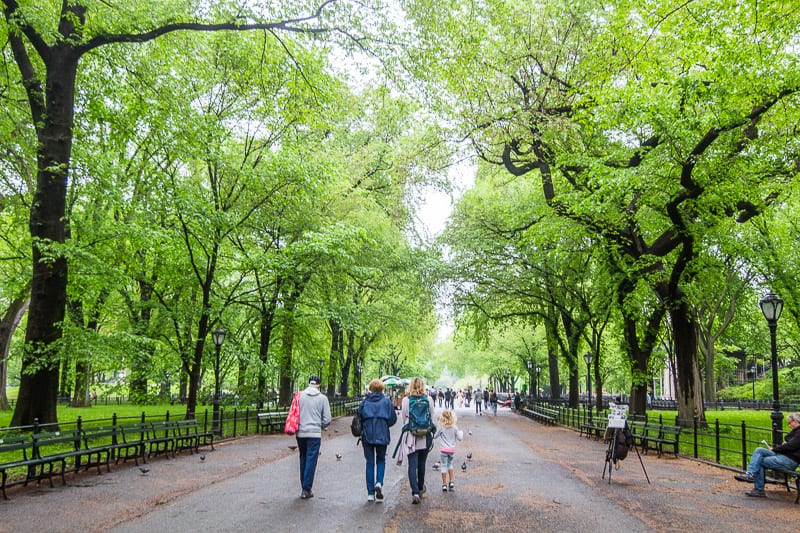


As I was waiting at a red light on Central Park West a bit before 4 p.m., the right rear door opened and a passenger jumped in.  Before I could say "hello" he barked, "59th and York and make it fly!"   Apparently he was in a big rush.

This kind of request is usually made in the form of a polite question, not a blunt command.  I looked in the rearview mirror to evaluate the situation.  In other words, why should I drive any faster than I  normally do?  Is this really an emergency?  I had one of those Nissan minivan cabs that day


which has a partition running the entire width of the cab.  One of the few things I like about this vehicle is that it allows the driver to fully view the passengers in the rear.  It also has an intercom that actually works, enabling the driver and passenger to hear each other.  So I was able to take a good look at this guy.

Hey, wait a minute -- he looked familiar.


Oh my God, it was McEnroe.  Again.  Much older.  After thirty-four years he has returned to me, the prodigal passenger.

"Mister McEnroe!" I exclaimed.

Big mistake.

If you recall from the second story in this series, the correct way to address John McEnroe is by referring to him by his last name only.  I should have remembered this and I immediately suffered the consequences of my blunder.

"WE DON'T HAVE TO TALK!" he screamed.

Now if this had been virtually anyone else in the world I would have tossed the guy out of my cab.  It's a dignity issue.  You can't allow people to talk to you that way unless, of course, they are drunk and much bigger than you.  But this was McEnroe. Actually, it was kind of charming.  I smiled as if he'd said, "Hello there, how are you?", which in his own way is sort of what he did.

I stepped lightly on the gas and we began moving downtown on Central Park West. His destination required me to make an almost immediate left turn onto the transverse which runs through the park at 65th Street.  It's the fastest route to the East Side.  But the transverse was closed due to a parade on 5th Avenue that day, so we had to cut over to Broadway, a detour.  McEnroe didn't take this lying down and began venting his rage at Mayor de Blasio, the tyrant who had no doubt orchestrated this outrage.  Ridiculous to get so upset, you say, but think about it. This is McEnroe.  Everyone knows how McEnroe feels about referees and mayors are pretty much the same as referees.  Right?

I realized there was no point in continuing on in that vein.  Instead, I said:

"Hey, do you remember what you were doing in the evening of March 13th, 1984?"

This non sequitur caught his attention.  He perked up and forgot about the mayor.

"I have no idea."

"You were in my cab.  I picked you up from your place on East End Avenue and took you to the Garden to a Knicks game.  We talked about sports.  I told you about the time I hit some balls with Martina Navratilova's coach."  

McEnroe's face lit up.  "I think I remember that ride!"

Well, that handled his don't-talk-to-me and his I'm-in-a-big-rush state of mind. Suddenly McEnroe was friendly, conversational, and in no particular hurry.  We began a rambling conversation about various subjects, one thing leading to another, as often happens in a lively exchange.  My long tenure as a taxi driver interested him and he asked me some questions about my more memorable rides.  One that I mentioned was the ride with a couple of Mafia hit men to Newark Airport.  That led to him telling me about a book he'd been reading at the time, I Hear You Paint Houses, which led to how much money Netflix was reportedly paying Martin Scorsese to direct the movie version.  And so on.

By the time we were about halfway to 59th and York I suddenly realized that I had the rarest of rare opportunities at hand.  And that this was really going to be fun.

Let me explain: in the last 34 years I have told the stories in Parts 1 and 2 of this series to countless passengers in my cab.  If the subject of tennis comes up, or if anything to do with what it takes to be the champion in a sport comes up, if time permits I will tell my passengers those two stories together.  First the story about how pleased I was with myself that I was able to hit the serve of Mike Estep, Martina Navratilova's coach.  Then the story about what McEnroe's response to me was, seven  months later, when I told him how pleased I was with myself that I could hit Mike Estep's serve:

"Well, Mike's never been known for his serve," McEnroe had said.

It burst my little bubble.

This always gets a laugh.  Then to make my point I really dig into McEnroe, putting emphasis on certain words.  I'll say: "here's a guy who is number ONE... in the WORLD!  NO ONE can beat him!  In the WORLD!  NO ONE!  But he's just a little concerned that maybe his TAXI DRIVER can hit his serve.  But then, oh, wait, it's okay.  It was only Mike Estep.  I'm safe."  

After a brief pause for more laughter I'll put the finishing touches on my speech:

"What we're looking at here is compulsive competitiveness of a magnitude that is borderline insane!  This guy is asylum bait.  He's surrounded by assassins.  Even his taxi driver, for God's sake, is a potential threat to his dominance in the world of tennis."

And the point I make is that this is what it takes to be Number One.

So -- the rarest of rare opportunities at hand was this: due to the high level of affinity that had been created between us by our free-flowing conversation, I knew I could now tell McEnroe the story I'd been telling passengers for 34 years about him to him.  Just the way I tell it.  In life this just never happens.

So I set him up.

As we hit some traffic on 57th Street, I asked him if he remembered what he'd said to me in 1984 about my tennis session with Martina's coach.  Of course he did not, so the door was open.  I started at the beginning with Mike Estep hailing me on 6th Avenue in August of 1983, how friendly he was, how he was telling me things about the men's tour he probably shouldn't be telling anyone, about how he always beats Martina in a real match, and so on, leading up to his invitation to come out onto the court so I could see what it's like to try to hit the serve of a pro, and then later observing the ferocity of Martina when she played him in a practice game for real.

Watching McEnroe in the mirror, it was clear that he was enjoying the story and I was in safe territory when the story became about him.  So I brought it on...

"...so it's seven months later, March 13th, 1984 to be exact..."

"...you're going to the Garden, you're in my cab, we're on the FDR Drive..."

"...I'm telling you how happy I was with myself that I was able to hit his serve..."

"...you move forward in your seat, a look of concern on your face..."

"...what was his name again? you ask..."

"...Mike Estep..."

"...you move back in your seat, all relieved..."

"...well, you know," you say, "Mike's never been known for his serve"...

I check in the mirror to see how McEnroe's responding.  He's loving it.  I continue, with emphasis:

"...it's 1984.  You're the Number ONE tennis player in the WORLD!  NO ONE can beat you!  In the WORLD!  NO ONE!  But you're just a little concerned that maybe your TAXI DRIVER can hit your serve!  But then, wait, it's okay, it's only Mike Estep.  I'm safe."

Looking again at McEnroe, I see he's just about doubled-over in laughter.  I move in for the kill.  In  mock exasperation, squealing:

"Mike's never been known for his serve?"

And then, the coup de grace, both middle fingers raised high in extended triumph:

"FUCK YOU!  FU-U-U-CK YO-U-U-U McENROE!"

Now he is doubled-over in laughter.  

I tell my passenger to go fuck himself and he loves it.  A great accomplishment for me, but I knew it wouldn't offend him.  Self-deprecation has always been one of McEnroe's sterling qualities -- his saving grace, actually.

A feeling of calm set in as the laughter subsided.  We rode in silence for half a minute or so, then  traffic for the 59th Street Bridge brought us to a complete stop at Park Avenue.  I told McEnroe I knew a cab driver trick to get around it and proceeded to turn one block south to 56th Street, which is always completely empty.  As we began to zip along at a decent pace, I remembered that in our previous ride back in '84 I had kind of set him up for giving me a big tip.  We now had only a couple of minutes before we'd arrive at his destination, but I realized it could be done again.

"You know, for many years you held the record for being the best celebrity tipper in my cab," I said.    

"Really!  Who broke it?"

"Leonardo di Caprio.  Back in 1997.  He wanted to know who was the best celebrity tipper I'd ever had in my cab and I said, 'believe it or not it was John McEnroe, who gave me double the meter.'  Then he said, 'well I'm gonna give you triple the meter.' And he did.  Pretty impressive, considering he was really just a kid at the time."

Looking at him in the mirror, I could see a certain look of concern appearing on his face which I'd seen before.  Remember, this is a man who suffers from Obsessive Competitive Syndrome.  

I continued:

"That record stood for 17 years until it was broken by Derek Jeter.  Jeter gave me quadruple the meter."

McEnroe was indeed concerned.  "What was Jeter like?" he asked.  "I've never met him."

I told him Jeter was as advertised -- friendly, funny, easy to talk to, unpretentious. 

We arrived at his destination, the Sutton East Tennis Club (of course!) at 59th and York.  The fare was $19.30 and  I could almost see the wheels turning in his mind -- "should I give this guy quintuple the meter?"  That would be almost $100.  Could he do it?  The title of Best Celebrity Tipper Of All Time was within his grasp -- again! -- and the tension was almost palpable. 

McEnroe, like most people these days, was paying with a credit card.  As the passenger is touching a screen in the back to enter the tip, the driver can watch on his own screen in the front to see what's happening.  McEnroe began tapping.  If this had been taking place in a stadium, the crowd would be hushed in nail-biting anticipation.  

Could he do it?

The numbers began coming up on my screen, ever so slowly, one digit at a time...  a five, then a zero, then a period and two more zeroes.  Fifty dollars.  A valiant effort, ladies and gentlemen, but, alas, not enough.  He had come up short.  So sad, really, to see Father Time catching up with them.  Even the great ones must fall eventually to his relentless pursuit.  

But wait!

Number of times what's on the meter is only one way of determining the winner. Simple quantity would be another, more accurate, means of awarding the trophy. Di Caprio's ride in 1997 had been a short one and triple the meter came to about fifteen dollars.  And Jeter's ride was also a short one, around $8 on the meter and he gave me two twenties.  A $32 tip.    

So actually McEnroe had done it!  After 34 years he had come back to reclaim his title -- the Best Celebrity Tipper of All Time In My Cab. 

Without question the greatest comeback in taxi history!


I immediately decided he should receive a trophy -- my book.  I always keep a copy handy on the dashboard should the need arise to show it to passengers and this was just such an occasion.  

Thanking him for his tip, I announced that I had something for him -- "because you're special!"  And I held it up for him to see.  I couldn't hand it to him because the partition in these Nissans is solid with no window, so I told him to come around to me to receive his prize.  While he was on his way I wrote an inscription: "To John McEnroe, Thanks for that double the meter in 1984!  Best wishes, Eugene Salomon."  
I handed him the book, we shook hands, and by the big smile on his face it seemed to me that he was as happy to receive it as he was when he'd been handed one of his many trophies for winning the U.S. Open.  

Although that could be something of an overstatement on my part. 


*********


I found myself basking in the afterglow of that ride as my day continued on.  While taking a break at one of the many Starbucks around the city I reviewed mentally what had transpired earlier.  By confronting and skillfully communicating with an angry passenger I had turned the ride into a pleasant experience for the both of us.  I had transformed "we don't have to talk" into a fifty dollar tip.  I had explained to the passenger the route I was taking and expertly navigated the city streets to get him there in the shortest possible time.  I was so able to get myself on his wavelength to the point that even saying "fuck you" to him was completely appropriate and appreciated.  And I had given him a book written by his own taxi driver, something that is not likely to happen to a passenger even once in a lifetime. Putting all modesty aside, that is what it takes to rise to the very top echelon of a subset of our culture called "taxi driver".


Thursday, October 04, 2018

What It Takes, Part 2 -- My (Verbal) Tennis Match With John McEnroe

You know, having a conversation is a lot like playing tennis.  A statement is made from one person to another, then it's responded to, tossed around, back and forth, each person trying to make his or her "point", each trying to "score".  This can be obvious, as in a debate, or it can be subtle, as in a friendly dialogue.  To some people, even saying "hello" can be an attempt at making a score before your opponent does.  That's how it was in the evening of March 13, 1984, when I looked in my rearview mirror and found that John McEnroe was sitting in the back seat of my cab.  

It was the doorman of his high-rise on East End Avenue who'd hailed me and opened the door for him but since I'd been looking down at my trip sheet, filling in the required information, I hadn't yet noticed who my new passenger was.  I simply called out my usual "hello" and awaited the response.  Would this one be friendly, in a big rush, arrogant, a drunk, a serial killer, or what?  McEnroe's response was a hard, direct shot, you might say, to my forehand.

"The Garden," he said.

Now, what was most important here was what wasn't said.  He didn't say "hello" back to me.  He didn't say "please".  He didn't say "Madison Square".  Just "the Garden", as if I automatically knew who he was and which garden he was talking about. It was more of an order than a request and at the same time it tested the ability of the recipient (me) to respond in kind.  An excellent opening -- I didn't yet know who he was, but he'd already scored.  Point, McEnroe.

I looked straight into the rearview mirror, wondering who would be speaking to me this way.  I recognized him immediately and shot back my own gut response:

"McEnroe," I blurted out, showing surprise but no great enthusiasm.

I give myself a point here because: a) I returned his sharp opening with one of my own.  If he had intended to be blunt with no mincing of words, he got the same from me.  b) I didn't show any false respect or false adulation or false friendliness. It was just "McEnroe", not "Mr. McEnroe", or "Oh, John McEnroe!"  Basically I was conveying an attitude that said, Okay, I know who you are, but you're not on a tennis court, buddy, you're sitting in my cab, so don't start up with any of those shenanigans you're famous for.  I can hit your serve.  Point, Salomon.

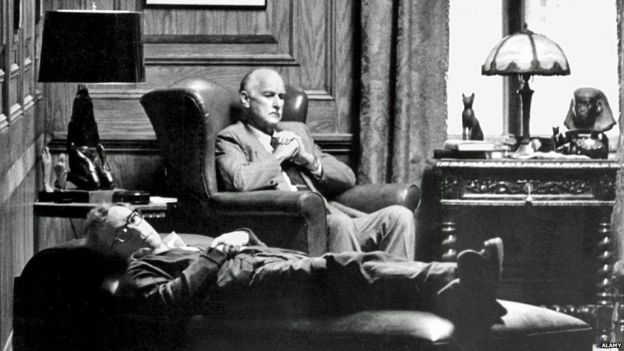
The Precise Moment of John McEnroe's Fall from Greatness | Mockingbird

His return caught me off guard.  "Yes, it's me," he said, more to himself than to me and barely loud enough to be heard.

Now this was a switch, a complete change of style.  His words could be interpreted as "Yes, the Great One is in your presence," but his tone was self-deprecating.  Here was John McEnroe in person poking fun at John McEnroe the celebrity, actually satirizing himself.  It was an impressive display of flexibility as a conversationalist. Point, McEnroe.

We volleyed as we headed south on East End Avenue.

"Are you playing tonight?" I asked, thinking maybe there was a tennis match at the Garden.  No, he said, he was going to a Knicks game.

"Take the Drive?" I asked.  (Meaning the FDR Drive, the highway that runs along the east side of Manhattan.)

"Yeah, please."

"Who are the Knicks playing tonight?"

"The Suns."

A couple more easy lobs were exchanged with no points scored.

Then, fearing the conversation might peter out for lack of fuel, I changed tempo by employing a technique I've used on other celebrities.  I express my regrets that I'm not all that familiar with their area of expertise (even if I am) because here would be a great opportunity for me to learn something from someone so renown in that field.  Celebrities live lives of annoyance from mundane questions posed by strangers and this may cause them to be reluctant to engage.  So by pleading ignorance (or even pretending you don't recognize them) it has the effect of putting them at ease.

"Too bad I don't really know that much about tennis," I kind-of-lied as I made a left on 79th Street and approached the entrance to the Drive,  "or I might be able to hold down an intelligent conversation here.  I mean, I play a little, but I don't really know the fine points of the game."

Looking in the mirror, I watched his facial expression loosen up just a notch.  I edged into the opening I had created.  "Funny," I said, "I seem to keep getting professional tennis players in my cab."

McEnroe was interested.  "Really?  Who?"

I could feel a big score coming up.  Here was the famous John McEnroe showing an interest in the not-famous me.  To hell with modesty, a surge of what let's call self-importance was rising from within and it felt good.

I told him about a couple of fares I'd had with tennis players whose names I didn't remember.  After talking for half a minute, however, I realized I was getting too chatty and that McEnroe's interest was waning.  So I served him up my big story ("What It Takes, Part 1") about how the previous summer I'd driven Mike Estep, Martina Navratilova's coach, out to a private club in Queens to practice with her; how Mike was such a great guy; how he'd asked me if I'd like to watch them practice; how I'd always wondered if I could return the serve of a pro, so I asked Mike if he'd hit me a few balls when we got there; and how -- isn't this great? -- he did.

McEnroe was all ears.  Not to brag but, really, I had the guy in the palm of my hand.

"Could you hit it?" he asked.

John McEnroe, the number one tennis player in the world, wants to know about my tennis game.  Yes!  Point, Salomon!

"Yeah," I said and, not trying to disguise my pride, I told him how I'd actually been able to get my racquet -- actually, Martina's racquet, ha-ha -- on the ball.  Not with any authority, mind you, but still, after a few serves I was getting my timing down and I could hit it.  Not bad for an amateur, huh?

McEnroe moved forward, a concerned look on his face.

"Who was that again?"

"Mike Estep," said I.

"Oh," he said, and he moved comfortably back in his seat again.  "Well, you know, Mike's never been known for his serve."

Ping!

The little bubble I'd been sitting in for the last seven months came bursting apart and evaporated into the atmosphere.

"Mike's never been known for his serve."

With one quick stroke I'd been reduced to the pathetic little tennis wannabe I actually was.

Point, set, match -- McEnroe.  

Damn!

I made a right and got on the FDR Drive.  Having been so profoundly reduced in stature, I found I could think of nothing to say to McEnroe so I just reverted to my job description as a New York City taxi driver and stepped on the gas.  Soon we were barreling along at 50 miles per hour in the middle lane, and for the next half a minute there continued to be no conversation between us, McEnroe no doubt quietly savoring the conquest of my dignity.  Understandably my mood began taking a turn toward the Dark Side.  What good was living, anyway?  There's always some venomous creature waiting to put its fangs into you just when life seems all zippity-do-dah.  Why continue slogging on with it?  

The idea of an end-it-all-with-a-glorious-bang entered my mind.  I could unfasten my seat belt, pick up speed to about 100 miles per hour, and crash into the stone wall that runs alongside the highway. McEnroe hadn't fastened his own seat belt so he'd probably go flying into the East River. This concept had an element of poetic justice to it which I found very appealing.  Mike's never been known for his serve, huh? We'll see about that.  I moved the cab over into the right lane and started looking for a good place in the wall to crash the cab.


But then, wait.  I reconsidered.

All right, one way of looking at it would be that I had been demolished, even humiliated, by McEnroe. But let's take a step back and delve into this a bit, shall we?  Here's a guy who is ranked NUMBER ONE in the WORLD.  There are MILLIONS of tennis players, ALL OVER THE WORLD.  They play this sport in schools, in colleges, in leagues, in private clubs, or just with friends.  If you're GREAT at it you may actually become a professional and make some kind of a living at it.  But then you're up against all the other players from ALL OVER THE WORLD who are also GREAT. Nevertheless you may become an elite player, rise high in the rankings, and become famous, respected, and wealthy.  But if you're the GREATEST OF THE GREAT -- if you are ranked NUMBER ONE IN THE WORLD -- you will have earned the AWE of both the general public and your own colleagues because NO ONE IN THE WORLD CAN BEAT YOU!  NO ONE!

And yet John McEnroe, the best tennis player in the world, and, some might say, the best tennis player of all time, is concerned that maybe his taxi driver can hit his serve.  But then, oh, it's okay.  It was only Mike Estep.  I'm safe.

Ladies and gentlemen, what we're looking at here is compulsive competitiveness of asylum magnitude and I suppose we're also looking at what it takes to be Number One in tennis and some other sports.  He is surrounded by assassins.  Everyone is a threat.  This is a guy who is one referee's bad call away from being surrounded by men in white coats and whisked off to the happy farm.

No, I decided, I would not crash the cab into the stone wall that runs alongside the FDR Drive.  In an act of considerable magnanimity,  I would let McEnroe live.  I realized he hadn't won the match, he'd only won a set.  So the game was still on.  But what I needed to do here was to clarify for myself what the object of the game we were playing actually was.  

I thought about it.   For him, I realized, it was to shape me into a dutiful listener so he could hear himself pontificate.  But for me, the game, in the time-honored tradition of taxi-driving, was to set my passenger up for giving me a big tip.

I awarded myself a point for this brilliant insight and the match continued.

Easing up on the pedal, I steered the cab back into the center lane.  Our conversation resumed, turning to sports in general -- football, baseball, hockey, basketball.  I began to notice that he'd listen carefully to whatever I had to say, wait just a moment, and then correct me.  My strategy was to listen carefully to him as well, but not to correct him.  For example, when at one point he interjected into the conversation that tennis is the greatest sport that ever was, I didn't contradict him even though everybody knows that baseball is the greatest sport that ever was.  Agreement creates affinity and affinity is crucial in the tipping phase of the ride.  So it could have appeared to an observer that McEnroe was scoring all the points here, but in reality I was holding even with him.

We exited the FDR at 34th Street.  The conversation had turned to boxing and McEnroe was telling me that Larry Holmes, who was then the undefeated heavyweight champion, would soon lose.

"Who'll beat him?" I asked.

"He'll beat himself," McEnroe snapped back.  A return with some real zing to it, especially considering that the person giving it was himself was the champion of the tennis world at that time, and McEnroe received a point for style.

We moved along on 34th Street and as we approached 2nd Avenue McEnroe committed a breach of taxicab etiquette by telling me to turn left and take 31st Street to the Garden.   The offense here is giving simple directions to a professional driver, as if I don't know how to get to Madison Square Garden.  But in this case I let the faux pas pass without comment as it suited my game plan.  The street he chose is actually the slowest way to get to the Garden from the East Side because you'll get a red light at every intersection.  He was adding three minutes to the ride. That's good for the meter but what I liked most was that it was giving me more time to work him for the tip.  Advantage, Salomon.

As we began our crosstown trek on 31st Street McEnroe, perhaps realizing that the end of the ride was approaching, suddenly seized complete control of the conversation and began to preach in earnest about his issues with tennis.  This was good news.  I could be getting taxi-driver-as-therapist money here.


First he hit on the officiating.  His complaint, he said, was that the officials aren't professional officials.  He pointed out that in baseball and football the players get to know the officials on a first-name basis.  In a close call their decisions are respected because the players know they are competent.  But in tennis, he said, you see new faces in every tournament, officials you've never met before.  Trust in their competence isn't given a chance to develop. 


FLASHBACK: John McEnroe calls umpire 'moron' at Queen's Club | Belfast News  Letter


I thought, wow, you know, he makes a good point here, and I awarded him one.  I'd never heard that argument expressed before and it made perfect sense -- of course, a lack of trust in the professionalism of the officials would create problems with the players.  But a few moments later I realized, wait, this is McEnroe's justification for why it's okay to berate officials during a match, as he was so famous for doing.  I took the point away for faking himself out.


Next, he took on the fans.  "New York fans are the worst," he squawked, recalling when he'd played against Vitas Gerulaitis, who was from Queens, in the finals of the U.S. Open in 1979.  What are the odds, he asked, of two guys who are both from Queens ever making it to the finals of the U.S. Open, played in Queens, in the same year?  And the fans?

"They booed both of us!"

Now here McEnroe was clearly committing a foul.  It would be one thing if he had it out for one particular fan or for even a certain type of fan.  But all New York fans? Come on.  I had no choice but to deduct a point for unsportsmanlike conduct.

We arrived at the Garden.  I pulled up to a special side entrance on 31st Street where McEnroe wanted to be dropped off, stopped the cab, and started tallying up the points.  With the penalty point deducted from his score it appeared to be a dead heat.  So... this match was going to be decided by the tip.  The fare on the meter was $5.20.  (This was in 1984. Today that ride would cost around $15.)  A cheap or -- considering it's a celebrity -- even an average tip would force me to conclude that my efforts had been in vain and I would have to concede the match to my opponent.  It would have to be a definitive, excessively generous gratuity to win.

With tension mounting, McEnroe opened his door and stepped out onto the street. He reached into the pocket of his coat and, stepping halfway back into the cab, handed me two bills: a five and a single.  It was going to be an eighty-cent tip, slightly less than average for a $5.20 fare.  I would have to interpret this as a snub, a cheapskate's ace, and give the final point and the match to McEnroe.

But wait!

McEnroe reached into his pocket again.  Out came several more bills which he handed to me with an almost apologetic look on his face.  He closed the door, waved goodbye, and walked toward the Garden, smiling.  I counted the bills.  There were six singles.  So McEnroe had tipped me $6.80 on a $5.20 fare, better than double the meter.  It was the best tip I'd ever received from a celebrity, a record that stood for twelve years.

Point, set, match -- Salomon!


********


Notes:

1. This is the second in a three-part series, "What It Takes".  Stay tuned for Part 3, "McEnroe Returns".

2. I am able to recall the details of a ride taken 34 years ago is because a) it was particularly memorable, and b) I've always kept journals of my most interesting rides.

3. There's a documentary recently released about McEnroe's year, 1984 (the same year he was in my cab), in which he won an incredible 82 out of 85 matches.  To see a clip from In The Realm Of Perfection click below:


4. Click on this one to see a taxi nearly running over McEnroe (from the movie Mr. Deeds):


Friday, September 07, 2018

What It Takes -- Part 1, Martina and Mike

For most of us today, sports are a part of our lives.  As toddlers we are already playing catch and kicking balls around.  As children we play in games with our friends and idolize the grown-ups who play the same games we do (and they wear uniforms!).  Getting a bit older we may participate in organized leagues and start to take our games more seriously.  Such a person may begin to think:

I wonder if I could play this sport professionally myself?

As time goes on it becomes clear that some people have been blessed with skills which set them apart from their peers.  He or she may become the star of one (or more than one) of their school teams.  They may receive a scholarship from a college which is interested in their athletic ability.  Scouts for professional teams might even be watching them and offer them a contract.

So a selection process is at work here.  Let's say you're one of these people who've progressed this far.  You're a professional athlete at some level.  You're finding the competition now is really fierce.  You most likely will be thinking:

I wonder if I can continue to compete successfully in my sport for years to come? How long can this go on?

Okay, let's say it does go on.  You're an established professional who's beaten the odds and you are still playing at the highest level.  But being somewhat famous and making a lot of money are not enough, you find.  The selection process is still at work for you.  Now you are no longer asking -- no, actually you are telling yourself:

I am the best who ever was.  No person, no obstacle, can stop me.  I choose this for my destiny: I am Number One, I am the greatest player to have ever played this damned sport, the champion of the ages, that's who I am.  I will not be, I cannot be, defeated. 

People like this are rare.  You have probably never met one.

Driving a taxi in New York City for all these years, I've met two of them.  From those rides I was able to gain an insight about what it takes to stand alone on top of the mountain.  Here are the stories, in chronological order....


MARTINA AND MIKE

On a sunny, mid-August day in 1983 I saw my next fare waving at me at the corner of 56th Street and 6th Avenue in Manhattan.  He was a 30-something guy, white shorts, a polo shirt, and in the hand that wasn't up in the air he was carrying about half a dozen tennis racquets.  Placing them carefully on the back seat as he got in (I noticed) he told me his destination was a certain country club out in Douglaston, Queens, about a thirty-minute ride.  

Well, I'm always sizing up my passengers as they get in, mainly to ascertain whether or not they're conversational.  This often means picking out something to comment on in the environment, saying something about it, and noting their response.  In this case, it was easy: 

"So what's with all the tennis racquets?" 

"You know who Martina Navratilova is, the tennis player?"

"Oh, sure."

Although I don't really follow the sport as a fan (I'm a casual player), it would have been difficult in 1983 not to know who Martina Navratilova was.  She was the number one female tennis player in the world at the time and she was very famous.  
"I'm her coach," my passenger said cheerfully, "and these are her racquets.  I'm going out to Queens now to practice with her."

"Oh, right, the U.S. Open," I said.  "When does it start?"

"It starts tomorrow for the qualification rounds, but Martina isn't playing until Monday."

Just from the pleasant tone of his voice, I knew I had a real conversationalist here. And clearly there could be plenty to talk about.  I became (once again) the interviewer of my own talk show and he, my special guest. 

His name was Mike Estep.  He was a professional tennis player himself, he told me, ranked 250th on the men's tour.  By the end of the ride, however, he would be ranked Number One in a unique category of my own invention: The Friendliest Passenger In My Cab Of All Time.  


Mike was totally happy to answer any questions I threw at him, and then some. Things like:

"How long have you been Martina's coach?"

"I just recently came on board.  You know, she's never won the U.S. Open.  I think I can help her do that."

"How so?"

"Well, the main thing is she's got to charge the net more.  Be more aggressive."

"Oh."

I knew nothing about tennis strategy but appreciated his candor.  I realized a door had been opened for me here.  I could ask this guy anything about anything.

"When you practice, do you ever play a game for real?"

"Sure."

"Who wins?"

"Oh, I beat her every time," he said -- not bragging, just matter-of-factly.

Interesting.  The number 250 male can beat the number one female.  Every time. Or so he says.  I wondered if this could really be true.  Hmmm...

I let the conversation flow around a bit and Mike told me some of his stories about being on the tour.  About how he'd once played an exhibition match in India against that country's top tennis player and, although he lost the match, he was happy to have lost because it caused the people who'd come to see them compete (the Indian locals) go home smiling.  Another story had to do with a time a couple of years earlier when he'd been playing at Wimbledon.  They have a parlay betting method in the U.K. in which a bettor can choose the winners of several consecutive matches on a card and if all his picks win, the bettor can walk away with quite a bit of money.  Mike learned later that there had been a gambler who had a card in which he'd correctly picked the winners of several matches and needed just one more correct pick on his card to win a small fortune.  That match had been a match that Mike had played in and won, but the gambler had picked his opponent to win it, so he wound up winning nothing.  "The other guy is higher ranked than me," Mike said, "but what he [the bettor] didn't know is that I always beat him."  He felt bad for the gambler, adding that he had no illusions about his own chances of going much further in the tournament.  "It's not like I'm going to win Wimbledon," he said.  


Our thirty-minute ride went by very quickly, which is a phenomenon that can happen in a taxicab when there's no lull in the conversation.  As we were about to enter the parking lot of the private country club in Douglaston where Martina was staying, Mike surprised me:

"Would you like to come over and watch us practice?"

Every once in a while I answer a question correctly.  Dismissing immediate thoughts of "needing to get back to work" I replied:

"Sure!"

What an extraordinary invitation!  So I parked the cab right there in the parking lot and the two of us got out and began walking toward the tennis court, about a hundred yards away down a path to our right.  A thought came to mind: as a fan of baseball and, as mentioned, as a casual tennis player, I've often wondered what it would be like to try to hit a ball thrown by a Major League baseball player or to hit the serve of a professional tennis player.  Is it really that hard to hit it?  Would I even see it as it went zipping by me?  I realized I had an opportunity at hand and seized the moment.  I said to Mike:

"You know, I've always wondered what it would be like to try to return the serve of a professional tennis player.  Do you think you could hit me a few?"

Now, keep in mind, I'm not an imposing kind of person andI would never have asked this question unless I was sure it was appropriate.  But Mike had already shown that he was such a friendly guy that there was no question in my mind that he'd be glad to accommodate me if he could.

"Well," he said, "if Martina's not out there yet... sure."

We arrived at the court.  About a dozen people were gathered around, waiting to see Martina.  But instead what they saw was her coach and a guy wearing jeans with a big smile on his face go out onto the court.  Martina had not yet arrived.

How surreal was this?  Thirty-five minutes ago I was driving my cab up 6th Avenue looking for a fare.  Now I am standing on a tennis court with one of Martina Navratilova's racquets in my hand, waiting for her coach to start hitting me serves.  I am eagerly awaiting being humiliated in a nice way by my own inability to play the game, and in view of a bunch of spectators.  Bring it on!

Mike raised his racquet in the air and pumped one at me.

To my surprise I reacted in time to hit the ball.  It didn't go anywhere near the net, but it didn't go past me, either.  I was pleased.  Mike hit me another one.  I hit it again, a little better this time.  On the next serve (and now I'm starting to bounce back and forth in imitation of how tennis players awaiting serves put their bodies in motion just before the ball is hit to them) I hit the ball over the net.  Out of bounds, but over the net.  Mike hit me another one, and a few more.  On each serve, as I was getting my timing down, I was hitting better shots.

I'm starting to think, damn, maybe I'm better at this sport than I've given myself credit for.  Maybe I should take this game more seriously, get into a league myself, take lessons.  I could be a contender.

Suddenly out onto the court steps Martina Navratilova.  She sees her coach playing tennis with some guy holding one of her racquets in his hand.

Martina, in her Czechoslovakian accent, looking at Mike: "Who's dis?"

Mike, nonchalantly: "Oh, it's my taxi driver."

Martina: "Oh!...  Okay!"

And with that she sits down, her back against the fencing that surrounds the court, to watch us play.

Oh my god, now I am playing tennis with not only a bunch of spectators gawking at me, but under the gaze of the best female tennis player in the world, as well.  And I'm playing with her racquet!  Pressure!  Mike serves me again, and this time I hit the ball over his head, again out of bounds but at least I'm getting the center of the racquet on the ball.  I'm beginning to wonder if I'm too old to turn pro.

On his next serve, Mike puts some "English" on the ball, causing it to spin sharply off to one side as it hits the surface and making it completely impossible for me to hit it back.  This was great fun, a bit of well-deserved showing off on his part, and after one more of these, thinking it better not to overstay my welcome, I returned Martina's racquet to its rightful owner, thanking her and Mike profusely for their hospitality, so to speak.  I walked behind the fence and found a solitary position (not among the other spectators) from which to watch their practice session.

Martina stepped out onto the court and it began.

They had what appeared to be a set regimen of drills.  In one of them they stood only about ten feet apart from each other on opposite sides of the net and volleyed back and forth, machine-gun-rat-a-tat-tat style, a marvelous display of reflexes and coordination.  These were professional, conditioned athletes doing their homework, you might say, although with their grace and precision it seemed to me they could just as well have been ballet dancers or circus acrobats.   There was also a physicality about them, Martina especially, that was striking.  She exuded strength, the musculature in her arms and thighs sculpted like a statue of an Amazon warrior.


This is not to minimize Mike. At one point during a break in their routine, he walked over to me and asked me what I thought.

"It's hard for me to believe there are 249 guys better than you," I replied.  He was that good.

Returning to the court, they began to practice by playing a game for real, to win. Immediately I remembered what Mike had said in the cab:

"Oh, I beat her every time."

Now I could get to see for myself if this were really true.  They played for about twenty minutes, and they played hard.  Did he beat her?  Yes, in fact, he did.  And this is what gave me my first insight about what it takes to be the one standing alone on top of the mountain.

It was Martina's ferocity in missing a point in a practice session.  Ferocity at herself. It was a little scary to witness.  I was glad I was standing behind a fence!

Now you may be recalling how upset you may have become in some game you had once been trying to win, but did not.  You may be thinking that that's how Martina must have felt as she failed to anticipate what the trajectory of Mike's next shot would be and watched helplessly as the ball went whizzing by her.  I'm going to make an assumption here that you are underestimating what Martina's actual response was.  "Upset" is not the word.  Nor would "dismayed", "agitated", "unnerved", "angered", "disturbed", or "flustered" be the words.

I believe the more accurate description would be MORALLY OUTRAGED.

No, this was not just a return she'd failed to make.  This was an INJUSTICE.  This was an IDIOCY that was UNACCEPTABLE.  This was failure to store grain in anticipation of a harsh winter.  This was not properly securing your fishing boat to the pier before the big storm hit.  This was putting twenty grand on a horse named Alvoc because Jack, the local bookie, says he has inside information.

After failure, the mindset becomes akin to a hard knuckles fistfight in a VIRTUOUS WAR to do WHATEVER IT TAKES to RIGHT THE WRONG THAT HAS BEEN DONE.

That, along with all the skills, is what it takes to become Number One.

Mike Estep, the friendliest passenger who ever rode in my cab and a tennis virtuoso, had what it takes to rise to the middle rankings on the men's tour.  But he didn't have that.

Martina did.

And a couple of weeks later, for the first time, she won the U.S. Open.


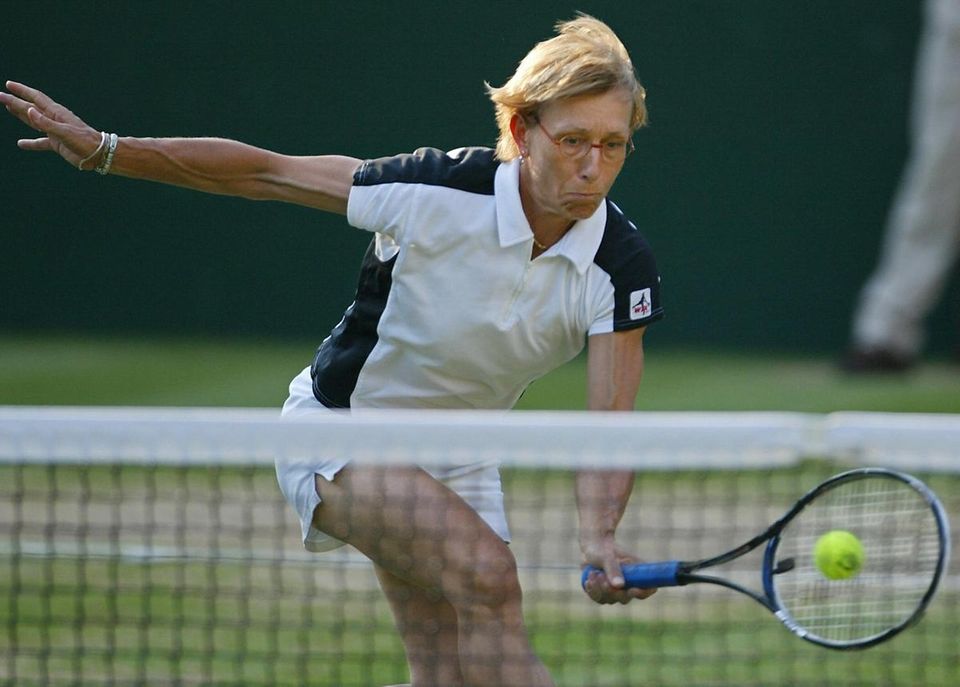
                   Martina Navratilova | 30 Legends of Women's Tennis: Past, Present ...

*****


This is the first in a three-part series, "What It Takes".  Stay tuned for Part 2, "My (Verbal) Tennis Match With John McEnroe".


Monday, March 28, 2016

What It Takes To Get Rid Of A McDonald's

Here's a question I've asked dozens of passengers in my cab over the years, and I'll ask it to you now: have you ever -- in your life -- noticed a McDonald's that, once it was there, ceased to be there? Think about this for a minute... I'm talking about every town or city you've ever lived in, every town or city you've ever known, every highway you've ever driven on that had a rest stop, every mall you've ever shopped in: have you ever known of a McDonald's that went away?

I'll bet you can't name even one.

I say this because no one in my cab has ever been able to think of one.  Well, actually there was one passenger who could.  He said there was a mass shooting in a McDonald's in San Diego, California, in 1984 in which twenty-one people were killed, and in the aftermath the McDonald's Corporation decided to raze the building and donate the land to the city rather than reopen it.  However, a new McDonald's was eventually built just a few blocks away.  So it's debatable as to whether or not this counts.

Wondering why this was so, I learned through conversations with passengers and with a bit of research on the net that in the great majority of cases the McDonald's Corporation owns the land upon which the restaurants are constructed.  A realtor in my cab recently told me, in fact, that people are mistaken if they think McDonald's is in the hamburger business.  Actually, he said, they're in the real estate business.  The value of their real estate holdings, including the land itself and the buildings, is more than 28 billion dollars.

So imagine my surprise when I drove up 10th Avenue in Manhattan a few weeks ago and noticed that a fence had been constructed around a McDonald's at 34th Street and it was shuttered up.  This was especially interesting to me because this very same McDonald's was, in fact, demolished about twenty years ago and I remember thinking at the time that it was the only one I knew of that had ever gone away. Especially strange, I thought, because it was one of the very few restaurants in Manhattan that had its own parking lot.  You could actually park your car and go into the place to eat, unheard of in the real estate paradise known as Manhattan.  And now it was gone?

No!  What happened was that, Hydra-like, it came back!  A new, bigger, two-story McDonald's arose in its place and was super-sizing the fries, sodas, and shakes all over again.  What, I had to wonder, could it possibly take to kill off one of these joints?

The answer to that question requires a closer look at what's been happening in the section of Manhattan that is bounded from north to south by 34th Street and 30th Street and from east to west by 10th and 12th Avenues.  It has its own new name: "Hudson Yards".  "Hudson" because the Hudson River is right there next to 12th Avenue and "Yards" because the construction that's underway there extends over the West Side Rail Yard, where trains headed for Pennsylvania Station come, go, and hang out.  It's a massive real estate development which when completed is expected to consist of sixteen skyscrapers with more than 12 million square feet of office, residential, and retail space.  An extension of the Number 7 subway line -- a massive construction project in itself -- was recently completed and opened for business with a station on 34th Street between 10th and 11th Avenues, the first new subway station to open in New York City in twenty years.

It's a big deal.

So why did the McDonald's go out?  Well, it was due to the value of its land, of course.  We all know about "location, location, location" and this is a location wet dream.  It's about an acre of the most prime real estate imaginable, literally adjacent to the new subway station.  Who was the genius who years ago decided to acquire a plot big enough for a parking lot?  Incredible.

I had to wonder what the price could have been for the McDonald's Corporation to sell out.  Happily, I was able to extract this information from two recent passengers in my cab.  One was a real estate lawyer and the other an executive of the development company which bought the land. (It's amazing to me how, when I decide that I want certain information, somehow a passenger shows up in my cab who provides me with it.  It's been happening for years -- a phenomenon, really.)

Anyway, what do you think it was?  Before you read on, just sit back for a minute and think about it.  An acre of land in the middle of a huge, huge real estate development in a whole new section of Manhattan that has its own new subway line -- what do you think that's worth in today's dollars?

Okay, here's the answer (drum roll, please)...

One hundred and forty-four million dollars, including the air rights.

One hundred and forty-four million dollars.

So now we know.

That's what it takes to get rid of a McDonald's.


Sorry, Morgan Spurlock.