Showing posts with label baseball. Show all posts

Thursday, October 04, 2018

What It Takes, Part 2 -- My (Verbal) Tennis Match With John McEnroe

You know, having a conversation is a lot like playing tennis.  A statement is made from one person to another, then it's responded to, tossed around, back and forth, each person trying to make his or her "point", each trying to "score".  This can be obvious, as in a debate, or it can be subtle, as in a friendly dialogue.  To some people, even saying "hello" can be an attempt at making a score before your opponent does.  That's how it was in the evening of March 13, 1984, when I looked in my rearview mirror and found that John McEnroe was sitting in the back seat of my cab.  

It was the doorman of his high-rise on East End Avenue who'd hailed me and opened the door for him but since I'd been looking down at my trip sheet, filling in the required information, I hadn't yet noticed who my new passenger was.  I simply called out my usual "hello" and awaited the response.  Would this one be friendly, in a big rush, arrogant, a drunk, a serial killer, or what?  McEnroe's response was a hard, direct shot, you might say, to my forehand.

"The Garden," he said.

Now, what was most important here was what wasn't said.  He didn't say "hello" back to me.  He didn't say "please".  He didn't say "Madison Square".  Just "the Garden", as if I automatically knew who he was and which garden he was talking about. It was more of an order than a request and at the same time it tested the ability of the recipient (me) to respond in kind.  An excellent opening -- I didn't yet know who he was, but he'd already scored.  Point, McEnroe.

I looked straight into the rearview mirror, wondering who would be speaking to me this way.  I recognized him immediately and shot back my own gut response:

"McEnroe," I blurted out, showing surprise but no great enthusiasm.

I give myself a point here because: a) I returned his sharp opening with one of my own.  If he had intended to be blunt with no mincing of words, he got the same from me.  b) I didn't show any false respect or false adulation or false friendliness. It was just "McEnroe", not "Mr. McEnroe", or "Oh, John McEnroe!"  Basically I was conveying an attitude that said, Okay, I know who you are, but you're not on a tennis court, buddy, you're sitting in my cab, so don't start up with any of those shenanigans you're famous for.  I can hit your serve.  Point, Salomon.
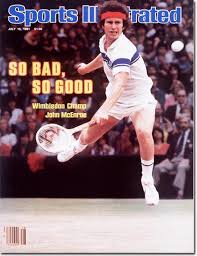
The Precise Moment of John McEnroe's Fall from Greatness | Mockingbird

His return caught me off guard.  "Yes, it's me," he said, more to himself than to me and barely loud enough to be heard.

Now this was a switch, a complete change of style.  His words could be interpreted as "Yes, the Great One is in your presence," but his tone was self-deprecating.  Here was John McEnroe in person poking fun at John McEnroe the celebrity, actually satirizing himself.  It was an impressive display of flexibility as a conversationalist. Point, McEnroe.

We volleyed as we headed south on East End Avenue.

"Are you playing tonight?" I asked, thinking maybe there was a tennis match at the Garden.  No, he said, he was going to a Knicks game.

"Take the Drive?" I asked.  (Meaning the FDR Drive, the highway that runs along the east side of Manhattan.)

"Yeah, please."

"Who are the Knicks playing tonight?"

"The Suns."

A couple more easy lobs were exchanged with no points scored.

Then, fearing the conversation might peter out for lack of fuel, I changed tempo by employing a technique I've used on other celebrities.  I express my regrets that I'm not all that familiar with their area of expertise (even if I am) because here would be a great opportunity for me to learn something from someone so renown in that field.  Celebrities live lives of annoyance from mundane questions posed by strangers and this may cause them to be reluctant to engage.  So by pleading ignorance (or even pretending you don't recognize them) it has the effect of putting them at ease.

"Too bad I don't really know that much about tennis," I kind-of-lied as I made a left on 79th Street and approached the entrance to the Drive,  "or I might be able to hold down an intelligent conversation here.  I mean, I play a little, but I don't really know the fine points of the game."

Looking in the mirror, I watched his facial expression loosen up just a notch.  I edged into the opening I had created.  "Funny," I said, "I seem to keep getting professional tennis players in my cab."

McEnroe was interested.  "Really?  Who?"

I could feel a big score coming up.  Here was the famous John McEnroe showing an interest in the not-famous me.  To hell with modesty, a surge of what let's call self-importance was rising from within and it felt good.

I told him about a couple of fares I'd had with tennis players whose names I didn't remember.  After talking for half a minute, however, I realized I was getting too chatty and that McEnroe's interest was waning.  So I served him up my big story ("What It Takes, Part 1") about how the previous summer I'd driven Mike Estep, Martina Navratilova's coach, out to a private club in Queens to practice with her; how Mike was such a great guy; how he'd asked me if I'd like to watch them practice; how I'd always wondered if I could return the serve of a pro, so I asked Mike if he'd hit me a few balls when we got there; and how -- isn't this great? -- he did.

McEnroe was all ears.  Not to brag but, really, I had the guy in the palm of my hand.

"Could you hit it?" he asked.

John McEnroe, the number one tennis player in the world, wants to know about my tennis game.  Yes!  Point, Salomon!

"Yeah," I said and, not trying to disguise my pride, I told him how I'd actually been able to get my racquet -- actually, Martina's racquet, ha-ha -- on the ball.  Not with any authority, mind you, but still, after a few serves I was getting my timing down and I could hit it.  Not bad for an amateur, huh?

McEnroe moved forward, a concerned look on his face.

"Who was that again?"

"Mike Estep," said I.

"Oh," he said, and he moved comfortably back in his seat again.  "Well, you know, Mike's never been known for his serve."

Ping!

The little bubble I'd been sitting in for the last seven months came bursting apart and evaporated into the atmosphere.

"Mike's never been known for his serve."

With one quick stroke I'd been reduced to the pathetic little tennis wannabe I actually was.

Point, set, match -- McEnroe.  

Damn!

I made a right and got on the FDR Drive.  Having been so profoundly reduced in stature, I found I could think of nothing to say to McEnroe so I just reverted to my job description as a New York City taxi driver and stepped on the gas.  Soon we were barreling along at 50 miles per hour in the middle lane, and for the next half a minute there continued to be no conversation between us, McEnroe no doubt quietly savoring the conquest of my dignity.  Understandably my mood began taking a turn toward the Dark Side.  What good was living, anyway?  There's always some venomous creature waiting to put its fangs into you just when life seems all zippity-do-dah.  Why continue slogging on with it?  

The idea of an end-it-all-with-a-glorious-bang entered my mind.  I could unfasten my seat belt, pick up speed to about 100 miles per hour, and crash into the stone wall that runs alongside the highway. McEnroe hadn't fastened his own seat belt so he'd probably go flying into the East River. This concept had an element of poetic justice to it which I found very appealing.  Mike's never been known for his serve, huh? We'll see about that.  I moved the cab over into the right lane and started looking for a good place in the wall to crash the cab.
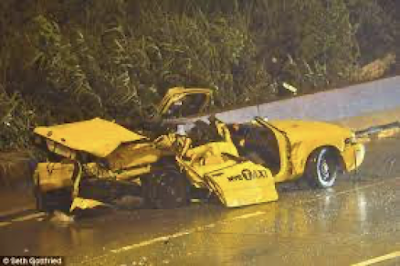


But then, wait.  I reconsidered.

All right, one way of looking at it would be that I had been demolished, even humiliated, by McEnroe. But let's take a step back and delve into this a bit, shall we?  Here's a guy who is ranked NUMBER ONE in the WORLD.  There are MILLIONS of tennis players, ALL OVER THE WORLD.  They play this sport in schools, in colleges, in leagues, in private clubs, or just with friends.  If you're GREAT at it you may actually become a professional and make some kind of a living at it.  But then you're up against all the other players from ALL OVER THE WORLD who are also GREAT. Nevertheless you may become an elite player, rise high in the rankings, and become famous, respected, and wealthy.  But if you're the GREATEST OF THE GREAT -- if you are ranked NUMBER ONE IN THE WORLD -- you will have earned the AWE of both the general public and your own colleagues because NO ONE IN THE WORLD CAN BEAT YOU!  NO ONE!

And yet John McEnroe, the best tennis player in the world, and, some might say, the best tennis player of all time, is concerned that maybe his taxi driver can hit his serve.  But then, oh, it's okay.  It was only Mike Estep.  I'm safe.

Ladies and gentlemen, what we're looking at here is compulsive competitiveness of asylum magnitude and I suppose we're also looking at what it takes to be Number One in tennis and some other sports.  He is surrounded by assassins.  Everyone is a threat.  This is a guy who is one referee's bad call away from being surrounded by men in white coats and whisked off to the happy farm.

No, I decided, I would not crash the cab into the stone wall that runs alongside the FDR Drive.  In an act of considerable magnanimity,  I would let McEnroe live.  I realized he hadn't won the match, he'd only won a set.  So the game was still on.  But what I needed to do here was to clarify for myself what the object of the game we were playing actually was.  

I thought about it.   For him, I realized, it was to shape me into a dutiful listener so he could hear himself pontificate.  But for me, the game, in the time-honored tradition of taxi-driving, was to set my passenger up for giving me a big tip.

I awarded myself a point for this brilliant insight and the match continued.

Easing up on the pedal, I steered the cab back into the center lane.  Our conversation resumed, turning to sports in general -- football, baseball, hockey, basketball.  I began to notice that he'd listen carefully to whatever I had to say, wait just a moment, and then correct me.  My strategy was to listen carefully to him as well, but not to correct him.  For example, when at one point he interjected into the conversation that tennis is the greatest sport that ever was, I didn't contradict him even though everybody knows that baseball is the greatest sport that ever was.  Agreement creates affinity and affinity is crucial in the tipping phase of the ride.  So it could have appeared to an observer that McEnroe was scoring all the points here, but in reality I was holding even with him.

We exited the FDR at 34th Street.  The conversation had turned to boxing and McEnroe was telling me that Larry Holmes, who was then the undefeated heavyweight champion, would soon lose.

"Who'll beat him?" I asked.

"He'll beat himself," McEnroe snapped back.  A return with some real zing to it, especially considering that the person giving it was himself was the champion of the tennis world at that time, and McEnroe received a point for style.

We moved along on 34th Street and as we approached 2nd Avenue McEnroe committed a breach of taxicab etiquette by telling me to turn left and take 31st Street to the Garden.   The offense here is giving simple directions to a professional driver, as if I don't know how to get to Madison Square Garden.  But in this case I let the faux pas pass without comment as it suited my game plan.  The street he chose is actually the slowest way to get to the Garden from the East Side because you'll get a red light at every intersection.  He was adding three minutes to the ride. That's good for the meter but what I liked most was that it was giving me more time to work him for the tip.  Advantage, Salomon.

As we began our crosstown trek on 31st Street McEnroe, perhaps realizing that the end of the ride was approaching, suddenly seized complete control of the conversation and began to preach in earnest about his issues with tennis.  This was good news.  I could be getting taxi-driver-as-therapist money here.


First he hit on the officiating.  His complaint, he said, was that the officials aren't professional officials.  He pointed out that in baseball and football the players get to know the officials on a first-name basis.  In a close call their decisions are respected because the players know they are competent.  But in tennis, he said, you see new faces in every tournament, officials you've never met before.  Trust in their competence isn't given a chance to develop. 


FLASHBACK: John McEnroe calls umpire 'moron' at Queen's Club | Belfast News  Letter


I thought, wow, you know, he makes a good point here, and I awarded him one.  I'd never heard that argument expressed before and it made perfect sense -- of course, a lack of trust in the professionalism of the officials would create problems with the players.  But a few moments later I realized, wait, this is McEnroe's justification for why it's okay to berate officials during a match, as he was so famous for doing.  I took the point away for faking himself out.


Next, he took on the fans.  "New York fans are the worst," he squawked, recalling when he'd played against Vitas Gerulaitis, who was from Queens, in the finals of the U.S. Open in 1979.  What are the odds, he asked, of two guys who are both from Queens ever making it to the finals of the U.S. Open, played in Queens, in the same year?  And the fans?

"They booed both of us!"

Now here McEnroe was clearly committing a foul.  It would be one thing if he had it out for one particular fan or for even a certain type of fan.  But all New York fans? Come on.  I had no choice but to deduct a point for unsportsmanlike conduct.

We arrived at the Garden.  I pulled up to a special side entrance on 31st Street where McEnroe wanted to be dropped off, stopped the cab, and started tallying up the points.  With the penalty point deducted from his score it appeared to be a dead heat.  So... this match was going to be decided by the tip.  The fare on the meter was $5.20.  (This was in 1984. Today that ride would cost around $15.)  A cheap or -- considering it's a celebrity -- even an average tip would force me to conclude that my efforts had been in vain and I would have to concede the match to my opponent.  It would have to be a definitive, excessively generous gratuity to win.

With tension mounting, McEnroe opened his door and stepped out onto the street. He reached into the pocket of his coat and, stepping halfway back into the cab, handed me two bills: a five and a single.  It was going to be an eighty-cent tip, slightly less than average for a $5.20 fare.  I would have to interpret this as a snub, a cheapskate's ace, and give the final point and the match to McEnroe.

But wait!

McEnroe reached into his pocket again.  Out came several more bills which he handed to me with an almost apologetic look on his face.  He closed the door, waved goodbye, and walked toward the Garden, smiling.  I counted the bills.  There were six singles.  So McEnroe had tipped me $6.80 on a $5.20 fare, better than double the meter.  It was the best tip I'd ever received from a celebrity, a record that stood for twelve years.

Point, set, match -- Salomon!


********


Notes:

1. This is the second in a three-part series, "What It Takes".  Stay tuned for Part 3, "McEnroe Returns".

2. I am able to recall the details of a ride taken 34 years ago is because a) it was particularly memorable, and b) I've always kept journals of my most interesting rides.

3. There's a documentary recently released about McEnroe's year, 1984 (the same year he was in my cab), in which he won an incredible 82 out of 85 matches.  To see a clip from In The Realm Of Perfection click below:


4. Click on this one to see a taxi nearly running over McEnroe (from the movie Mr. Deeds):


Wednesday, December 06, 2017

The Fan Strikes Back

Baseball.

It's the one sport I am really a fan of, and I have suffered much because of it.

As a kid I was raised as a fan of the New York Giants baseball team by my father, himself a lifelong devotee of that franchise, and I worshipped the players. Then, when I was nine years old, they packed up their bats and balls and moved to San Francisco, taking my Willie Mays with them.  What a slap in the face to an innocent child who'd done nothing but love them!

It was the first in a long series of betrayals that were yet to come.

There followed four years of abandonment and bitterness.  The only baseball team left in town was the Yankees, but switching to them at that time was not an option, as I'd been thoroughly indoctrinated to see them as The Enemy.  So I trudged through empty days in some kind of baseball purgatory, left on my own to play second base for my Carvel 91 Little League team without a role model to emulate nor a guide to show me the way.

Strange thoughts of retribution began to creep into my universe.  I would find myself sitting in class in elementary school with my attention drifting to mental scenarios of Horace Stoneham, the owner of the Giants at that time, showing up at my front door and begging me for forgiveness.  I would insist that he move our Giants back to New York City and come to my school to make the announcement with me at  his side.  He'd give me a bunch of tickets to games.  He'd send Willie Mays over to my house to give me tips on hitting.  My friends would see me hanging with Willie and would be jealous.  Billy O'Reilly would offer to be my best friend if he could just get to spend time with Willie, too.  Of course I would not allow it.

Not surprisingly, my grades began to suffer.

But in 1962 it looked like things might be starting to turn around. The New York Mets were created as a new National League expansion team, and, although they were awful in terms of winning games, they served as an adequate replacement for the Giants.  Things went along smoothly until 1969 when they made the mistake of winning the World Series.  With their fans now expecting them to play like winners, they immediately began to implode.  Nolan Ryan, a rising star who went on to become one of the best players in baseball history (and today has thousands of kids named after him) was traded away.  Tom Seaver, who had earned the nickname "The Franchise", was let go in a silly contract dispute.  Mets management thought it would be a good idea to decorate Shea Stadium with gigantic neon stick figures of baseball players and to have a huge plaster apple rise from a huge plaster hat whenever a Met hit a home run.

I felt my intelligence was being insulted.  Hey, Mets, I'm an educated baseball fan.  I don't need flashing lights and electric apples to keep my attention on the game. Still, I followed the team and rooted for them even though they quickly descended into mediocrity and worse.

Then in 1975 free agency arrived, thus planting the seed of the fan's moral dilemma.  From a human rights point of view players of course should be able to be paid what the market will bear.  Who are the owners to prevent players from offering their services to the highest bidder?  Slaveholders?  It was actually heartwarming, for a while, to see the big stars making big money.

But things soon got out of hand.  Apparently what the market would bear, what with all the TV revenue, ticket sales, concession sales, trademark income, and so on, was more than anyone could have imagined.  The average annual salaries of Major League baseball players ballooned from $113,000 in 1979 to over $3,000,000 in 2006.   And that was the average!  The big names were making tens of millions per year with guaranteed contracts that paid them that money even if they had bad years or sat half the season on the bench.

The average working person began to have a hard time relating to this.  A teacher or a cop makes barely enough to keep food on the table and maybe not even enough to take the family to a baseball game, but some guy who can run a little faster, throw a ball a little harder, and hit a ball a little better can make... what?  Tens of millions of dollars for playing baseball for just a single season?  Some began to question the values of our culture -- a disconnect was setting in.

You would think that when some guy is making millions of dollars a year for playing a game that he'd be happy with what he's got, perhaps even thanking his lucky stars every day for his good fortune.  But no. In 1981 the players and their union thought they should get more.  So they went on strike, canceling 713 games.  In 1994 there was a lockout (this time the owners wouldn't agree to the players' demands) which abruptly ended the season in August and cancelled the entire post-season, including the World Series.

Then, to make matters even worse, in the late '90s we found out that many of the star players were actually cheaters.  Some guy whose name was on your kid's t-shirt was actually jacked up on "performance-enhancing drugs".  Aside from the betrayal of trust that it loudly proclaims, this even tore away at the history of the game. Now when a new record is being approached (such as the number of home runs hit in a season or in a career) the question invariably arises as to whether or not the new record should count in the record books if the player had ever been found to have been taking PEDs.

You know, with all of the perfectly valid things to become cynical about in this world, baseball should not have been one of them.  But it was.  I myself had become so disenchanted about the way things were going that I decided I was a "free agent" as a fan in 1985.  My loyalty was no longer a given -- it had to be earned. I had to wonder why I was even bothering to pay attention to these overpaid, pill-popping cheaters.  After some soul-searching I realized what it was.

It was the game itself.

Baseball.

It's the most intriguing, most theatrical, most balanced, and most intellectual sport ever invented.  Consider this:

In baseball...

--- there's no clock.  A game could theoretically go on forever.  There's no possibility of a tie.  I love that.

--- it's a game in which a contest between two individuals (the pitcher versus the hitter) immediately shifts into a game between multiple team players the moment the ball is hit.

--- it's a game of likelihoods, represented as statistics, which keep you thinking as the game continues, not just watching.

--- you don't have to have a huge body to play it at its highest level.  In fact this year a player on the Houston Astros, Jose Altuve, who stands at just 5 feet, 6 inches, won the Most Valuable Player award in the American League.  A player on the Yankees, Aaron Judge, who is 6 feet, 7 inches, came in second in the voting.

--- it's like a symphony, with diminuendos (moving slowly) building into huge crescendos (increasingly unbearable tension with every pitch).

--- you can get to know the players as individuals.  They're not hidden behind masks, like in American football.  They're not in constant motion, as in many sports.  Each player on a team comes to bat four or five times in an average game.  This gives the fan opportunities to become familiar with them as personalities, similarly as you would come to know a character in a drama.

And then there's this, as aspect of the game I find especially endearing:

Baseball is the only sport in which a fan in the stands can, in certain specific circumstances, become an active and legal participant in the game itself.  When a batter hits a ball in the air that is heading for the stands, once the trajectory of the ball crosses the point that separates the stands from the playing field, the rule book states that the fan in the stands has as much right to catch the ball as the player on the field who is also trying to catch it.  If that player is on your team, you should get out of his way and let him catch it.  But if he's on the opposing team, the fan should try to catch or deflect the ball himself before the player can get to it.  For that specific moment the fan in the stands is actually a player on the team!  

Every once in a while this magnificent aspect of baseball actually determines the outcome of a game.  October 9th, 1996, was one of those times.  The New York Yankees were playing the Baltimore Orioles in the first game of the American League Championship Series.  Late in the game Derek Jeter hit a long fly ball to right field that was descending close to the fence.  A twelve-year old kid named Jeffrey Maier reached over and scooped the ball into the stands.  It should have been ruled fan interference but the umpire called it a home run and a great controversy ensued.  Nevertheless, the call stood (this was before they used videotape replays to decide close plays) and the kid became instantly famous.  He was dubbed the "angel in the outfield" by the New York media and appeared on talk shows.  Not only that, but he went down in baseball history and to this day any good Yankee fan or serious fan of the sport knows his name.

Here's the video of the incident:


And this is what aired on The Today Show the next day:


Okay, all of the above is to set you up for what occurred in my taxi in the early morning hours of August 30, 2002.  Here is a story from "the vault", one I have told to many passengers in my cab but never before gotten around to writing -- a tale of retribution by a fan who just couldn't take it anymore...


I'd started my shift late that night and that, along with a few lousy rides, had dampened my mood.  Plus there was something else going on that night which was really bothering me  -- the deadline of yet another threatened baseball strike was set for midnight.  If an agreement wasn't reached by that time, the season would come to a halt -- there would be no baseball the next day and, who knows, maybe not for the remainder of the season.

I'd been following this on the radio, of course.  Just after the midnight hour an announcement came over the air that the deadline had been extended -- the negotiations between the owners and the baseball union were continuing on into the night. This was hopeful, but it was still maddening to me as well.  Just the idea of millionaires thinking their working conditions could warrant a strike...  it was infuriating.  This strike thing was really getting under my skin.

The night went on.  Business was slow.  According to my trip sheet, at 2:09 I picked up a guy and a girl coming from a bar on 47th Street between Broadway and 8th Avenue and took them to 26th and 6th.  After dropping them off I headed back to 47th Street and at 2:24 picked up another fare, two young ladies, and took them to 89th and 2nd.  I then drove downtown to see if I could catch a fare at a club on 56th Street between Park and Lexington Avenues.  It was a good move.  At exactly 2:51 four people came out of the club and entered my cab.

Three of them were beautiful young women, well-tanned and well-cleavaged, wearing skin-tight party dresses.  They squeezed together in the back seat.  The fourth passenger was a guy who might be called a "cool dude".  He had on an expensive-looking suit and wore his hair in abbreviated dreadlocks -- not the full-length kind that would go down below the shoulders, but a shorter version that ended in mid-neck.  It was an unusual look that caught my attention.

As he sat down next to me in the front seat, he immediately took control of his new environment.  "Hey, man," he said, "let's get something else on the radio." Then, without bothering to ask me if that was okay, he reached over and changed the station from the one I had on ("oldies" rock and roll) to one he preferred (hip-hop). He then turned around in his seat and started carrying on with the girls.

It was a severe breach of taxicab etiquette.  Passengers in party mode often want some kind of dance music to keep them in the groove, and requests are always honored.  But to reach over and change the station without even asking... well, that's beyond rude.  It's belittling to the driver, as if he's not there, not really a person.  And, although it is a mode of public transportation, it's still my car you're in, buddy.

Nevertheless, I choose not to make an issue of behavior like this.  My thinking in these situations is, okay, this passenger is acting badly, but he will be out of my life in ten or fifteen minutes.  Most people are relatively polite and there are always a few who are too full of themselves to notice, or care, how their behavior affects others. That's how it is.  I can tolerate this.  There's no need to take a stand.

I pulled out from the curb and drove east on 56th.

"So where are you heading?" I asked, since no one had yet given me a destination.

"Just go downtown, man, we're gonna find another club," the cool dude said, then he turned around again and continued chatting it up with the ladies.

I made a right on Lex, which goes downtown.  The party was continuing as we drove along, the music loud, the laughter loud, and the driver not enjoying the experience. As we approached 34th Street I was told by the cool dude to pull over and stop beside an all-night deli.

"Just getting some cigarettes," he said, "back in a minute."  He got out of the cab and was joined on the street by one of the girls from the back seat.

As I watched him open the door to the deli, it suddenly hit me -- I realized who this guy was!  This was Tony Tarasco, a baseball player currently on the Mets, an outfielder, who had once played for the Baltimore Orioles.  Earlier in the season I'd read an article in the newspaper about him, about how he'd been in a gang in Los Angeles when he was a teenager and was able to leave that behind to become a big-league baseball player.  It showed a picture of him with this hair style, the abbreviated dreadlocks, which was why I recognized him.  And if you watched the above video you would already know that it was Tony Tarasco in right field in Yankee Stadium on October 9th, 1996, who was trying to catch the ball that was deflected into the stands by the young fan.

Well, wasn't this interesting!  Here it was, nearly three in the morning, a baseball strike pending, and I've got a baseball player in my cab who at the moment was buying cigarettes and was not yet done partying.  I looked at the two girls in the mirror -- beautiful, so well put-together, all that cleavage, a couple of 
Jayne Mansfields. They were making small talk between themselves. One of them, apparently, was from Sweden.

All these bits of information began to whirl around in my mind... my long-lost Giants, the hapless Mets, millionaire athletes living in bubbles, the steroids, the strikes, the magnificence of the game itself, soaring ticket prices, radios, the magnificence of the game itself, night clubs, cigarettes, the magnificence of the game itself, cleavage...

I was starting to feel emboldened.  I reached over to the radio dial and turned it back to my own station.  That was more like it.

The door opened.  Tony Tarasco and the other girl got back in the cab.  Right away he noticed the station had been changed.

"Hey, man, what happened to my music?"

"Oh, the girls didn't like it.  I turned it back."

A complete lie, but at the moment it seemed like the right thing to say.

There was a hesitation.  And then, in what can only be attributed to divine intervention, at that very instant a bulletin came on over the radio with the latest news about the baseball strike. Both of us stopped talking and, listening intently, we learned that the negotiations were still continuing on into the night.  Then, just as the report ended, I seized the moment.  Turning to my station-changing passenger, I went into a loud and angry mock tirade that went pretty much like this:

"If those MOTHERFUCKERS DARE go on strike, we're NEVER coming back!  NEVER! FUCK these over-paid millionaires! FUCK THEM!  Less than a year after 9-11 and THIS is what these MOTHERFUCKERS want to do?  Go on STRIKE?  Oh, boo-hoo, you poor little baseball babies, you only made three million dollars last year!  Are you KIDDING?  Go on STRIKE?   FUCK THEM!  I'm telling you, man, if they go on strike, we fans are NEVER coming back!  NEVER!"

He seemed to have enjoyed the rant.  With a big smile he said:

"Oh, man, you don't know who I am!"

There followed what in the theater is called a "pregnant pause".  If life were a novel, this would have been the moment of climax, when the hero knows that his war has been won, his journey done, his object of desire attained.  All that remained was procedural.

Savoring the moment, I flipped my own demeanor to cheerfulness and, with a big smile, I said:

"Oh, yes, I know who you are.  You're Tony Tarasco.  And I've got two words for you, Tony..."

He was stunned, truly, as if he'd been caught by a right hook to the chin.

"What?"

I went for the knock-out:

"Jeffrey Maier!  That kid's more famous than you are!"

His bravado flying out the window, he seemed to have descended into an introspective spin and was at a loss for words.  Finally, he said:

"Well, I don't know about that..."

It took a few moments for Tony to regain his composure.  Then we had a civil back and forth about the pros and cons of the looming baseball strike.  My point of view was, among other things, that it was less than a year after the Twin Towers came down and thousands lost their lives.  Millionaire athletes going on strike in times like these would be the epitome of greed and disrespect.  His argument was that it's a short career and players need to be thinking about their grandchildren.

I looked in my mirror at the three curvy ladies in the back seat.  It was hard to imagine them as grandmothers.

By the time we arrived at the new club, any hard feelings that may have arisen from my sneak attack had dissolved.  Tony turned out to be a good sport.  At one point he showed me an electronic device he had attached to his belt with which he would vote either "yes" or "no" to whatever agreement might be reached in the negotiations.  I thought that was cool and pretended I was going to try to yank it away from him.  He enjoyed that, which I appreciated.   It showed me he was a guy who could be kidded around with.

"Vote 'yes'," I demanded as we reached their destination, a new club.  With a smile and a wave goodbye (and an excellent tip, I must say) he and the girls were gone.

The next day the news was that an agreement had been reached and the players had voted to accept it.  There would be no strike.

Later I learned that Tony had been quite correct about one thing he'd said to me -- it is indeed a short career, at least for most players.  Two days after he was in my cab, he played in his last game in the Major Leagues.  His career as a player was over, although he has remained in the game as a coach.

But I was correct about another thing.  I have told this story to scores of passengers in my cab, each of them describing him or herself as a baseball fan. I ask them all if they remember the name of the kid who deflected the ball into the stands.  The great majority of them do -- "Jeffrey Maier"!  But only one passenger so far (who turned out to be from Baltimore) remembered the name of the player who was trying to catch that ball.

So you can go to a baseball game, try to catch a ball that is heading right toward you and, if Fate decrees it, you can wind up being better remembered in baseball lore than many, if not most, of the players who actually played the game.

Baseball -- the magnificence of the game itself.


Sunday, September 21, 2014

Running The Gamut, Number Three

One of the great things about driving a taxi in New York City - perhaps the greatest thing - is that on any given day you may run the gamut: that is, you may pick up people who are able representatives of both the top and the bottom of the social spectrum. Your first passenger may be a nun who works for God and your second a street hooker who works for Jake the Snake, her pimp; your third an assistant district attorney and the fourth the guy he’s sending to prison. And so it goes - the parade of humanity enters and exits through your doors. It’s magnificent, really.

(Note: I’ve written two other posts on this subject, “Running The Gamut”, and “Running the Gamut, Number Two”. If you’d like to read them please click here and here.)

So, in this episode of Running the Gamut, we’re going to zero in on a specialized zone of activity in New York City, the world of baseball. For those of you who may live in a part of the planet where baseball is not played, let me fill you in on the basics:

- baseball is the number one sport in the United States. It is played on many levels, but the ultimate goal of any player is to make it to the top level, which is called the Major League.

- the first Major League game was played in 1871.

- there are thirty teams in the Major League, spanning across the country in most of our principal cities. The season goes from April until the end of September, with the three-tiered playoff games continuing until the end of October. The regular season consists of 162 games for each team.

- in New York City there are two baseball teams, the Yankees and the Mets. The Yankees came into existence in 1903 and have long been the premiere team of the sport. Many of baseball’s iconic players (such as Babe Ruth, Joe DiMaggio, and Mickey Mantle) were Yankees. They have won 27 championships, far more than any other franchise. Their home is Yankee Stadium in the Bronx. The Mets have been around since 1962. They have won two championships in their 52 years. They play in Citi Field in Queens.

On August 7th, a Thursday, I started my shift at 5:30 pm, as I normally do. My first passengers were two ladies - one middle-aged, the other a twenty-something - going from Columbus Circle down to Penn Station. They were both wearing the pinstriped jerseys of the Yankees - the familiar, interlocking “NY” on the front and, I noticed, the number 2 on the backs of both of them. The Yankees had played a game that afternoon so I knew without even needing to ask where they were coming from. A conversation began.

Yes, they told me, they’d been at the game, adding that there was some kind of delay on the subway, which was why they were in my cab - and they had only twenty minutes to catch a train to New Jersey. Could we make it? I told them to relax, I’d get them to Penn Station on time. And we were on our way.

I soon discovered that they were mother and daughter, both big Yankee fans, that they go to at least one Yankee game together every year (“it’s a tradition”), that the game they’d just attended was the only game for them this year, and that, hooray, the Yankees had won. Still, the mother said, they were “greatly disappointed”.

“Why?” I asked (of course). I mean, the Yankees won, you’re supposed to be happy.

“Because Jeter didn’t play!” they both answered, almost in unison.

“Oh, gee, that’s too bad,” I said, completely understanding their dismay.

Again, for the benefit of those readers who may not know baseball, allow me to tell you why this fellow named Jeter not playing in that game would be such a letdown to my passengers. Derek Jeter has been a star player - the captain of the team, actually - for the Yankees for the last twenty years. During his tenure the Yankees have won five championships and gone to the playoffs 17 times. On a personal level he has broken so many statistical records that they seem endless. He ranks sixth on the all-time hits list. (That means that, going back to 1871, only five players have had more hits than he.) And off the field he has been the very epitome of what we would hope a star athlete to be. Hard-working, generous, respectful, always upbeat, never involved in a controversy, never a bad word said against him - he is truly a role model not only for America’s youth, but for everybody. All around the country he is regarded as the “face of baseball”. People are naming their children (and their pets) after him. And now, at the age of 40, he has announced that this season will be his last. Fans of opposing teams are crowding into their own stadiums to get one last look at him when the Yankees come to town and are giving him standing ovations when he comes to bat. He is the superstar of the world of baseball.

So this was why my passengers were so disappointed even though the Yankees won the game. Being devoted Yankee fans and fans of Jeter in particular - the number 2 on their jerseys is his number - they, too, had wanted to see him play one last time. But, alas, he’d been given the day off, something that happens from time to time during the course of the long, long season.

Nevertheless, my passengers were in good spirits as we approached the entrance to Penn Station at 34th Street and 7th Avenue, despite the presence above us of a gigantic Nike billboard featuring a thirty-foot image of Derek Jeter acknowledging the adoration of his fans.

“Re2pect” was the only text accompanying the image.


As mother and daughter left my cab with smiles on their faces and five minutes to spare, my eyes wandered to the shop directly on my right. It was a Modell’s Sporting Goods store, one of many in the city, where they sell mostly apparel for fans. The entire window displayed t-shirts, jerseys, hats, buttons, and every other imaginable form of commemoration featuring, guess who?


Yes, it has been a Derek Jeter year in New York City, if not the entire country. “We need our heroes,” I thought, as I pulled out into the quagmire of traffic on 7th Avenue. And indeed we do. In this age of super-cynicism, is it not something of importance to have a counterbalance to the liars, the cheats, the pretenders, and the thieves who show up for a free meal at every opportunity? It is important. Let the good guys win every once in a while.

I slogged along in the evening rush for the next few hours. At 6:50 three out-of-towners went from 77th and York down to the Astor Place Theatre in the East Village to see Blue Man Group, a nice twenty-dollar run on the FDR Drive. Then there was a short ride over to Alphabet City. On my next one, from the Bowery down to the intersection of Allen and Chrystie, I found myself sitting in a bumper to bumper jam-up on 2nd Avenue. Looking around at the environment, I noticed one of those gigantic double-decker tourist buses just to the left of me which was decorated with - well, will you look who’s here again? - fifteen-foot-high Derek Jeter action images on all sides. “Jesus,” I thought, “this guy is everywhere.”

The next few fares took me to the West Village, up again to the Upper East Side, down to 60th and 5th, and then, at 8:30, to 22nd and 8th in Chelsea. 8:30 is around the time for my ritualistic coffee break, so I parked at 6th Avenue, went into the Starbucks at the corner, got my tall Pike (no room for milk), returned to the cab, dug through my bag to retrieve my carrot muffin sliced into bite-sized pieces the night before, and began munching away in happiness. Ah, that feeling of the hot coffee meeting the muffin… bliss.

Okay, back to work. My next fare was a chatty fellow going from the popular Eataly restaurant and market on 23rd and 5th all the way up to 157th and St. Nicholas Avenue in Harlem - $28.50 on the meter and a $5 tip - a great ride. After that it was 73rd and Columbus down to 15th and 5th, followed by 14th and 4th down to Gold Street in the Financial District. The night was wearing on, and I was doing pretty well, both in spirit and in money.

At 11:12 a twenty-something woman beat out another twenty-something woman in a rush to get to my cab at 27th and Park - it can get quite busy in certain sections of Manhattan at around that time on a Thursday night - and directed me to drive to LaGuardia Place and Houston Street on the southern boundary of Greenwich Village. When I arrived there eight minutes later I pulled over on Houston at the intersection but had to wait a bit for her to swipe her credit card - it took several swipes to register - and then to gather her stuff together and open the door. As she did so a particularly attractive young lady standing a short distance away noticed that my cab was becoming available and began moving quickly toward me with her hand in the air. Seeing the hail, I remained at the curb instead of pulling out onto the street. She hustled up, opened the door, got in, and said, “Someone else is coming”, with a concerned look on her face. About five seconds went by until the person we were waiting for came jogging toward the cab, being pursued by three or four shouting females who were basically begging him to pose for a picture with them. He stopped at the opened door of my taxi and stood with the girls for a few moments, flashing a very familiar smile while they snapped away and thanked him profusely.

And then Derek Jeter got into my cab.

“It’s number 2,” I said, sort of half to myself and half to them, and a bit in shock.

“Hiya buddy,” said Derek Jeter.

“I can’t get away from you!” I exclaimed (in jest).

“I’m following you, buddy!” Derek replied, smiling.

Their destination was a street in the West Village, so this was to be a short ride, only five minutes or so. Immediately I knew I had a problem, and a sort of panic set in. Derek Jeter has descended upon my cab from outer space and is all mine for five minutes. I knew from his friendliness upon entering that he would be open to conversation - but what should I talk to him about? One thing I’ve learned about major celebrities is that you try not to talk to them about the thing for which they’re famous. When I had Paul Simon in my cab, for instance, did I speak a word to him about his music? No. We had a memorable conversation about baseball, actually. (That story is in my book, by the way.) So here was the Crown Prince of Baseball sitting in my cab. If not baseball, what should the topic be? The answer hit me with the impact of a Randy Johnson fastball.

I had heard several months ago what Derek plans to do after he retires from baseball and, when I heard it, it really grabbed my attention. It’s not what you would expect. You’d think it would be broadcasting, managing a baseball team, or even becoming the owner of one. Something along those lines. But no. He plans to publish books. Derek Jeter, book publisher - doesn’t that open up a side to him we never knew existed? Amazing. So our five minutes together were spent primarily discussing books.

Out of respect - or should I say “re2pect” - for the confidentiality of a private conversation, I will not say more than that. But I will say this:

1. One of the fears some people have upon meeting a celebrity they’ve admired from a distance for many years is that the guy or gal will turn out to be a jerk in person. There should be no such fear regarding Derek Jeter. He wears it well, as was said of Jackie Kennedy. Derek Jeter is a nice guy, a caring person. There’s a kind of goodness that radiates from him.

2. Many people, when I tell them I had a certain celebrity in my cab, want to know about the tip. “How much did he tip you?” they ask. Well, I won’t say that, either, but I will say that Derek has surpassed Leonardo di Caprio as the best celebrity tipper I’ve ever had in my cab, a mark that had stood for 18 years. (That story’s in my book, too.) So there’s another record broken by Derek Jeter!

3. He likes to call you “buddy”. Aside from how he greeted me, I’ve heard this as well from a couple of different sources. Apparently everyone is Derek’s buddy. With this in mind, I found a fantasy had elbowed its way into my universe…


Derek Jeter At The Pearly Gates

There had been much excitement when the word spread around Heaven that Derek Jeter would be arriving the next day. Angels, spirits, and souls of all types left their clouds at the break of dawn to ensure they would be there in time to catch a glimpse of the Face of Baseball and give him a warm, heavenly welcome. At the appointed hour, amid a chorus of trumpets and harps, Derek arrived at the Pearly Gates and was greeted with great joy by none other than Saint Peter himself. After the speeches were over and a choir of children sang “Take Me Out To The Ball Game”, Saint Peter pulled Derek over to the side and said, “Come with me, Derek, there’s someone I’d like you to meet.” At once the clouds parted, thunder roared, and Derek found that he was standing alone with his host in some kind of divine baseball field. A bright figure appeared from the dugout and floated toward them. “Derek,” whispered Saint Peter, “I’d like you to meet... God.”

God: “Derek Jeter! What a pleasure to meet you at last!”

Derek: “Hiya buddy, how ya doin'?”

God and Derek exchanged pleasantries for a couple of minutes until an angel suddenly appeared to escort Derek to his next engagement and drove him off in a golf cart.

“Wow,” Saint Peter said to God as they disappeared from sight, “Derek Jeter!”

“Look,” said God, beaming - “I got his autograph!”


And so did I - on my trip sheet…


Back to work, I must admit I was on Cloud Nine. My Derek Jeter experience had elevated my emotional tone up to a steady flow of enthusiasm which carried over to the rest of the passengers in my cab for the remainder of the shift. Each new arrival soon learned that, “Hey, guess who I had in my cab just a little while ago? Derek Jeter!” What amazed me, however - and this is such a New York City phenomenon - was that of the eight more fares who rode with me until I quit at four in the morning, half of them had never heard of him!

A pleasant thirtyish woman in Brooklyn, going from Grand Street in Williamsburg to Dean Street in Crown Heights, was happy that I was happy, but she was from Germany - no baseball. A fellow coming from a gay club in Hell’s Kitchen en route to Astoria thought it was interesting, but he was from Indonesia - no baseball. A kid who was actually wearing a Yankee cap took me from 73rd and 5th Avenue down to the Lower East Side and barely grunted in reaction to my Jeter announcement, but he was from the Twilight Zone - no baseball. And then, to top it off, I had a young lady from Japan, where the entire country is addicted to baseball, admit to me that she didn’t know who Jeter was, although she did know who Matsui and Ichiro are, Japanese stars who have both played on the Yankees.

“I am sorry,” she said, “I’m a street performer and I’m drunk!”

Well, that’s New York City for you. A city so huge and so diverse - bursting at the seams with all kinds of people from every corner of the world - that such a thing could be possible. If a superstar of baseball had played for twenty years on a team in any other city in the country it would be inconceivable that virtually anyone living in that city would not know him well. But in New York this can be so.

So I had run the gamut of the world of baseball, from the adoring mother and daughter who were so disappointed because they didn’t get to see Jeter play, to the object of their affection himself. Imagine if they’d stowed away in the rear compartment of the taxi - merely six hours later they could have met him in person! I wish I knew who they were so I could tell them that! But it was my very last passenger who made me realize that I had also run a gamut of another kind.

I was driving up Amsterdam Avenue just a few minutes before four o’clock, en route to a gas station at Broadway and 130th Street, when I spotted a figure in the shadows about a block ahead at 113th Street who apparently was trying to hail me. As I got closer I could see that he was crouched over a walker, appeared to be in pain or at least in some discomfort, and that the entrance to the emergency room of St. Luke’s Hospital was just down the street. I pulled over and stopped.

He was a gaunt man, quite small, I think Hispanic, and I judged him to be about 40 years old. He thanked me for stopping - there aren’t many taxis around at this hour - and asked if I could help him get into the cab. He was quite frail, barely able to lift his leg high enough to make it into the rear compartment, and was, in fact, coming from St. Luke’s. Taking care that he didn’t slip and fall, I held his arm and guided him in, then placed his walker in the back. As we drove off he told me about his condition, a spinal injury which had left him crippled. I sensed no self-pity or blame, it was just the way it was and he was carrying on. His destination was a mere seven blocks up the road to a project complex at La Salle Street. When we got there he paid me the $5.50 fare in cash, no tip, and asked for a receipt, so he could be reimbursed. He put the receipt in his pocket and we began the reverse process of extricating him from the taxi. That took a minute and then he thanked me for my help and began moving toward his building in his walker, an inch at a time.

I was done for the night and drove a few blocks over to Broadway and the gas station. After filling up, I had some time to reflect on the events of the evening, particularly this last ride. That frail man had sat in the same seat where Derek Jeter had been sitting only a few hours earlier. Both were about the same age. Aside from his fame and charisma, Jeter is a physical specimen, taller and more impressive in person than I had realized. If you had no idea who he was and saw him walking down the street, you might well have thought he could be a professional athlete. My last passenger, by contrast, was at the bottom of that scale.

New York, the City of the Human Condition.

We carry on.


Wednesday, August 22, 2012

Means Of Exchange

Recently I had one of those iffy passengers who fell right in the middle of the Trouble/No Trouble Line of Demarcation. He might be okay, he might not be okay - I couldn't tell.

He was a twenty-something, medium height, medium weight, wearing a t-shirt and jeans, with a Detroit Tigers baseball cap topping off the package. So he looked all right as I approached him, his hand in the air, on 2nd Avenue up in the Upper East Side. But a moment after I brought the cab to a complete stop I noticed the first sign of trouble. It was a nuance thing, just a little tiny thing only a veteran cabbie would spot: it took him just slightly too long to open the rear door. Normally you stop and there is a one to two second elapse of time before you hear the click of the door handle being lifted. It took this fellow three to four seconds to accomplish that task. If he'd been with other people it wouldn't have appeared on the radar screen as he could have been saying goodnight to his friends, but this guy was alone. Figuring in the additional factors that it was two-thirty in the morning and he was in an area where there is a multitude of bars all still open even though it was a Tuesday, and it translates to the driver as only one thing:

he's drunk.

Now, some of us realize this and drive off immediately. But I'm not as quick as I used to be and, besides, it's dead slow on Tuesday at 2:30 a.m. and if I don't take this guy it could be - who knows? - half an hour before I get another passenger in my cab. And karma being what it is, that next passenger will probably be a drunk, too. So I stayed put and awaited fate. The question now became, how serious would it be with this guy? How drunk was he?

The first thing you have to do is put him through a little coherency test. Is he capable of communication? Can he tell you where he wants to go? Obviously if he can't do this the ride never begins. So you don't start driving or turn on the meter until he clears that hurdle. This guy, although he was taking too long to respond, was not so drunk that he couldn't tell me that 7th Street between Avenues C and D was his destination. So I started moving forward.

"Do you want to take the Drive?" I asked. We would either jump on the FDR Drive, a highway, or head down to Alphabet City on 2nd Avenue. The Drive would be faster.

No answer.

"Take the Drive?" I repeated.

I looked at him in the mirror. Oh, shit, he was slumping over. Immediately the possibility of three bad things presented themselves to me mentally:

a) he may vomit;
b) he may be so out of it that he doesn't realize that he has gotten into a cab and has no way of paying for the ride;
c) he may descend into complete unconsciousness and be unable to be awakened.

And now I was stuck with him. He'd given me an address, he'd closed the door behind him, and we were moving. I could think of nothing to do but hope for the best and take him where he'd said to go.

"I'm taking the Drive," I called out, knowing I was speaking to an inanimate object. I made a left on 79th and within a minute we were on the FDR's 73rd Street entrance ramp at the edge of the East River. The tension was mounting up within me. The biggest fear of the three bad things is a) above. Puke spilling out onto the back seat of the cab is a horror of Stephen King proportions to a taxi driver. But there are ways of trying to handle the vomit candidate and the best of them is to keep him talking. Unfortunately that wasn't possible with this guy. All I could do was get him to his place as quickly as possible in order to reduce his window of opportunity. So I picked up my speed and whispered a little prayer to the Patron Saint of Please Don't Throw Up In My Cab.

I took the long way to the Houston Street exit, knowing he wouldn't object, since it was the fastest way to get him there. In less than five minutes we were off the Drive and cruising up Avenue D toward 7th Street. I made the left there and steeled myself for what was to come - how bad would it be?


"So where should I stop?" I kind of yelled toward the general vicinity of the rear compartment.

Not surprisingly, once again there was no response.

I pulled the cab over to the curb, stopped, and turned around in my seat, fearing I would see the guy covered in vomit. But, hooray, there was none - just a human body lying flat on the seat in marinated slumber. My task now was merely to wake him up, a far better situation than having to clean up the former contents of his esophagus.

"Hey, buddy, we're here, wake up!" I announced.

He stirred slightly. There was hope.

I raised the volume. "Buddy, we're here - WAKE UP!"

He opened his eyes. Good man.

"We're on 7th between C and D," I said in a normal voice. "So where is your building?"

Arousing from his dreams, he looked around at his surroundings. I could see from the expression on his face that he understood that he was in a taxicab and that I was a taxi driver. So of the three possibilities listed above, he'd made it past a) and c). All he had to do now was tell me where exactly he lived and pay me the $16.30 on the meter.

"Where's you building?" I repeated.

He looked a me a bit oddly, not as if he didn't understand the words I was saying but as if he didn't understand why I would want to know. There's a certain stage of drunkenness in which the gears are turning but they don't mesh together and result in forward motion, like a car with a transmission problem.

"Your building - where is it?" I asked again, thinking if I rephrased the question I might get an answer.

"Go downa da cawna," he said, still half-asleep. This was progress. I drove down to Avenue C, made a right at the corner, and pulled into an empty space at the curb. Okay, I'd done my job, now it was time to get paid and be on my way. Time is money in my business. Or at least hopefully it is.

"It's $16.30 on the meter," I said flatly.

Silence.

I looked at him again in the mirror and saw that his head was slumped over on his shoulder and his eyes were closed. The motion of the cab on our little half-block journey to C had rocked him back to sleep. He would have looked cute if he'd been a six-year-old boy.

"It's $16.30," I called to the back in a near yell.

He stirred.

"16.30," I repeated, calmly.

He now understood that it was his job to find either $16.30 or a credit card on his person and he began to move his hands around into various pockets in his clothing in order to accomplish this task. I sensed trouble but gave him the benefit of the doubt in my mind as I awaited payment. Like many drunks he probably had the money but didn't remember where he'd put it.

I waited.

A minute went by.

Turning again to the back seat, I saw that he'd suffered a setback in his mission - he was slumped over again with eyes closed. I would have to take control of the situation. God, how I hated this, you have no idea.

"Buddy, wake up."

He stirred.

"C'mon, it's $16.30 on the meter. You gotta pay me so I can get back to work."

"...yeah...okay..."

Once again, his hands began searching. What was good here was that at least he wasn't trying to be evasive. I had no sense that he was going to try to beat the fare. From this we could progress. I still thought it was a better than even chance that I'd be paid.

So I waited.

Thirty seconds went by, but I could here the sounds of his hands patting himself down. Still hopeful.

Sixty seconds.

Nothing. Time's up.

"What's happening?" I asked in a not-friendly way.

"All I got is two dollars."

"How about a credit card? You have a credit card?"

"Uh... no..."

Damn.

"You mean you got in my cab with two dollars in your pocket and no credit card?"

"uh... well..."

And with that he resumed his search of pockets and any other crevices he could get his hands into. I was pissed but not outraged. Again, I appreciated that he wasn't trying to bullshit me. He wasn't trying to tell me to "wait here while I go get the money" and then of course you never see him again. He wasn't trying to pay with just the two dollars. To the contrary, he was earnestly, albeit drunkenly, trying to find the money which was somehow mysteriously eluding him.

Still, I wanted to get paid. So I decided to do something that has proven to be remarkably effective in similar situations in the past. And that is, to get a cop. It is amazing how often a passenger is suddenly able to find his money when a cop shows up.

Now, New York must be the most policed city in the world. In most areas of Manhattan you can't stand in the same spot for more than two minutes before a police car drives by, even at two in the morning. This can be intimidating if you're a driver and you're worried about being pulled over for some stupid infraction. But it's great if you actually need a cop.

Sure enough, after about a minute and a half of watching in my side view mirror with one eye and and keeping my attention on my passenger in the rear view mirror with the other, I spotted a cruiser coming up slowly behind me on Avenue C. I opened my door, stepped out of the cab, and waved at the cops.

They stopped beside me. As always, there were two in the car. The officer sitting on the right rolled down his window. With that blank, neutral gaze that cops have when they're entering a scene, he asked me with only the expression on his face what was up. I told him the situation: passenger, probably drunk - $16.30 on the meter - two dollars - no credit card. In unison, they stepped out of the patrol car, walked slowly to the rear of the cab, and opened the passenger's door.

"Good evening, sir, the driver says you don't have enough money to pay the fare," one of them said, flatly.

My passenger, replying in a new found coherency, indicated that he was trying to find his money, it must be here somewhere. The cop said okay, find it. After another minute of futile hand motions, Mister Sobering Up Quickly admitted to the cop that all he had was two bucks. And no credit card. The officer suggested that perhaps he could call someone who could come over and pay the fare. And added that if he could not produce the required sixteen dollars and thirty cents that he would be placed under arrest for theft of services.

That will get your attention.

Like a surreal reversal of the hit TV show Cash Cab, my passenger had a shout-out with which to call a friend and beg for help. I could almost hear the sounds of quiz show music in the background as he nervously dialed a number and waited for a connection to come through. And then, good news, his friend was on the line. He told him the situation, adding that he was about to get "fucking arrested" for not being able to pay for a taxi ride. But his face turned from hope to despair as he learned that his would-be saviour was nowhere in the vicinity at the moment and could not help him out.

Perhaps he could call someone else, the cop suggested.

He could not, my passenger replied, since he didn't know anyone else who lived anywhere around here.

The jig was up. Like a condemned man about to walk the plank, he told the officer he was out of options and resigned himself to his fate. The cop who had been standing beside the first cop came over to me and started to take my information for his police report. Meanwhile the first cop was informing my passenger in a formal manner that he was about to be placed under arrest. He had him step out of the cab and place his hands behind his back as a prelude to being handcuffed.

It was an awful scene and I was not pleased with it as I did not perceive my passenger to be an evil person. In fact, I had come to kind of like the guy. I saw him as a basically well-intentioned individual who may or may not have a drinking problem. And I admired him for not trying to insult my own or the cops' intelligence.

Being hauled off in cuffs was way too much of a penalty here. But, on the other hand, I still wanted to get paid. I knew that if he was arrested I would eventually get a phone call from the precinct informing me that I could come down and pick up my $16.30. No one was going to sit in jail for very long before somehow coming up with that relatively paltry sum. I mentally searched for a solution to the problem and after a few moments I found it.

It was sitting on his head.

I turned around in my seat and called over to the about-to-be jailbird. With the first cop's permission he leaned back into the rear compartment to hear what I had to say.

"I'll make you a deal," I proposed. "In exchange for the ride, I'll take your Tiger's cap. Give me the hat and we'll call it even."

You have never seen the word "elation" better expressed than by the look that appeared on my passenger's face. His baseball cap was immediately placed into my possession and both his hands reached forward to embrace my own as he thanked me, thanked me, thanked me from the bottom of his heart.

"The offending party and myself have reached an agreement in this matter," I declared in mock seriousness to the officer standing beside me who'd been filling out his report, "and I consider the situation to be resolved." A slight smile appeared on his face, the only expression of emotion that was made by either of them. He closed his book and walked over to where the first cop was standing, who was already sending my passenger on his way.

And so, that was that. My passenger was released from custody, headed back toward Avenue D on 7th Street, and disappeared into the shadows, hatless. I thanked the cops and they, too, quickly vanished. I was left sitting there on the corner of C and 7th for another minute, filling out the details on my trip sheet and reflecting on what had just gone down. The truth is, it would have been enough of an exchange for me to just have been thanked so profusely like that. But now I had a new hat, to boot.

All I could think was one thing.

Go Tigers!


********


That, and one other thing: click here for Pictures From A Taxi.

Thursday, October 02, 2008

Shea Goodbye

I believe that in America the edifices that have the most meaning to the greatest numbers of people - more so than any other public structures - are our baseball stadiums. First there is the love of the game itself. And what follows right behind that is an attachment to the stadium where the game is played at its highest level.

I grew up on Long Island, about 30 miles east of New York City. Throughout my entire childhood I played baseball in one form or another. There were the organized Little League games and the less organized choose-up games; there was stick ball, wiffle ball, softball, and made-up games like "Catch A Fly, You're Up" and "Running Bases". There were even table games (the forerunners of video games) like Parker Brothers Baseball. And of course there were the endless, solitary hours spent throwing a rubber ball against a wall or the roof of the house and catching it as it came back to you.

What went hand in glove with playing these variations were the sacred trips into the city with my father to see his team, and therefore my team - the New York Giants - play Major League Baseball in the ancient stadium that once stood in Harlem, the Polo Grounds. The Giants abandoned New York for California in 1958 but the Polo Grounds was not torn down. It proudly held its position in space until it was occupied by its new tenants, the New York Mets, in 1962. By that time I was 12 years old and, in those days, that meant you were old enough to get on a train with your friends and ride the rails all the way from Long Island to Harlem. To see the Mets!

Not that I didn't still go to an occasional game with my father. I did. But now I went to lots of games with my pals. Then, in '64, Life dealt me a winning hand: Shea Stadium was completed, the new home of the Mets, and it was much closer to my home on Long Island. I was set. In that summer of '64, I was at Shea so often that it became my home away from home and its address in the landscape of my mind would become the place where so many memories of the final days of boyhood would be stored.

Now, as the last game has been played in Shea and it awaits the executioner's wrecking ball, I find myself inevitably reminiscing about the place. I remember in particular two extraordinary games that I attended that year with my friends. The first was on May 31st. It was the second game of a double-header with the San Francisco Giants which lasted 23 innings. Aside from being the longest baseball game ever played, this game had several notable things happen, each of which was so special in its own right that, if you watched baseball games every day for your whole life, you might never see even once: there was a triple play executed by the Mets; there was a steal of home by a player on the Giants, Orlando Cepeda; Willie Mays played not only his usual center field, but played the shortstop position, as well (yes, I saw Willie Mays play shortstop!); and it was later revealed that a pitcher on the Giants, future Hall-Of-Famer Gaylord Perry, threw his first "spitball" in that game.

Of course, the Mets lost, but who cared? My friends and I were baseball savvy enough to realize we'd seen baseball history, and our appreciation of the game was senior to the game's final score. Also, we had a little code that we were proud to adhere to: we never left a game before it was finished. That day we had arrived at Shea Stadium at 11:30 in the morning and we didn't get home until 1 a.m. - a baseball fan's badge of honor.

Then, on June 21st, we went to another Sunday double-header, this time versus the Phillies. In the first game of the afternoon a pitcher on that team, Jim Bunning, pitched one of the rarest of all baseball events - a perfect game. Not a single Mets player reached first base. It had happened only seven other times in Major League history. That pitcher, Jim Bunning, is today a United States Senator from the state of Kentucky. Another less-than-once-in-a-lifetime, extraordinary baseball masterpiece.

But in looking back at my days with Shea, I can see that the memories I take from it that are the most meaningful to me are not recollections of particular games where I happened to be in attendance. They are the memories of the adolescent adventures my friends and I perpetuated in that arena.

This was a time in our lives - between the ages of 13 and 15 - when we were in the process of stepping away from our childhoods and testing out the world of adults, trying to figure out not only where we would fit in, but also experiencing by trial and error what we could get away with. And Shea fit in perfectly with this rite of passage. It wasn't just a stadium to us - it was a challenge.

One thing we knew was that we didn't like to pay to get into the place. So we discovered there were certain gates which, if we felt daring, we could sneak under and get in for free. But usually we did pay the $1.30 general admission, which gave you a seat in the upper deck. However, we never stayed up there. We always snuck down into the box seats and, more often than not, we wound up sitting right behind one of the dugouts.

As the season went on, and our boldness increased, we found new frontiers to conquer. For example, we'd always wanted to catch a foul ball, but we'd never gotten one. Then at one game during batting practice we noticed an errant ball lying near the stands which no one had retrieved. My friend Billy, a bit more bold than the rest of us, climbed over the fence onto the field to get it, then climbed back into the stands where he belonged. He was soon pounced on by a stadium cop who gave him a choice of either returning the ball or keeping it and getting tossed out of the park. The choice was obvious: Billy kept the ball, was escorted outside, then promptly snuck back in and joined us for the remainder of the afternoon.

As the season wore on it seems, in retrospect, that we were beginning to think of Shea Stadium as being ours. What else could account for this kind of impudence: we discovered that if we hung around in our seats for as long as possible after a game had ended and left only when being ordered to do so by security, we could duck into the men's room on our way out and hide there for about twenty minutes. Why would we want to do this? Because when we finally emerged from the men's room, everyone had gone and we then had the stadium all to ourselves. We would actually go out onto the field and run around the bases and talk to each other on the telephone that connects the bullpen to the dugout. A sign that hung above the top step of the Mets' dugout which said "Watch Your Step" wound up in my friend's bedroom.

We had balls, all right.

But what turned out to be our piece de la resistance occurred on Sept. 7th when the Mets played a game with a team then called the Colt .45s (now the Houston Astros). Billy and I decided to go up to the press box level of the stadium in the 9th inning to watch the end of the game. We discovered that if you carried yourself as if you belonged there, security probably figured you were the sons of some big-shot executive and they wouldn't bother you. So there we sat with the media, as if we ourselves were reporters. Then, just as the game ended, we opened a door we shouldn't have opened and found ourselves standing in the broadcasting booth with Lindsey Nelson, the Mets announcer, who was live on the air! The technicians in the booth froze in horror and begged us in pantomime not to interfere with the show, which we did not. Later, as a souvenir of our good behavior, they gave us the lineup card that had been shown on television prior to the game. It listed the players for the Mets on one side and the players for the Colts on the other. Billy and I later flipped a coin for who would get the Mets half. I won the toss, as you can see. That's Casey Stengel's signature at the bottom.

The success of our impertinence may have had an effect on the psyche of my friend, as he went on to have a career as a broadcaster himself. You may have heard of him. His name is Bill O'Reilly and what you just read is the story of the first time O'Reilly ever set foot in a broadcasting booth.
Ahhh, the good old days... sigh... anyway, that's my own story about a ballpark and what it meant to a kid. Thank you for indulging me in this bit of pure nostalgia that has nothing whatsoever to do with taxi driving.

And goodbye, Big Shea.


Friday, June 20, 2008

I'm A Free Agent

Baseball is king in New York City and has been for over a hundred years. So when the Mets fired their manager, Willie Randolph, this week it wasn't surprising that I had a few fares in which this was the topic of conversation. One fan, who happened to live in the building where Babe Ruth died on West 29th Street (the French Building, formerly the French Hospital), was particularly passionate about the turn of events. On and on he railed about the injustice of it all, the enormity of the incompetence of the owners, and the complicity of the players.

It was as if he was a member of the team himself.

When he finally calmed down, he noticed that someone was actually in the cab with him (me) and asked the question I love to hear from baseball fans: "So who do you root for, the Mets or the Yankees?"

The reason I love being asked this is because it gives me an opportunity to expound on my philosophy as a fan to the passenger, and hopefully create a convert. My answer is this: "I'm a free agent." It always brings a smile.

What is a fan who's a free agent? It's a fan who has thrown off the shackles of loyalty and set down conditions of his own by which he may choose to root or not root for a particular team. Yes, I know this kind of fan will be accused by some of not being a "true" fan or of being a "fair-weather" fan. Phooey. That's just manure that's been fed to you by propagandists. Let me tell you something. As a fan, you have a right to get your money's worth and you have a right to your own dignity. Listen here...

My history as a baseball fan has been a torturous one. I began life with the New York Giants in the 1950s for the very good reason that most people have when they become fans of teams: it was the team my father rooted for. Everything was fine until 1958 when I noticed that the first of many knives that were eventually to be found sticking in my back had been planted there by one Horace Stoneham, the owner of the team. He had moved my Giants, and my Willie Mays, to San Francisco.

Think for a moment, if you will, of the enormity of the betrayal involved here. Millions of little kids being told by their fathers that the heroes whose pictures they worship on their baseball cards were no longer around, they didn't play for "us" anymore. Little kids who had spent so many hours memorizing the most trivial details about these men - these Giants - were now being told it was all for nothing. Willie Mays, Don Mueller, Whitey Lockman, Johnny Antonelli - it was just a hoax. They don't really give a damn about you. Beat it, kid.

Nevertheless, when the Mets were created in 1962, I was first in line. Throughout all my teenage years I was devoted to the team, never deviating in my loyalty, never considering switching over to the Yankees even though they had great teams and the Mets were pathetic. And then they let Tom Seaver go because of a contract dispute. And then they painted Shea Stadium a garish blue and put five-story high neon stick figures of baseball players up as decorations. And then they installed a gigantic apple that comes out of a gigantic hat whenever a Met hits a home run.

I was developing issues with this team that were still unclear to me due to the blindness of my devotion. But in 1985, just before that season was about to begin, fate put a player of the Mets in my cab and a process of clarification began. His name was Rusty Staub, a veteran outfielder and slugger, who had been around the Major Leagues for over twenty years and was about to begin his final season as a player. Rusty was a popular figure in New York. He owned a restaurant on the Upper East Side and was reknown as a chef, even doing commercials for American Express in a chef's outfit.

Well, I of course was excited when "Le Grand Orange" (as he was dubbed when he played in Montreal due to his red hair) and the pretty blonde who was with him plopped themselves down on my back seat. As we set off for his destination (his own restaurant) I asked Rusty how it was looking for the Mets in the upcoming season. And I was pleased to see that he was quite willing to talk baseball. There was nothing aloof about the guy, and he went into quite a bit of detail about what had been going on with the Mets over the winter.

But there was something in the way he talked about the team that caught my attention. Whenever he spoke about the Mets, he always referred to them in the third person. He used the pronoun "they". Not "we" - "they". "They" signed this guy. "They" are going to give a certain pitcher a chance to make the team.

After dropping off Le Grand and the blonde, my attention fixed on this observation. The thought occurred to me that whenever I listen to a sports talk show on the radio, the callers invariably speak about the team they root for in the first person. We need pitching. We need to make a trade. As if they're on the team themselves. And yet here was a guy who was actually ON the team who didn't think of himself as a "Met". To Rusty the "Mets" were the people who acquire and release players and sign the paychecks. But he correctly knew who he was: he was a perpetual free agent who was currently leasing his services to an organization known as the New York Mets.

The psychology of this is fascinating. Apparently if you can get the potential fan to make an emotional attachment to your franchise you can lure him into forever living vicariously through the exploits of your players. Obviously, this is true. I had made that emotional attachment. But I couldn't get the thought out of my mind that if a guy who's actually on the team does not have it, then why should I?

I had reached an epiphany of sorts. My understanding had exceeded my emotion. I had become a free agent.

I started looking at baseball differently. I was appreciating the game itself more than I had before. And I looked at the Mets differently. Was this team worthy of my time? If I was going to pick out one organization to know thoroughly and to care about, should this be the one? After carefully evaluating my options, I decided that in fact the Mets and I were a good match. I continued to buy newspapers in order to read about them, to spend precious hours watching them on television, and to keep their station locked in on the radio dial in my cab.

But that changed in 1989. After assembling a championship team with a great cast of characters in the previous five years, the Mets inexplicably started to disembowel themselves, culminating in a bone-headed trade of star players Lenny Dykstra and Roger McDowell to the Phillies for an infielder named Juan Samuel. I exercised the option in my contract and traded myself to the Yankees.

Eventually I sat back and took a good, long look at what it is I expect of a team with which I was willing to enter into a committed relationship. Here are my four little rules:

1. Be competitive. You don't have to win. You don't even have to make the playoffs. But you need to come close. When September rolls around, you should have at least an outside shot at the wild card.

2. Assemble an interesting cast of characters and keep them. One of the great charms of baseball is that over time you can get to know some of the players extremely well. Good teams cultivate a core group of star players who are the backbone of the team. You don't trade these guys. If you lose them to free agency, okay. But you don't send them away.

3. Don't insult my intelligence. I don't come to a game to hear loud rock music, see fireworks, or watch a cartoon-character roll around on the infield. I come to see a game and to learn more about the game.

4. Don't allow criminals or cheats to be on the team. Somebody can throw a ball 98 miles per hour but enjoys torturing dogs in his free time? Pass on that guy.
Four little rules. If you own a baseball team and want to keep me on your roster, you'd better follow them. Otherwise, I'll walk. And it's always my walk year.

********

And when I walk, I usually wind up here (at Pictures From A Taxi).