Showing posts with label famous passengers. Show all posts

Thursday, October 04, 2018

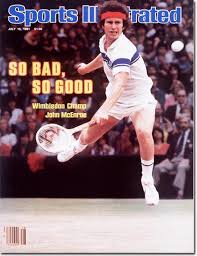
What It Takes, Part 2 -- My (Verbal) Tennis Match With John McEnroe

You know, having a conversation is a lot like playing tennis.  A statement is made from one person to another, then it's responded to, tossed around, back and forth, each person trying to make his or her "point", each trying to "score".  This can be obvious, as in a debate, or it can be subtle, as in a friendly dialogue.  To some people, even saying "hello" can be an attempt at making a score before your opponent does.  That's how it was in the evening of March 13, 1984, when I looked in my rearview mirror and found that John McEnroe was sitting in the back seat of my cab.  

It was the doorman of his high-rise on East End Avenue who'd hailed me and opened the door for him but since I'd been looking down at my trip sheet, filling in the required information, I hadn't yet noticed who my new passenger was.  I simply called out my usual "hello" and awaited the response.  Would this one be friendly, in a big rush, arrogant, a drunk, a serial killer, or what?  McEnroe's response was a hard, direct shot, you might say, to my forehand.

"The Garden," he said.

Now, what was most important here was what wasn't said.  He didn't say "hello" back to me.  He didn't say "please".  He didn't say "Madison Square".  Just "the Garden", as if I automatically knew who he was and which garden he was talking about. It was more of an order than a request and at the same time it tested the ability of the recipient (me) to respond in kind.  An excellent opening -- I didn't yet know who he was, but he'd already scored.  Point, McEnroe.

I looked straight into the rearview mirror, wondering who would be speaking to me this way.  I recognized him immediately and shot back my own gut response:

"McEnroe," I blurted out, showing surprise but no great enthusiasm.

I give myself a point here because: a) I returned his sharp opening with one of my own.  If he had intended to be blunt with no mincing of words, he got the same from me.  b) I didn't show any false respect or false adulation or false friendliness. It was just "McEnroe", not "Mr. McEnroe", or "Oh, John McEnroe!"  Basically I was conveying an attitude that said, Okay, I know who you are, but you're not on a tennis court, buddy, you're sitting in my cab, so don't start up with any of those shenanigans you're famous for.  I can hit your serve.  Point, Salomon.
The Precise Moment of John McEnroe's Fall from Greatness | Mockingbird

His return caught me off guard.  "Yes, it's me," he said, more to himself than to me and barely loud enough to be heard.

Now this was a switch, a complete change of style.  His words could be interpreted as "Yes, the Great One is in your presence," but his tone was self-deprecating.  Here was John McEnroe in person poking fun at John McEnroe the celebrity, actually satirizing himself.  It was an impressive display of flexibility as a conversationalist. Point, McEnroe.

We volleyed as we headed south on East End Avenue.

"Are you playing tonight?" I asked, thinking maybe there was a tennis match at the Garden.  No, he said, he was going to a Knicks game.

"Take the Drive?" I asked.  (Meaning the FDR Drive, the highway that runs along the east side of Manhattan.)

"Yeah, please."

"Who are the Knicks playing tonight?"

"The Suns."

A couple more easy lobs were exchanged with no points scored.

Then, fearing the conversation might peter out for lack of fuel, I changed tempo by employing a technique I've used on other celebrities.  I express my regrets that I'm not all that familiar with their area of expertise (even if I am) because here would be a great opportunity for me to learn something from someone so renown in that field.  Celebrities live lives of annoyance from mundane questions posed by strangers and this may cause them to be reluctant to engage.  So by pleading ignorance (or even pretending you don't recognize them) it has the effect of putting them at ease.

"Too bad I don't really know that much about tennis," I kind-of-lied as I made a left on 79th Street and approached the entrance to the Drive,  "or I might be able to hold down an intelligent conversation here.  I mean, I play a little, but I don't really know the fine points of the game."

Looking in the mirror, I watched his facial expression loosen up just a notch.  I edged into the opening I had created.  "Funny," I said, "I seem to keep getting professional tennis players in my cab."

McEnroe was interested.  "Really?  Who?"

I could feel a big score coming up.  Here was the famous John McEnroe showing an interest in the not-famous me.  To hell with modesty, a surge of what let's call self-importance was rising from within and it felt good.

I told him about a couple of fares I'd had with tennis players whose names I didn't remember.  After talking for half a minute, however, I realized I was getting too chatty and that McEnroe's interest was waning.  So I served him up my big story ("What It Takes, Part 1") about how the previous summer I'd driven Mike Estep, Martina Navratilova's coach, out to a private club in Queens to practice with her; how Mike was such a great guy; how he'd asked me if I'd like to watch them practice; how I'd always wondered if I could return the serve of a pro, so I asked Mike if he'd hit me a few balls when we got there; and how -- isn't this great? -- he did.

McEnroe was all ears.  Not to brag but, really, I had the guy in the palm of my hand.

"Could you hit it?" he asked.

John McEnroe, the number one tennis player in the world, wants to know about my tennis game.  Yes!  Point, Salomon!

"Yeah," I said and, not trying to disguise my pride, I told him how I'd actually been able to get my racquet -- actually, Martina's racquet, ha-ha -- on the ball.  Not with any authority, mind you, but still, after a few serves I was getting my timing down and I could hit it.  Not bad for an amateur, huh?

McEnroe moved forward, a concerned look on his face.

"Who was that again?"

"Mike Estep," said I.

"Oh," he said, and he moved comfortably back in his seat again.  "Well, you know, Mike's never been known for his serve."

Ping!

The little bubble I'd been sitting in for the last seven months came bursting apart and evaporated into the atmosphere.

"Mike's never been known for his serve."

With one quick stroke I'd been reduced to the pathetic little tennis wannabe I actually was.

Point, set, match -- McEnroe.  

Damn!

I made a right and got on the FDR Drive.  Having been so profoundly reduced in stature, I found I could think of nothing to say to McEnroe so I just reverted to my job description as a New York City taxi driver and stepped on the gas.  Soon we were barreling along at 50 miles per hour in the middle lane, and for the next half a minute there continued to be no conversation between us, McEnroe no doubt quietly savoring the conquest of my dignity.  Understandably my mood began taking a turn toward the Dark Side.  What good was living, anyway?  There's always some venomous creature waiting to put its fangs into you just when life seems all zippity-do-dah.  Why continue slogging on with it?  

The idea of an end-it-all-with-a-glorious-bang entered my mind.  I could unfasten my seat belt, pick up speed to about 100 miles per hour, and crash into the stone wall that runs alongside the highway. McEnroe hadn't fastened his own seat belt so he'd probably go flying into the East River. This concept had an element of poetic justice to it which I found very appealing.  Mike's never been known for his serve, huh? We'll see about that.  I moved the cab over into the right lane and started looking for a good place in the wall to crash the cab.
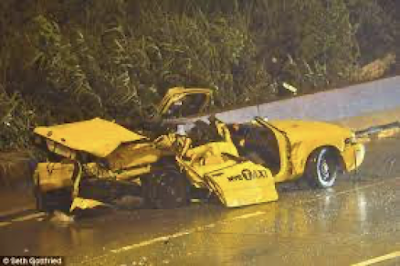


But then, wait.  I reconsidered.

All right, one way of looking at it would be that I had been demolished, even humiliated, by McEnroe. But let's take a step back and delve into this a bit, shall we?  Here's a guy who is ranked NUMBER ONE in the WORLD.  There are MILLIONS of tennis players, ALL OVER THE WORLD.  They play this sport in schools, in colleges, in leagues, in private clubs, or just with friends.  If you're GREAT at it you may actually become a professional and make some kind of a living at it.  But then you're up against all the other players from ALL OVER THE WORLD who are also GREAT. Nevertheless you may become an elite player, rise high in the rankings, and become famous, respected, and wealthy.  But if you're the GREATEST OF THE GREAT -- if you are ranked NUMBER ONE IN THE WORLD -- you will have earned the AWE of both the general public and your own colleagues because NO ONE IN THE WORLD CAN BEAT YOU!  NO ONE!

And yet John McEnroe, the best tennis player in the world, and, some might say, the best tennis player of all time, is concerned that maybe his taxi driver can hit his serve.  But then, oh, it's okay.  It was only Mike Estep.  I'm safe.

Ladies and gentlemen, what we're looking at here is compulsive competitiveness of asylum magnitude and I suppose we're also looking at what it takes to be Number One in tennis and some other sports.  He is surrounded by assassins.  Everyone is a threat.  This is a guy who is one referee's bad call away from being surrounded by men in white coats and whisked off to the happy farm.

No, I decided, I would not crash the cab into the stone wall that runs alongside the FDR Drive.  In an act of considerable magnanimity,  I would let McEnroe live.  I realized he hadn't won the match, he'd only won a set.  So the game was still on.  But what I needed to do here was to clarify for myself what the object of the game we were playing actually was.  

I thought about it.   For him, I realized, it was to shape me into a dutiful listener so he could hear himself pontificate.  But for me, the game, in the time-honored tradition of taxi-driving, was to set my passenger up for giving me a big tip.

I awarded myself a point for this brilliant insight and the match continued.

Easing up on the pedal, I steered the cab back into the center lane.  Our conversation resumed, turning to sports in general -- football, baseball, hockey, basketball.  I began to notice that he'd listen carefully to whatever I had to say, wait just a moment, and then correct me.  My strategy was to listen carefully to him as well, but not to correct him.  For example, when at one point he interjected into the conversation that tennis is the greatest sport that ever was, I didn't contradict him even though everybody knows that baseball is the greatest sport that ever was.  Agreement creates affinity and affinity is crucial in the tipping phase of the ride.  So it could have appeared to an observer that McEnroe was scoring all the points here, but in reality I was holding even with him.

We exited the FDR at 34th Street.  The conversation had turned to boxing and McEnroe was telling me that Larry Holmes, who was then the undefeated heavyweight champion, would soon lose.

"Who'll beat him?" I asked.

"He'll beat himself," McEnroe snapped back.  A return with some real zing to it, especially considering that the person giving it was himself was the champion of the tennis world at that time, and McEnroe received a point for style.

We moved along on 34th Street and as we approached 2nd Avenue McEnroe committed a breach of taxicab etiquette by telling me to turn left and take 31st Street to the Garden.   The offense here is giving simple directions to a professional driver, as if I don't know how to get to Madison Square Garden.  But in this case I let the faux pas pass without comment as it suited my game plan.  The street he chose is actually the slowest way to get to the Garden from the East Side because you'll get a red light at every intersection.  He was adding three minutes to the ride. That's good for the meter but what I liked most was that it was giving me more time to work him for the tip.  Advantage, Salomon.

As we began our crosstown trek on 31st Street McEnroe, perhaps realizing that the end of the ride was approaching, suddenly seized complete control of the conversation and began to preach in earnest about his issues with tennis.  This was good news.  I could be getting taxi-driver-as-therapist money here.


First he hit on the officiating.  His complaint, he said, was that the officials aren't professional officials.  He pointed out that in baseball and football the players get to know the officials on a first-name basis.  In a close call their decisions are respected because the players know they are competent.  But in tennis, he said, you see new faces in every tournament, officials you've never met before.  Trust in their competence isn't given a chance to develop. 


FLASHBACK: John McEnroe calls umpire 'moron' at Queen's Club | Belfast News  Letter


I thought, wow, you know, he makes a good point here, and I awarded him one.  I'd never heard that argument expressed before and it made perfect sense -- of course, a lack of trust in the professionalism of the officials would create problems with the players.  But a few moments later I realized, wait, this is McEnroe's justification for why it's okay to berate officials during a match, as he was so famous for doing.  I took the point away for faking himself out.


Next, he took on the fans.  "New York fans are the worst," he squawked, recalling when he'd played against Vitas Gerulaitis, who was from Queens, in the finals of the U.S. Open in 1979.  What are the odds, he asked, of two guys who are both from Queens ever making it to the finals of the U.S. Open, played in Queens, in the same year?  And the fans?

"They booed both of us!"

Now here McEnroe was clearly committing a foul.  It would be one thing if he had it out for one particular fan or for even a certain type of fan.  But all New York fans? Come on.  I had no choice but to deduct a point for unsportsmanlike conduct.

We arrived at the Garden.  I pulled up to a special side entrance on 31st Street where McEnroe wanted to be dropped off, stopped the cab, and started tallying up the points.  With the penalty point deducted from his score it appeared to be a dead heat.  So... this match was going to be decided by the tip.  The fare on the meter was $5.20.  (This was in 1984. Today that ride would cost around $15.)  A cheap or -- considering it's a celebrity -- even an average tip would force me to conclude that my efforts had been in vain and I would have to concede the match to my opponent.  It would have to be a definitive, excessively generous gratuity to win.

With tension mounting, McEnroe opened his door and stepped out onto the street. He reached into the pocket of his coat and, stepping halfway back into the cab, handed me two bills: a five and a single.  It was going to be an eighty-cent tip, slightly less than average for a $5.20 fare.  I would have to interpret this as a snub, a cheapskate's ace, and give the final point and the match to McEnroe.

But wait!

McEnroe reached into his pocket again.  Out came several more bills which he handed to me with an almost apologetic look on his face.  He closed the door, waved goodbye, and walked toward the Garden, smiling.  I counted the bills.  There were six singles.  So McEnroe had tipped me $6.80 on a $5.20 fare, better than double the meter.  It was the best tip I'd ever received from a celebrity, a record that stood for twelve years.

Point, set, match -- Salomon!


********


Notes:

1. This is the second in a three-part series, "What It Takes".  Stay tuned for Part 3, "McEnroe Returns".

2. I am able to recall the details of a ride taken 34 years ago is because a) it was particularly memorable, and b) I've always kept journals of my most interesting rides.

3. There's a documentary recently released about McEnroe's year, 1984 (the same year he was in my cab), in which he won an incredible 82 out of 85 matches.  To see a clip from In The Realm Of Perfection click below:


4. Click on this one to see a taxi nearly running over McEnroe (from the movie Mr. Deeds):


Monday, April 11, 2016

Harry Belafonte

The great Harry Belafonte and his wife Pamela Frank were passengers in my cab yesterday.  Cheerful and exuberant, he took a minute to oblige my request for a picture.

If you are not familiar with Harry Belafonte, please click on the link above and check out his Wikipedia page.  He has been an inspiration to millions, including myself, since the 1950s, and he continues to be.

Would you believe he is 89 years old?


(Photo by Pamela Frank)


Sunday, September 21, 2014

Running The Gamut, Number Three

One of the great things about driving a taxi in New York City - perhaps the greatest thing - is that on any given day you may run the gamut: that is, you may pick up people who are able representatives of both the top and the bottom of the social spectrum. Your first passenger may be a nun who works for God and your second a street hooker who works for Jake the Snake, her pimp; your third an assistant district attorney and the fourth the guy he’s sending to prison. And so it goes - the parade of humanity enters and exits through your doors. It’s magnificent, really.

(Note: I’ve written two other posts on this subject, “Running The Gamut”, and “Running the Gamut, Number Two”. If you’d like to read them please click here and here.)

So, in this episode of Running the Gamut, we’re going to zero in on a specialized zone of activity in New York City, the world of baseball. For those of you who may live in a part of the planet where baseball is not played, let me fill you in on the basics:

- baseball is the number one sport in the United States. It is played on many levels, but the ultimate goal of any player is to make it to the top level, which is called the Major League.

- the first Major League game was played in 1871.

- there are thirty teams in the Major League, spanning across the country in most of our principal cities. The season goes from April until the end of September, with the three-tiered playoff games continuing until the end of October. The regular season consists of 162 games for each team.

- in New York City there are two baseball teams, the Yankees and the Mets. The Yankees came into existence in 1903 and have long been the premiere team of the sport. Many of baseball’s iconic players (such as Babe Ruth, Joe DiMaggio, and Mickey Mantle) were Yankees. They have won 27 championships, far more than any other franchise. Their home is Yankee Stadium in the Bronx. The Mets have been around since 1962. They have won two championships in their 52 years. They play in Citi Field in Queens.

On August 7th, a Thursday, I started my shift at 5:30 pm, as I normally do. My first passengers were two ladies - one middle-aged, the other a twenty-something - going from Columbus Circle down to Penn Station. They were both wearing the pinstriped jerseys of the Yankees - the familiar, interlocking “NY” on the front and, I noticed, the number 2 on the backs of both of them. The Yankees had played a game that afternoon so I knew without even needing to ask where they were coming from. A conversation began.

Yes, they told me, they’d been at the game, adding that there was some kind of delay on the subway, which was why they were in my cab - and they had only twenty minutes to catch a train to New Jersey. Could we make it? I told them to relax, I’d get them to Penn Station on time. And we were on our way.

I soon discovered that they were mother and daughter, both big Yankee fans, that they go to at least one Yankee game together every year (“it’s a tradition”), that the game they’d just attended was the only game for them this year, and that, hooray, the Yankees had won. Still, the mother said, they were “greatly disappointed”.

“Why?” I asked (of course). I mean, the Yankees won, you’re supposed to be happy.

“Because Jeter didn’t play!” they both answered, almost in unison.

“Oh, gee, that’s too bad,” I said, completely understanding their dismay.

Again, for the benefit of those readers who may not know baseball, allow me to tell you why this fellow named Jeter not playing in that game would be such a letdown to my passengers. Derek Jeter has been a star player - the captain of the team, actually - for the Yankees for the last twenty years. During his tenure the Yankees have won five championships and gone to the playoffs 17 times. On a personal level he has broken so many statistical records that they seem endless. He ranks sixth on the all-time hits list. (That means that, going back to 1871, only five players have had more hits than he.) And off the field he has been the very epitome of what we would hope a star athlete to be. Hard-working, generous, respectful, always upbeat, never involved in a controversy, never a bad word said against him - he is truly a role model not only for America’s youth, but for everybody. All around the country he is regarded as the “face of baseball”. People are naming their children (and their pets) after him. And now, at the age of 40, he has announced that this season will be his last. Fans of opposing teams are crowding into their own stadiums to get one last look at him when the Yankees come to town and are giving him standing ovations when he comes to bat. He is the superstar of the world of baseball.

So this was why my passengers were so disappointed even though the Yankees won the game. Being devoted Yankee fans and fans of Jeter in particular - the number 2 on their jerseys is his number - they, too, had wanted to see him play one last time. But, alas, he’d been given the day off, something that happens from time to time during the course of the long, long season.

Nevertheless, my passengers were in good spirits as we approached the entrance to Penn Station at 34th Street and 7th Avenue, despite the presence above us of a gigantic Nike billboard featuring a thirty-foot image of Derek Jeter acknowledging the adoration of his fans.

“Re2pect” was the only text accompanying the image.


As mother and daughter left my cab with smiles on their faces and five minutes to spare, my eyes wandered to the shop directly on my right. It was a Modell’s Sporting Goods store, one of many in the city, where they sell mostly apparel for fans. The entire window displayed t-shirts, jerseys, hats, buttons, and every other imaginable form of commemoration featuring, guess who?


Yes, it has been a Derek Jeter year in New York City, if not the entire country. “We need our heroes,” I thought, as I pulled out into the quagmire of traffic on 7th Avenue. And indeed we do. In this age of super-cynicism, is it not something of importance to have a counterbalance to the liars, the cheats, the pretenders, and the thieves who show up for a free meal at every opportunity? It is important. Let the good guys win every once in a while.

I slogged along in the evening rush for the next few hours. At 6:50 three out-of-towners went from 77th and York down to the Astor Place Theatre in the East Village to see Blue Man Group, a nice twenty-dollar run on the FDR Drive. Then there was a short ride over to Alphabet City. On my next one, from the Bowery down to the intersection of Allen and Chrystie, I found myself sitting in a bumper to bumper jam-up on 2nd Avenue. Looking around at the environment, I noticed one of those gigantic double-decker tourist buses just to the left of me which was decorated with - well, will you look who’s here again? - fifteen-foot-high Derek Jeter action images on all sides. “Jesus,” I thought, “this guy is everywhere.”

The next few fares took me to the West Village, up again to the Upper East Side, down to 60th and 5th, and then, at 8:30, to 22nd and 8th in Chelsea. 8:30 is around the time for my ritualistic coffee break, so I parked at 6th Avenue, went into the Starbucks at the corner, got my tall Pike (no room for milk), returned to the cab, dug through my bag to retrieve my carrot muffin sliced into bite-sized pieces the night before, and began munching away in happiness. Ah, that feeling of the hot coffee meeting the muffin… bliss.

Okay, back to work. My next fare was a chatty fellow going from the popular Eataly restaurant and market on 23rd and 5th all the way up to 157th and St. Nicholas Avenue in Harlem - $28.50 on the meter and a $5 tip - a great ride. After that it was 73rd and Columbus down to 15th and 5th, followed by 14th and 4th down to Gold Street in the Financial District. The night was wearing on, and I was doing pretty well, both in spirit and in money.

At 11:12 a twenty-something woman beat out another twenty-something woman in a rush to get to my cab at 27th and Park - it can get quite busy in certain sections of Manhattan at around that time on a Thursday night - and directed me to drive to LaGuardia Place and Houston Street on the southern boundary of Greenwich Village. When I arrived there eight minutes later I pulled over on Houston at the intersection but had to wait a bit for her to swipe her credit card - it took several swipes to register - and then to gather her stuff together and open the door. As she did so a particularly attractive young lady standing a short distance away noticed that my cab was becoming available and began moving quickly toward me with her hand in the air. Seeing the hail, I remained at the curb instead of pulling out onto the street. She hustled up, opened the door, got in, and said, “Someone else is coming”, with a concerned look on her face. About five seconds went by until the person we were waiting for came jogging toward the cab, being pursued by three or four shouting females who were basically begging him to pose for a picture with them. He stopped at the opened door of my taxi and stood with the girls for a few moments, flashing a very familiar smile while they snapped away and thanked him profusely.

And then Derek Jeter got into my cab.

“It’s number 2,” I said, sort of half to myself and half to them, and a bit in shock.

“Hiya buddy,” said Derek Jeter.

“I can’t get away from you!” I exclaimed (in jest).

“I’m following you, buddy!” Derek replied, smiling.

Their destination was a street in the West Village, so this was to be a short ride, only five minutes or so. Immediately I knew I had a problem, and a sort of panic set in. Derek Jeter has descended upon my cab from outer space and is all mine for five minutes. I knew from his friendliness upon entering that he would be open to conversation - but what should I talk to him about? One thing I’ve learned about major celebrities is that you try not to talk to them about the thing for which they’re famous. When I had Paul Simon in my cab, for instance, did I speak a word to him about his music? No. We had a memorable conversation about baseball, actually. (That story is in my book, by the way.) So here was the Crown Prince of Baseball sitting in my cab. If not baseball, what should the topic be? The answer hit me with the impact of a Randy Johnson fastball.

I had heard several months ago what Derek plans to do after he retires from baseball and, when I heard it, it really grabbed my attention. It’s not what you would expect. You’d think it would be broadcasting, managing a baseball team, or even becoming the owner of one. Something along those lines. But no. He plans to publish books. Derek Jeter, book publisher - doesn’t that open up a side to him we never knew existed? Amazing. So our five minutes together were spent primarily discussing books.

Out of respect - or should I say “re2pect” - for the confidentiality of a private conversation, I will not say more than that. But I will say this:

1. One of the fears some people have upon meeting a celebrity they’ve admired from a distance for many years is that the guy or gal will turn out to be a jerk in person. There should be no such fear regarding Derek Jeter. He wears it well, as was said of Jackie Kennedy. Derek Jeter is a nice guy, a caring person. There’s a kind of goodness that radiates from him.

2. Many people, when I tell them I had a certain celebrity in my cab, want to know about the tip. “How much did he tip you?” they ask. Well, I won’t say that, either, but I will say that Derek has surpassed Leonardo di Caprio as the best celebrity tipper I’ve ever had in my cab, a mark that had stood for 18 years. (That story’s in my book, too.) So there’s another record broken by Derek Jeter!

3. He likes to call you “buddy”. Aside from how he greeted me, I’ve heard this as well from a couple of different sources. Apparently everyone is Derek’s buddy. With this in mind, I found a fantasy had elbowed its way into my universe…


Derek Jeter At The Pearly Gates

There had been much excitement when the word spread around Heaven that Derek Jeter would be arriving the next day. Angels, spirits, and souls of all types left their clouds at the break of dawn to ensure they would be there in time to catch a glimpse of the Face of Baseball and give him a warm, heavenly welcome. At the appointed hour, amid a chorus of trumpets and harps, Derek arrived at the Pearly Gates and was greeted with great joy by none other than Saint Peter himself. After the speeches were over and a choir of children sang “Take Me Out To The Ball Game”, Saint Peter pulled Derek over to the side and said, “Come with me, Derek, there’s someone I’d like you to meet.” At once the clouds parted, thunder roared, and Derek found that he was standing alone with his host in some kind of divine baseball field. A bright figure appeared from the dugout and floated toward them. “Derek,” whispered Saint Peter, “I’d like you to meet... God.”

God: “Derek Jeter! What a pleasure to meet you at last!”

Derek: “Hiya buddy, how ya doin'?”

God and Derek exchanged pleasantries for a couple of minutes until an angel suddenly appeared to escort Derek to his next engagement and drove him off in a golf cart.

“Wow,” Saint Peter said to God as they disappeared from sight, “Derek Jeter!”

“Look,” said God, beaming - “I got his autograph!”


And so did I - on my trip sheet…


Back to work, I must admit I was on Cloud Nine. My Derek Jeter experience had elevated my emotional tone up to a steady flow of enthusiasm which carried over to the rest of the passengers in my cab for the remainder of the shift. Each new arrival soon learned that, “Hey, guess who I had in my cab just a little while ago? Derek Jeter!” What amazed me, however - and this is such a New York City phenomenon - was that of the eight more fares who rode with me until I quit at four in the morning, half of them had never heard of him!

A pleasant thirtyish woman in Brooklyn, going from Grand Street in Williamsburg to Dean Street in Crown Heights, was happy that I was happy, but she was from Germany - no baseball. A fellow coming from a gay club in Hell’s Kitchen en route to Astoria thought it was interesting, but he was from Indonesia - no baseball. A kid who was actually wearing a Yankee cap took me from 73rd and 5th Avenue down to the Lower East Side and barely grunted in reaction to my Jeter announcement, but he was from the Twilight Zone - no baseball. And then, to top it off, I had a young lady from Japan, where the entire country is addicted to baseball, admit to me that she didn’t know who Jeter was, although she did know who Matsui and Ichiro are, Japanese stars who have both played on the Yankees.

“I am sorry,” she said, “I’m a street performer and I’m drunk!”

Well, that’s New York City for you. A city so huge and so diverse - bursting at the seams with all kinds of people from every corner of the world - that such a thing could be possible. If a superstar of baseball had played for twenty years on a team in any other city in the country it would be inconceivable that virtually anyone living in that city would not know him well. But in New York this can be so.

So I had run the gamut of the world of baseball, from the adoring mother and daughter who were so disappointed because they didn’t get to see Jeter play, to the object of their affection himself. Imagine if they’d stowed away in the rear compartment of the taxi - merely six hours later they could have met him in person! I wish I knew who they were so I could tell them that! But it was my very last passenger who made me realize that I had also run a gamut of another kind.

I was driving up Amsterdam Avenue just a few minutes before four o’clock, en route to a gas station at Broadway and 130th Street, when I spotted a figure in the shadows about a block ahead at 113th Street who apparently was trying to hail me. As I got closer I could see that he was crouched over a walker, appeared to be in pain or at least in some discomfort, and that the entrance to the emergency room of St. Luke’s Hospital was just down the street. I pulled over and stopped.

He was a gaunt man, quite small, I think Hispanic, and I judged him to be about 40 years old. He thanked me for stopping - there aren’t many taxis around at this hour - and asked if I could help him get into the cab. He was quite frail, barely able to lift his leg high enough to make it into the rear compartment, and was, in fact, coming from St. Luke’s. Taking care that he didn’t slip and fall, I held his arm and guided him in, then placed his walker in the back. As we drove off he told me about his condition, a spinal injury which had left him crippled. I sensed no self-pity or blame, it was just the way it was and he was carrying on. His destination was a mere seven blocks up the road to a project complex at La Salle Street. When we got there he paid me the $5.50 fare in cash, no tip, and asked for a receipt, so he could be reimbursed. He put the receipt in his pocket and we began the reverse process of extricating him from the taxi. That took a minute and then he thanked me for my help and began moving toward his building in his walker, an inch at a time.

I was done for the night and drove a few blocks over to Broadway and the gas station. After filling up, I had some time to reflect on the events of the evening, particularly this last ride. That frail man had sat in the same seat where Derek Jeter had been sitting only a few hours earlier. Both were about the same age. Aside from his fame and charisma, Jeter is a physical specimen, taller and more impressive in person than I had realized. If you had no idea who he was and saw him walking down the street, you might well have thought he could be a professional athlete. My last passenger, by contrast, was at the bottom of that scale.

New York, the City of the Human Condition.

We carry on.


Tuesday, August 12, 2014

Come On Back

Why rushest thou so, Robin Williams?

Come on back.

I am hereby requesting an encore of the Frances McDormand you did for me.

And it would only be polite on your part to give me an opportunity to thank you... for the kindness behind your words.

Why rushest thou so?

We loved you - didn't you know?

Come back.

Robin Williams was in my cab on September 7, 2008.  I'm proud to say that twenty minutes of his life were spent with me. The story of that ride can be found in the post called "Feathers In My Bald Spot", Sept. '08 in the archives.

Thursday, October 18, 2012

Speed Of Particle Flow

I had a little episode a few nights ago that could serve as a model for the efficiency that is possible in today's world.  The chronology went something like this...

11:41 p.m. - I pick up two ladies, one a twenty-something, the other middle-aged, coming out of the Mark Hotel on East 77th Street.  They tell me they will have two stops, the first on Central Park South.  As we head downtown on 5th Avenue, I can tell from their conversation that they are business colleagues.

11:46 p.m. - The older woman gets out across the street from her hotel on CPS.  I'm told that the next stop will be the Marriott Marquis Hotel in Times Square.  "Do you know where that is?" the twenty-something asks, demonstrating that she is an out-of-towner.  Any cabbie would be familiar with the gigantic Marquis.  "Sure," I reply, unoffended.

11:47 p.m. - We stop at a red light at 7th Avenue.  Looking at her in the mirror, she seems friendly so I decide to liven up the ride by making an out of the blue comment to her.  "Do you see that building on the left?" I ask, indicating the stately New York Athletic Club. 

"Yes," says she. 

"You know the Christmas song 'Santa Claus Is Coming To Town'?"

"Yeah."

"Thirty years ago I brought the man who wrote that song to that building."

Her eyes widened.  "Really!  Wow!"

Bingo, we were off to the races.  I tell her my J. Fred Coots story as we make the left onto 7th Avenue and proceed toward the Marquis on 45th Street.

11:50 p.m. - As we wait at the red light at the special right-turn-only lane at 45th Street, she asks me what time the stores close tomorrow, a Wednesday - she's catching a plane in the morning and wonders if there'll be enough time to do some shopping.  I tell her I think the stores open at 10, but caution that I can't be sure because I haven't seen that hour of the day for years since I drive the night shift and sleep in the morning.  In fact, I add, I'm not even sure that there actually is a ten o'clock in the morning, a little joke.  She smiles.

11:52 p.m. -  We pull up beside the Marquis on 45th.  Somehow the conversation has meandered onto the subject of what the odds would be of getting a passenger twice in a cab in New York City.  I wind up telling her a story about having had a Major League baseball player from the California Angels in my cab twice in two successive years.  This then leads into a related story about how the only way to have an advantage when betting on baseball is to have some inside information about particular circumstances that could affect the outcome of a game, and that these two rides had provided me with just that.  She appears to be fascinated.

11:54 p.m. - The conversation finally comes to an end.  She pays the $11.00 fare with a credit card, adding a $3.30 tip, then smiles, leaves the taxi, and disappears into the hotel.  I drive off down 45th Street toward 8th Avenue, looking for my next passenger.

11:56 p.m. - Not finding anyone after driving up 8th for ten blocks, I decide to take a break as it is almost midnight and that is routinely when I stop and eat.  I make a few turns and wind up on 59th Street between 10th and 11th Avenues, a quiet block where I won't be disturbed. 

11:58 p.m. - Stepping out of my cab, I continue my routine by opening the back door to search for any debris left by passengers and, whoa, sitting on the seat is an iPhone.  I pick it up and bring it to the front for examination.  I find two things, one good and one bad.  The good is that it is not locked.  The bad is that it says it's down to only ten percent of its charge remaining, which means that if its owner doesn't call me soon, the phone will loose its charge and will likely never be able to be returned.  However, since it's not locked I am able to open the address book and look for the name of the person, I have learned from experience, who is the single best person to call for help.  And that person's name is "Mom". 

12:00 a.m. - I scroll and find Mom.  I call Mom.  The call is immediately answered because Mom thinks her daughter or son is calling.  "Hi, honey," says Mom.  I explain that I'm not honey, I'm a taxi driver in New York City who has just found this iPhone on the back seat.  She thanks me for calling, mentions that she is in Ohio, and tells me it belongs to her daughter.  I tell her the iPhone is nearly out of charge and that I'd like to leave my own cell phone number with her so that in case I'm not able to make contact with her daughter she will still have a way of reaching me after the next time she talks to you.  I give Mom my number, who then says that if she knew what hotel her daughter was staying at, she would call her herself to give her my number.  I tell her that it's likely her daughter was my last passenger and that she's staying at the Marriott Marquis hotel in Times Square.  Mom thanks me again and gets off the line.

12:03 a.m. - I am munching on my grilled chicken and whole wheat bread while adding up the money numbers thus far into the shift .  My cell phone rings.  It is my last passenger calling me from the Marquis.  I tell her I'll be there in ten minutes.

12:11 a.m. - I arrive back at the Marquis.  After a minute of waiting, my relieved former passenger approaches on the sidewalk and is reunited with her precious iPhone, which, in today's world, pretty much contains her life within it.  She thanks me profusely and offers me a twenty dollar bill as her way of showing her gratitude.  Thinking it would be noble to refuse the reward, upon seeing the bill coming toward me I accept it anyway, thinking it's important for a person's self-esteem to be able to keep their exchange in.  We chat for a minute and go our separate ways.  I stuff the bill in my shirt.          

To think that all of this - from picking up a passenger at the Mark Hotel, to having an extended and enoyable conversation with that passenger, to contacting her mother halfway across the country in the middle of the night, to reuniting the passenger with a lost possession - all of this took place within half an hour. 

Amazing.

What a world we live in today.

Monday, April 30, 2012

Mister Hess

Well, speaking of the Hess Station at 45th and 10th, here's one from the vault. I've written a couple of times about one of the unique aspects of driving a cab in New York City, the phenomenon of finding yourself suddenly mingling with various strata of the human race with whom you otherwise would probably never have had the opportunity to be in contact.
(See "Running The Gamut". And "Running The Gamut, Part 2" .)

That's what happened during the rush hour one evening in December of 1990. I picked up three men in business attire - suits and overcoats - on the west side of Midtown who wanted to go to a restaurant across town, a ten to fifteen minute haul, depending on traffic. Two of them got in the back and the other, a somewhat older gentleman, perhaps in his '70s, sat up front with me. I owned my own cab in those days and it had no partition (I hate them), so it made for a more comfortable fit for the three of them to seat themselves this way. The two in the rear could move around easily and the lack of a Plexiglas obstruction made conversation from front to back no problem for all three of them.

As the ride got under way, they continued a conversation which had already been in progress before entering the cab. I, a professional fly on the wall, took note that what they were talking about was how the situation in Iraq was affecting the price of oil. Clouds of war were in the air in those days. Sadaam had already invaded Kuwait, the international coalition had been formed, and a deadline for withdrawal had been sanctioned by the U.N. In retrospect I wish I'd paid more attention to exactly what they were saying, but at the moment I thought they were just three businessmen discussing what was currently in the news. I tuned them out and put my attention back on the observation of the particles in perpetual motion on the streets and sidewalks of New York City.

After a couple of minutes, however, my contemplation was interrupted by the gentleman to my right.

"Hey, driver," he said, "what kind of gasoline do you put in your cab?"

"Amoco, usually," I replied.

"Do you ever use Hess?"

"Sometimes."

"Do you know that station on 45th and 10th?"

"Sure."

"Are you happy with the service you get over there?"

"Yeah, I guess."

"Tell me something - are the bathrooms clean?"

I noticed in the mirror that the two fellows in the back had big grins on their faces and were suppressing laughter. I knew something was up and needed no further prompting to turn the tables on them.

"All right," I said with a smile of my own, "that's it... which one of you guys is Leon Hess?"

The older gentleman sitting beside me reached over and shook my hand. He was, in fact, Leon Hess, the founder and owner of Hess Oil and, no less impressive, the owner of the New York Jets football team. It was understandable that I hadn't recognized him. Unlike some owners of professional sports teams, Leon Hess never gave interviews and was quite low profile when it came to the media. You never saw a picture of him in the papers.

Having had his identity revealed, which was no doubt his intention, the subject turned immediately to the Jets. I admitted to Mr. Hess right away that wasn't much of a football fan, that baseball was my sport, but that didn't deter him. I think I became for him "The Fan", at least for the moment, and he went into a digression about the current situation in Jets World. The team had been particularly horrible that year and although there were still a couple of weeks left in the regular season, they were already out of contention for making the playoffs. Mr. Hess told me with some anguish that he'd just fired the coach.

"I hated to do it," he exclaimed, "he's a good man. But it's my responsibility to do whatever I can to put a winning team on the field."

He told me he'd been at Giants Stadium the previous Sunday to watch the other New York football team, the Giants, play the Dallas Cowboys in below-freezing temperatures. Although the weather was brutal, he said the stadium had been full. He contrasted that with the fact that his own team had only been filling half the seats in the same stadium for the last few home games due to their losing ways.

"It's not the fans' fault," he said, "Jets fans are the best in the world. It's up to me not to let them down."

I wished I'd been more of a football fan so I could have held my own in conversation with him and I kind of apologized for being so much on the periphery of the sport. It was too bad my friend Harry wasn't here, I told him, because Harry was a guy who probably knows as much about the Jets as he did. Harry was a sports fanatic who could tell you the names of every position player on the team for the last ten years.

"Say hello to Harry for me," Mr. Hess said with a smile as he and his friends got out at a swanky-looking restaurant.

He paid me double the meter, something I appreciated more for its acknowledgement implication than its monetary value. And I noticed that he had not fastened his seat belt even though he was sitting up front seat with me. A sign of trust, I thought, that I also appreciated.

I've had many years to reflect on that ride. It left me with a first-hand experience with, as mentioned, a type of person with whom I might otherwise have never come into contact. Here was Leon Hess, a lion of American business, probably a billionaire, giving me fifteen minutes to form an impression of how someone in his station in life might be. And the impression was quite a favorable one.

Was he aloof?

No, to the contrary.

Was he friendly and conversational?

Quite so.

Did he show any of the social class snobbery, the "I'm over here and you're over there" attitude of people who feel cab drivers are beneath them?

Not at all.

Did he, in fact, demonstrate that most admirable of characteristics, caring?

In a big way, not only when he spoke of his football team and its fans, but when he spoke of his oil company and its customers.

You know, there's no data better than first-hand data. When you've seen something with your own eyes, it doesn't much matter what you read in the papers or hear other people say about that with which you've had personal contact. You know. I can't say that because Mr. Hess made a favorable impression on me that all people at the pinnacle of Big Business are nice guys. But because of this ride I also can't fall into the easy assumption that you've got to be a rat to rise to the top.

And that's one of those little nuggets of wisdom one picks up along the way.


********


Along with this, of course: click here for Pictures From A Taxi.

Thursday, May 26, 2011

Celebrity Look-Alikes

Has anyone ever told you that you look like a certain celebrity?

Over many years of taxi-driving, I have found this question popping up from time to time between myself and various passengers. It, like the question posed in my last post - "Have you ever met or known of anyone with the same first and last name as your own?" - is a sure-fire conversation spark plug. Really, it never fails to get a response. By actual survey, I've found that the majority of people say "yes" to that question when asked. And then they'll tell me which celebrity it is and I'll usually see a vague resemblance. ("Ah, yes, you both have two eyes and a nose!")

But sometimes the passenger really is a celebrity look-alike. Many years ago (before he died) I had a man in my cab who was a dead ringer for Henry Fonda. This fellow looked so much like Henry Fonda that I thought he was Henry Fonda.

"Uh, are you Henry Fonda?" I asked, figuring the straightforward was the best approach.

"Nope," he said with a smile, "just look like him."

I still wasn't sure. Maybe this was the real Henry Fonda's way of avoiding annoying people. Only after a few more back and forths was I able to discern that, indeed, my passenger was not Henry Fonda. Then he told me a story about a time he'd played in a charity golf tournament in which Henry Fonda himself was a participant. With great pleasure in the recollection, he remembered the reactions of all the people who saw him there and had no questions in their minds that he was the actual item. What an opportunity for the accidental wannabe.

Another time I had a young man in my cab who told me he made his living as Michael J. Fox's body double. Seeing him close-up, you would not have mistaken him for Michael J. Fox. The face was similar, but not convincingly so. However, his height, weight, bone structure, hairline, and hair color were identical. His job was to stand in for the star when only long-distance shots were on the schedule. This enabled the real Michael J. Fox to not have to show up on the set that day so he could do other things. What a gig!

It can also happen that the person you thought bore a resemblance to a certain celebrity turns out to actually be that celebrity! One night I picked up a man coming out of a bar on the Upper West Side who was wearing a skullcap that covered most of his head. He told me he wanted to go to a building on Central Park West, just a few blocks away, and asked if I could wait for him for a few minutes while he went inside, explaining that it was his daughter's birthday and he wanted to drop off a present.

Not a problem. He made his delivery and, upon returning to the back seat, took off his hat. Suddenly his appearance caught my attention.

"Say, do people ever tell you that you look like James Taylor?" I asked.

"Yeah, it happens all the time," he replied, "...I am James Taylor."

I looked at him more closely in the mirror. Goddamn, it was James Taylor!

"Oh. Hi, J.T.," I said.

And then I drove him back to the bar.

It is not always me who brings up this subject of celebrity look-alikes. I have often been told by passengers on their own origination that they think I look like such and such a famous person. Going back to the late '70s, when I started driving, and throughout the '80s, I was frequently told that I bore a resemblance to three celebrities in particular: Dick Cavett (an American talk-show host who peaked in popularity in the '70s); Chevy Chase (the comic actor); and Richard Dreyfuss (the movie star). Of the three, the only one I myself could see a resemblance to was Chevy Chase, particularly from certain angles. In fact, a couple of times people on the street approached me thinking I was Chevy Chase, which gave me a little vicarious thrill. However, as years went by and the aging process affected Chevy and me differently, the similarities kind of mutated and disappeared. Now I have to settle for the occasional half-blind passenger telling me I look like Dustin Hoffman or Woody Allen, neither of whom I look anything like, at all.

Now, to jump back to Karma Versus Coincidence again, what are the odds of this happening? Of the three celebrities I just mentioned whom I'd often been told that I resemble, two them - Dick Cavett and Richard Dreyfuss - eventually became passengers in my cab. What are the odds against that? A million to one? A hundred million zillion to one? But it did happen. And in both cases it gave me an opportunity which I think anyone who's ever been told that they look like a celebrity would love to have: the chance to ask the celebrity what he thinks.

Dick Cavett was first, in the autumn of 1980. He and his wife, Carrie Nye, hailed me as they emerged from a rear entrance to Lincoln Center on Amsterdam Avenue, and jumped in. I recognized him immediately and greeted him with a smile.

"Dick Cavett," I said cheerfully, "hi!"

I've had over a hundred celebrities in my cab over the years, most of them more famous than Dick Cavett, but his response to my greeting put him in a special celebrity category that is his alone: "Snob".

"79th and Park," he replied.

No return of my greeting, no show of being glad to be recognized, no smile, no "hello". Just "79th and Park". No "please", either.

Ouch.

Well, the nuance of his response was clear to even the oft-obtuse me. He was not allowing for the temporary equality of stature between taxi driver and passenger which - it may surprise you - is usually the case with very famous and influential people. (Read my Robin Williams story, for an example.) Instead, he had erected a little wall which said, "I'm on this side, you're on that side. Stay where you are."

Having been put in my place, I drove toward his destination without any attempt at conversation. I was heading for the Central Park transverse at 81st Street when a request came forth from the back seat to make a stop at a building on 83rd and Central Park West and wait there for a minute or two.

Sure.

I navigated the route and pulled up to the apartment house there in two minutes' time. Dick Cavett got out and scurried off into the building, leaving his wife behind with me. Rather than sit there in an uncomfortable silence, I attempted some small talk with her and found her to be a pleasant and conversational person. Perhaps that loosened me up a bit, as when her husband returned to the cab a couple of minutes later, I felt comfortable enough to pose the question to him that had been on my mind all the while.

"Mister Cavett," I said (he is the only celebrity I've ever felt that I needed to address as "mister"), "I have been told by people from time to time that they think I look like you. Do people ever tell you that they think you look like me?"

To his credit, Dick Cavett (who made his living as a quick-thinking wit) was right on it. He looked over at my name on my hack license and said, "Yes, as a matter of fact, I was having lunch with Greta Garbo just the other day and she mentioned to me that I look like that taxi driver, Eugene Salomon."

This was very funny because, in case you didn't know about Greta Garbo, she was a big movie star in the '30s who quit the movie business, retired to New York City, and never gave an interview again in her life. So it was a talk-show host's ultimate wet dream to ever be able to have a meeting with her, as she was so completely unobtainable.

I never did get Dick Cavett's opinion as to whether or not he thought I looked like him, but by this time it didn't matter to me. I was happy enough just to get any reaction at all, so I left it at that.

Richard Dreyfuss, on the other hand, was a piece of cake. As is usually the case with big-name celebrities, he was friendly, courteous, and very easy to talk to. I picked him up in the Theater District, where he was doing a Broadway show, and drove him to the Upper West Side where, he said, he was going to go shopping for a new watch. We chatted it up all the way to his destination on Columbus Avenue and then, just as he was about to get out, I hit him with my big question.
Turning around in my seat so he could easily see my face, I said this:

"I've often been told by passengers that they think I look like you. Do you think I look like you?"
He studied me carefully for a few moments before rendering judgement. I turned a bit from side to side and changed the expression on my face to give him more to work with, the tension mounting. Finally, he spoke.

"Hmmm..." he said, "no... but you've got a Richard Dreyfuss attitude."

And I've been a fan ever since!


********


Hey, buddy, can you spare a click? Put it here for Pictures From A Taxi.

Monday, August 23, 2010

Running The Gamut, Number Two

I wrote in a previous post (Running The Gamut) that one of the spectacular things about driving a cab in New York City is that on any given night it is possible to encounter passengers from the very top of the social spectrum all the way down to the very bottom. People - who can be so different from one another that they might as well be from other planets - make their entrances and exits in what could be described as a microcosmic parade of the human condition. It's vaudeville on wheels, and it can be quite a show.

Not long ago I had one of those nights that tap danced on the treetops and then slopped around in a puddle of mud. It dined at le Cirque, only to stretch its arm into a garbage can to scoop out a half-eaten slice of Ray's pizza. It was a warm bed in the Waldorf, then a cardboard box on the steps of the 5th Avenue Presbyterian Church.

You get the idea.

Let's start at the top.

On the evening of May 4th, a Tuesday, I found out that Time Magazine puts out an issue every year in which they announce the "100 Most Influential People In The World".

They divide their 100 into four categories:

1) Leaders

2) Artists

3) Thinkers

4) Heroes.

An essay is written about each person by another prominent person to make it even more interesting. The article about Bill Clinton, for example, was written by Bono. The one about Prince was written by Usher. The one about Oprah Winfrey was written by Phil Donohue.

I'm not particularly a reader of Time Magazine, so the reason I found out about this issue at all was a unique one. It turns out they have a big event to go along with the annual publication which is held, appropriately enough, in the Time Warner Building at Columbus Circle. It's a red carpet affair, of course, and guess where the red carpet ends? In a taxi stand right in the middle of the circle, that's where.

So when I was brought into the area by a passenger at 11:40 p.m., I noticed there was something going on and quickly secured a position on the taxi cue. Paparazzi were milling about, always a good sign, and a contingent of onlookers held their ground on both sides of velvet ropes that extended all the way from the curb to the entrance of the building, a distance of about thirty yards. What or whom these people were waiting to see I did not yet know, but my interest in the event itself was secondary. What interested me most was the extra business I could get at a time of the night when passengers start to become less plentiful. This was going to be money found, kind of like discovering a five-dollar bill smiling up at you from the sidewalk.

The taxi line moved quickly. Within five minutes I welcomed my next fare aboard - two gentlemen wearing tuxedos, one of whom sat up front with me, and two ladies all decked out in evening gowns. Obviously they were coming from this event, whatever it was, and, just as obviously, they were in great spirits. As we began driving toward their first destination, 40th and 9th, my curiosity kicked in and I slipped in some questions during slight pauses in their own conversations. It went something like this...

"So, what's going on at the Time Warner Building?" I asked the man sitting next to me.
He told me about Time's 100 Most Influential thing. I was impressed.

"Wow! There must have been a lot of celebrities, huh? I saw the paparazzi outside the building."

"Oh, lots of them," he replied.

"Any big names?"

"Elton John."

"Wow!"

"Sarah Palin."

"Wow!"

"Bill Clinton."

"Wow, Bill Clinton's in there? How's he looking?"

"He looks good! And he gave a great speech."

"You know, say what you will about Bill Clinton's politics or his personal life, but no one can deny he's one of the great orators of our time."

"He is, it's true."

"So what was your end of the deal?"

"Well, the gentleman in the back, and myself, were two of the people being honored."

"You mean, you are two of the most influential people in the world?"

"Well, I don't know about that, but that's what Time Magazine seems to think."

I was stunned. I would have thought that anyone who could be given such an honor would either be so famous that they'd be instantly recognizable or would be driven around in a luxurious private car with their own chauffeur. The four people in my taxi, I had assumed, were probably involved with the production of the event in some way, or perhaps had been invited guests.
My next question was the obvious one:

"So... who are you?"

The gentleman on my right introduced himself as Dr. Douglas Schwartzentruber and the gentleman in the back seat, he told me, was Chetan Bhagat. The ladies were their wives. The reason Time Magazine chose them was because Dr. Schwartzentruber is a pioneer in developing a vaccine that can treat certain types of cancers and Chetan Bhagat is India's most popular author.

As a taxi driver in New York City I'm sure I often have passengers in my cab who are truly Very Important People within their own spheres of influence, but it is rare that I actually get to know who they are. And it is never that I get them at a time when they've just been bestowed with an acknowledgment on so grand a scale. So I was aware of how special this moment was not only for them, but for me as well.

We drove down 9th Avenue in a taxi full of happy chatter. The afterglow of their evening was filling the cab with an energy that was rubbing off on me. It was that floating feeling you get sometimes during a perfect ride.

The organizers of the event had given the attendees souvenirs of several copies each of that issue of Time Magazine. Dr. Schwartzentruber gave me one to keep. After thanking him for this gift, I asked him and Mr. Bhagat to sign it for me. In all my 32 years of taxi-driving, and after having had well over a hundred celebrities in my cab, it was only the second time I had ever requested an autograph. The other time had been back in the '90s when I had Tori Spelling, then starring in the hit TV show Beverly Hills 90210, in the back seat, and the only reason I'd asked her was to impress Suzy, my teen aged daughter (who failed to be impressed - of course).


What's funny here is that Dr. Schwartzentruber, in order to help me find him in the magazine, wrote "heroes" after his name, but after looking him up I discovered that they had actually put him in the category of "thinkers". Not that it matters, of course - no doubt he's a hero as well. Chetan Bhagat's signature came out kind of illegibly (maybe he should be a doctor!), so he kindly printed his name under it, again so I'd be able to find him in the magazine.

As we arrived at 40th and 9th, the location of the Bhagats' hotel, it was interesting to overhear their conversation as they parted ways. Mr. Bhagat handed his card to the Schwartzentrubers and invited them to stay at his home in Mumbai if they were ever in that part of the world. And then he said this:

"I don't belong on the same stage with you."

I repeat this not in any way to diminish the work of Mr. Bhagat. In fact, as a writer myself, I find having someone of his stature in my cab to be a bit intimidating. I repeat this because I think he was correctly sizing up the magnitudes of importance here. Writers - whether they be writers of novels, screenplays, stage plays, or songs - are very important, indeed. We all know this. But the man sitting on my right - well, let's put it this way...

What if you, or someone you care for very much, had been diagnosed with a cancer and you were confronting the prospect of undergoing chemo and radiation therapies? But now, because of this man, that cancer could be treated, and very possibly defeated, with a vaccine. How would you regard the man who had spared you from this ordeal and perhaps had saved your life? It would be how the human race regarded the man who defeated polio in the '50s, Dr. Jonas Salk.

Kind of like God.

So as we proceeded toward the Schwartzentruber's hotel on 6th and 39th, a three-minute ride, I would have to admit to feeling honored and even humbled just to be in his presence. They say we are all born equal, and that is true in a legal sense, but we surely don't wind up being equal in terms of our worth to other people. Some of us are giants. This man had a value to the world that was beyond measurement. The thought occurred to me, as mundane as it was, that I should drive extra carefully with this precious cargo in my taxi. What if a mistake on my part caused him to be injured or killed? There could be no amount of taxi insurance that could ever cover the loss.

So we drove across 38th Street at about half my normal speed. I crossed the intersections of 8th and 7th Avenues only after being absolutely certain that no vehicle was about to run a red light and crash into us. And when we arrived at their hotel I scrutinized the oncoming traffic in my rear view mirror to make sure Dr. Schwartzentruber was not struck by an approaching car as he opened his door. He was damn well not going to die on my watch!

Along the way I tried to ask him some semi-intelligent questions about his work and he answered in layman's terms. I noted that he had no condescension in his manner and gave me no feeling of being "lesser than". And that's the way it always is with the great ones, isn't it?

After dropping off the Schwartzentrubers, my night went on. I went back to the Time Warner Building and picked up another fare. This time my passengers, a young man and a young woman, indeed were a part of the team that produced the event. After some pleasant chit-chat and a drop-off in the Gramercy Park section of Manhattan, business slowed down considerably, as it normally does on a Tuesday night after the witching hour. I took my post-midnight, fifteen-minute break and resumed cruising the streets of the city in search of business.

One of the great misconceptions about taxi-driving in New York is that many people assume we are always busy. Nothing could be further from the truth. After midnight on a weekday it is brutally competitive amongst cabbies trying to gain better position on the avenues so they will be the first to get to any passenger who may be somewhere down the road looking for a taxi. It's like a horse race, really.

In the next two and a half hours, I got only four rides and was feeling the stress that comes from working hard and having little to show for it. As it turned out, it was time for the bottom to show up.

Bottom appeared in the form of a potential passenger, a thirty-something male, hailing me on Amsterdam Avenue between 74th and 75th. I could tell from the way he was waving that this guy was in an undefined state of inebriation and stopping for him at all was not necessarily a good idea. When I say "undefined" I mean I knew he was drunk but I wasn't sure how drunk. Most stoned people are still viable passengers. This fellow was iffy. Nevertheless, I was desperate, so...
I pulled over and stopped.

As he approached the cab, he did the semi-coherent shuffle - one foot forward, one foot to the left, one foot forward, one foot to the right - but still he was able to get into the back seat without too much trouble. It looked like he might be okay, but that turned out to be wishful thinking.

"Hi, there," said I.

"How-you," he replied after a few vacant seconds.

"So where are you heading?"

"Yeah."

"Where you wanna go?"

A long pause, and then: "No wan go dere no go wan go."

I knew it was hopeless but for two minutes I kept trying to get a destination out of him, anyway. Finally I accepted defeat and left him standing in the same place where he'd been before he hailed me. I drove up Amsterdam, made a right on 81st, another right on Columbus, and headed downtown to a part of town where I'd be more likely to find a passenger at 3 a.m.

The thought later occurred to me that within three hours I'd had two passengers in my cab whose influence spans the globe and affects millions of people and then, sitting in the same seat, I'd had someone whose sphere of influence was so microscopic that he couldn't get his own memory banks to tell him where he lived.

I'd run the gamut.
********

And you can have gamuts galore by clicking here for Pictures From A Taxi. What a deal!

Thursday, September 17, 2009

Three Nights

I've often said that in nearly any night of cab driving in New York City something memorable happens, either in the cab itself or out on the street. If you could accurately remember each night behind the wheel, you'd most likely recall that, oh, yeah, that was the night that that happened. Or that was the night I saw that on the street. Last week was no different:

 
Sunday, 3:30 a.m.
The "city that never sleeps" was taking one of its catnaps. I had been cruising on my usual routes for more than half an hour without finding a fare, and it's at times like these that a cab driver can let his guard down, meaning that you may be so glad to get a passenger - any passenger - that you ignore the fact that the person who just got in your taxi looks exactly like Godzilla. Translation: it's a teenaged male who looks like a thug. He may turn out to be a nice kid, but you don't know that when you see him on the street. He just looks like a modern, urban version of the monster from the Japanese movie.

So I stopped for this kid on 6th Avenue at 56th Street, a "good" part of town. Even before he opened the door I felt I had made a mistake. When you've handled the same particles for many years, the oddities stand out. You may not know exactly what it is that keeps your attention on it, but you know that the particle hasn't made it through your internal filtering system. Call it instinct.

The kid was all wrong. Yes, he looked like a thug with his baseball cap pulled half-way down across his face, but many city kids look like thugs today. It's stylish. When he sat down in the back seat and told me his destination, 86th Street and Amsterdam Avenue, his speech seemed to be affected by drugs. He was coherent, but there was an odd slurring to his words. Nevertheless, I felt comfortable with his destination, also not a bad part of town, so I started driving.

Next, I tried to make some kind of conversation with him, but it turned out to be impossible due to his iPod earphones. The kid was in his own little world back there and could not be communicated with. But I wanted his money for the ride, so I ignored this additional danger sign and kept on driving.

Now, this is a big flunk on my part because I have a system for handling passengers like him (see The Three Strikes and You're Out System) but I failed to employ it. And it's especially a flunk because there have been a few taxi driver murders in New York City in the last couple of months and this kid could have been the one. Fortunately he didn't pull out a weapon. But what he did was this...

First, he changed his destination at the end of the ride (another danger sign) - now he wanted to go to 88th Street, which he mumbled in that slurred voice, just as we approached 86th. Then he wanted me to turn on 88th, which I did. Then, after some indecision, he told me to stop in the middle of the block. Then he opened the back door without paying me first. Then he stepped outside onto the street. And then he did what the experienced fare-beater has learned to do.

He ran at top speed in the opposite direction. Don't tell anyone, but that's the best way of getting a free ride. (Other than just asking for one.)

So his semi-stupor was an act. I felt the sting of being had, but wasn't really that upset about the $7 I'd lost on the ride with this punk. I was more upset with myself for having been so careless. Still, the game was on, so I put the cab in reverse and backed out of the block, hoping to catch him even though that was close to impossible. Then I circled the block one time thinking maybe I'd spot him and then get extraordinarily lucky and find a cop at the same time. But of course that didn't happen.

So it was money and time lost. But it was memorable. And if it was memorable, then it's a story. And a story has value, so I guess it wasn't a total loss after all.

Monday, 2 a.m.
And speaking of stories, one of the best sources for them in the world of taxi-driving is road rage. In a city of limited space but unlimited vehicles, the struggle for turf and manners never ends. Every taxi driver in New York has road rage stories. And Monday at 2 a.m. provided me with yet another one. And it was in a rather exotic category - "Road Rage Incidents With Garbage Truck Drivers".

Of all the different types of vehicles competing with each other for space in New York City, I think the struggle between taxicabs and garbage trucks is the most vicious. It's primarily a matter of size. Garbage trucks are enormous and often block the narrow, one-way streets while loading up. And there sits the taxi driver behind the garbage truck unable to go where he needs to go to find his next passenger or to bring the passenger he already has to the destination. It's an automatic turf war.

What often makes the situation worse is the fuck-you attitude of the garbage truck drivers. There is rarely an apology or a thank you from someone who has just taken several minutes of your time (and therefore money) so he could do his job. And there is no tit for tat in this relationship - the taxi driver never gets to take up any of the garbage truck driver's time, except for the occasional drop-off of a passenger in the middle of the block. And that's only for a few moments. Anyway, this endless conflict is a part of the life of a taxi driver and we learn to endure the suffering.

But there is only so much a person can take. And Monday at 2 a.m. was the last straw for me.

I had picked up a passenger on 56th Street between Broadway and 8th Avenue who was heading for Queens. This meant that we would drive straight across 56th to 3rd Avenue and then make two more turns to get onto the Queensboro Bridge. 56th Street happens to be a superb street for catching green lights and, wanting to impress my passenger (an attractive blonde) and at the same time start a conversation, I said to her that I thought we could get a green light at every intersection all the way to 3rd Avenue. She was doubtful that this was possible, but was curious to see if it could be done, which was the effect I'd hoped to create.

So off we went.

We indeed did make every light all the way across town. The blonde was impressed. And then, like in a scene from a movie, just at the moment when I was about to drive through the final green light at 3rd, a man walked out in front of the cab with his hands in the air. I stopped, thinking he was some kind of an idiot who was crossing the street against the light. But he didn't cross the street. He stood in the middle of the intersection for a moment, then turned around and made another hand signal to his buddy in a garbage truck who proceeded to back the truck onto 56th Street, completely blocking me and making it impossible to pass.

So instead of waiting two seconds to allow me to go through the green light - and it should be noted that there were no cars behind me - these guys felt the right thing to do was to stop me in my tracks and let me wait a couple of minutes so they could load a large pile of garbage from the sidewalk into their truck.

I was outraged. It was an insult, and an unprovoked insult, at that. I had done absolutely nothing to antagonize these guys. This was pure thug-ism, I'm-bigger-than-you-ism, civilization versus barbar-ism. It was so bad I felt it was worth it to do something which in retrospect might be called stupid, something that it says in the "Road Rage Manual" that you must never do.

I got out of my car.

Never, never, never get out of your car unless there's an accident. It's an unwritten rule acquired by the wise. But I did. I walked over toward the guy who'd been driving the truck and commenced shouting at him, pointing out that he could have let me go through the green light, among other things.

His response: "Shut up and let me do my job." A bit of irony there, considering the circumstances.

Needing to get in the last word, I shouted back "HURRY UP!" at him as I returned to the cab, knowing quite well that being ordered to do something by a cabbie would drive him crazy. He replied that, okay, now he was going to go as slow as possible. I didn't really care. It was no longer so much about time lost. It was about pride.

He and his co-worker finished hauling the plastic garbage bags into the truck in about two minutes, actually faster than I'd expected. They then started to move the truck forward through the green light and went about half-way across 3rd Avenue. I steered my cab around the right of it and into the intersection, thinking that hopefully they would turn left onto the avenue and be on their way. But I had a feeling this thing wasn't over. Thugs in big trucks have a habit of using their vehicles as weapons when they have found a way to justify acting out their destructive impulses.

Seeing that I was trying to make a left turn around him, the driver kept moving forward to block me. Then he stopped the truck completely. I stopped as well, waiting for him to move. But instead of seeing the truck go back into motion, I saw the driver coming toward me on foot with a truly crazed look in his eye, shouting obscenities. It was about to become physical.

I had three seconds to make a decision. Either stay put and get into some kind of altercation with a lunatic sanitation worker or drive away.

I drove away.

It meant continuing straight on 56th Street toward 2nd Avenue and then taking a detour to 1st Avenue in order to get to the bridge to Queens. And it meant swallowing a little bit of pride in order to avoid a situation that was right on the brink of getting not only ugly but dangerous, both in a physical and legal sense. Jail sentences and funerals are often conceived in situations just like this.

My passenger, meanwhile, had sat through the ordeal somewhat in shock, I think, and it led to a friendly debate about the pros and cons of taking a stand. Her opinion was that it wasn't worth it to get so fired up, that these guys were jerks, and "that's why they're garbage men"; my opinion was that there are instances when turning the other cheek causes more stress internally than the feeling of moral superiority is worth. At the end of the ride our conversation resulted in a very above-average tip and a cheerful wave goodbye from the sidewalk after she exited the taxi.

Which made the incident all the more memorable.

Tuesday, 4:30 a.m.

I was looking for one more short ride at the end of my shift when I spotted a man and a woman emerging from the Brill Building at Broadway and 49th Street who were looking for a cab. Two things were remarkable about this sighting:

1) The man was a celebrity, documentary filmmaker Michael Moore. The lady who accompanied him turned out to be his assistant.

2) I knew before stopping for them what they had been doing in that building and why they were leaving at this wee hour of the morning.

They got in my cab and told me their destination on the Upper West Side. Without even acknowledging that I knew who he was, I immediately said, "So, did you finish editing the new movie?"

They were kind of stunned.

"You know, the one about capitalism," I added.

They were doubly stunned.

Michael Moore smiled. "How did you know that?!" he asked.

It's a rare and particularly satisfying situation to drop some information on someone who could have no idea of how in the world you could possibly know something. It would be like approaching a stranger in a restaurant and leaning over and mentioning that "your sister Jenny- the one who lives in Ohio - wants you to give her a call". The stranger would think you have superhuman powers.

"I could go into my psychic routine," I replied, "but the truth is I had someone in my cab last night coming out of that building who was working on the film. He told me all about it, how you have something like forty people on the project and it's been going on for three days."

"Small world," said Michael Moore.

The ice having been effectively broken and even melted, we rolled up 8th Avenue toward their destination. Michael Moore is a man I have long admired for his courage in exposing the greed and corruption of powerful vested interests and his movie, Sicko, about the health care disaster in the United States, has been influential in shaping public opinion about the issue. With debate raging in this country at the current time, and with health care reform being debated and formulated by the federal government even as we spoke, I had one of those karma feelings I get from time to time while driving a taxi. My attention is on this health care battle. And then Michael Moore gets in my cab. Karma or coincidence? Hmmm...

I mentioned to him that I was a perfect example of the person who is being shut out from access to health care in the United States. The taxi powers-that-be, which is primarily the Taxi and Limousine Commission, deemed all taxi drivers in New York "independent contractors" many years ago even though in reality we are anything but. As such, owners of taxi garages don't have to provide benefits to the drivers. And even though I work a forty-hour work week, a full-time job, I do not make enough money to afford an individual health care policy. And I make too much to qualify for Medicaid. So I'm left in the middle.

"If you were living in any other industrialized country in the world," said Michael Moore, "you'd have access to health care."

"How do you think Obama is doing in regard to the health care issue?" I asked.

He replied that he thought the president needed to stick to his guns and not back down from political opponents.

Our conversation turned to his current project. It's a movie about what caused the financial crisis and how democracy is being stifled. He told me that he and his crew had been working around the clock for the last few days in order to get it done in time for consideration for an Academy Award. The deadline had been earlier in the evening and they did indeed finish in time. Talk about pressure!

It was nice to see for myself that someone you've admired from a distance doesn't turn out to be a prick in person. Michael Moore, I'm happy to say, was friendly, conversational, unpretentious, and even humble (calling me "sir"). He stayed in the cab for an extra minute at the end of the ride to finish up our conversation. And he shook my hand warmly as he left.

His assistant went on to a second stop and told me he'd barely had any sleep for the last four days, which made his congeniality all the more impressive. The next day, she said, they would be off to the Venice Film Festival.

An interesting peek into the lifestyle of one of the effective agents for change on this planet, I thought. And one of the really good guys in my opinion.

********

So those were three nights of memorable, and not untypical, occurrences while driving a cab in New York City. Yet as scary, enraging, exciting, and fascinating as those incidents were, they would pale in comparison to what was even more memorable for me on each of the three nights. Stay tuned...