Showing posts with label danger. Show all posts

Sunday, June 07, 2020

The Rhinoceros Story


Here's a story from the vault.  It's always been an oral narrative I've told to passengers in my cab when it seemed appropriate, but until now never written up. It concerns a certain rhinoceros with anger management issues.  How could that have anything to do with driving a taxi in New York City?  Read on.

First, some history...

I grew up in Levittown, New York, about a forty-five minute drive from Manhattan, where I was a student in a typical American high school.  I graduated in 1967.  It's common to look back at that time in your life as the "good old days", but not for me.  I couldn't wait to get out of the place!  It felt like prison to me.  This was the '60s and the tumult of the era was weighing heavily upon me.  The prospect of spending another four years in an academic environment, which is where most of the kids I knew were headed, had no appeal whatsoever.  I wanted to get far away and "see the world".  However, the idea of being drafted into the U.S. Army and being shipped far away into the world of the Viet Nam War also had no appeal.  So the thing to do, at least if you were a white, middle-class American boy, was to get yourself into college.  That was your ticket to stay out of the military, at least for a few years.  It was called a "student deferment".  So I needed to find a college that could serve both of these needs.

And find one I did in an offbeat school which had just recently been established not far from my hometown by the Society of Friends (the Quakers).  It was called Friends World College.  (Actually it was an "institute" when I enrolled in September of '67.  It was so new at the time that it was still in the process of becoming accredited by the State of New York.  When that occurred, about a year later, it could then officially be called a college.)

The basic idea of Friends World College was to create a learning experience in which students could grow into young adults with a "world view".  For four years they would spend successive semesters living in different parts of the planet.  This would not be sitting in classrooms, reading books, and taking exams.  It would be an integration into the cultures in which they were living.

It was very loosely structured.  There were no examinations or formal courses. The only real requirement was the keeping of a journal of one's thoughts and experiences.  Seminars and field trips were offered mostly having to do with topics which were progressive in that era, such as ecology, civil rights, consumer cooperatives, regional development, universal suffrage, intentional communities, and socialism.  Individual projects were encouraged and advisors were assigned to each student to offer guidance.

My first semester was spent at the North American campus (if you could call it that) on Long Island in a converted barracks leftover from a decommissioned Air Force Base named Mitchel Field.  There were 37 kids in my class.  We not only participated in student activities, but we shared work responsibilities like cooking and cleaning.  So this was not just a school, really, but a community.  Here I had finally found a group I could fit in with.  Spirited, intelligent, socially conscious to the point of being willing to do something about it, adventurous, iconoclastic: these would all be apt descriptions of the kids there, and of the faculty, too.  Plus we all traveled around in the preferred mode of hippie transportation in those days, the Volkswagen bus. 


68 vw bus for sale


My second semester was spent in Kenya, in East Africa.  Now this was "far away" indeed.  Not only in distance, but in time.  Kenya had only recently obtained independence from Great Britain and in 1968 was barely a nation state.  Being there was like traveling back in a time machine to an era when people lived in tribes, subsisted from the land, had very little, if any, contact with the outside world, and needed to be aware at all times of the dangers posed to them by their own predators, the animals.  

Our center was in the capital of the country, Nairobi.  It had many of the basic things we took for granted back home such as buildings, electricity, running water, paved roads, telephones, a post office, and a hospital.  But once you were just a little bit away from Nairobi, wow, were you ever in a different world.  Some of the things that remain engraved in my memory are:

-- living among people who never in their lives owned a pair of shoes.  Over the years the bottoms of their feet eventually became so calloused that they actually became their "shoes".

-- realizing that in the months I lived in Kenya not only had I never seen a tractor, I had never seen a horse-drawn or ox-drawn plow.  What I did see were women bent at right angles tilling the soil by hand.


April | 2011 | Brown. Girl. Farming.

-- going on a field trip with a few other students which was led by Jesse, a young man employed at the center, who escorted us to the village where he'd grown up.  We had to leave our VW bus behind and walk the last mile because there were no roads which led to the village, only trails.  At one point along the way Jesse suddenly screamed "Get down!" and we all hit the dirt just as a mass of bees the size of a truck flew right over our heads.  Damn!  Continuing on, we were greeted effusively by villagers, some of whom bestowed presents upon us.  We were only the second group of white people they had ever seen.  (Jesse had brought students from the previous class to his village a few months earlier.  They were the first.)   We were graciously welcomed by Jesse's parents who served us a wonderful meal. The homes in their village were made by building a frame from sticks and filling in the gaps with cow manure.  When it dries it hardens like clay and keeps the rain out.  Should a big storm come and wash the homes away, the villagers simply build new ones.

-- the school rented a house in the village of Machakos.  I stayed there for several weeks.


One day a long line of ants somehow entered the house, marched across the wooden floor, and exited on the other side of the place.  The "soldier" ants formed two columns and remained stationary.  In the lane they created, the "worker" ants, moving swiftly, carried small bits of food.  This went on for about an hour and then quite suddenly they were all gone.  Just passing through.

-- one of the few other places in Kenya which at that time could be called a city was Mombasa, on the Indian Ocean, 273 miles from Nairobi. These two cities were connected by what was then the only paved road in the country (other than those within the cities themselves).  Once while traveling in a car on this road with one of the faculty members we encountered some elephants standing right in the middle of it, blocking our way.  We moved forward quite slowly but got a little too close to them.  Suddenly one turned, raised his trunk, and started running toward us in a most unfriendly manner.  Not wishing to dispute the point, the car was hastily thrown into reverse and we backed up until the elephant was satisfied we were far enough away from him.  Then he went back to his buddies.  We sat there for what felt like half an hour before they finally went on their way.  We'll move when we damn well feel like it.


********


It was on this same road one day that six of us students -- none over the age of nineteen -- were making a journey from Nairobi to Mombasa in one of the VW buses. I don't remember why we were going to Mombasa but I do recall that we were in no rush to get there.  It was to be an all-day trip but not an urgent one.  We had some time to kill and to explore whatever might come our way.  And what came our way was...

Tsavo.

Tsavo (pronounced SAH-vo) is Kenya's largest National Park.  It's an area set aside for animals to live in their natural habitat.  No towns, no factories, no taxi garages. Just wide open land.   If you're a human, you come with the understanding that you're in Animal Town.

Sometimes when I speak about places like Tsavo to people I feel a need to emphasize the size of these so-called "parks".  This is not a theme park, like a Great Adventure or Disney's Animal Kingdom.  These national parks are extraordinarily huge.  Tsavo's land mass is 8,494 square miles (22,000 in kilometers).  That's almost exactly the same size as the entire state of New Jersey in the U.S. and slightly larger than Wales in the U.K.

We'd been rolling along in the bus for a few hours since departing from Nairobi, just looking at the usual sights along the road.  The landscape in this part of Africa is primarily flat, open plains, not heavily vegetated as you'd find in a rain forest or a jungle.  Your field of view is usually relatively unobstructed, allowing sightings of things like baobab trees and herds of zebras and antelopes.

We came upon a sign telling us we were approaching an entrance to Tsavo National Park.


Airstrips and entrance gates in Tsavo west national park

We stopped and pulled over to the side of the road.  A quick tally was taken -- "Hey, wanna check out Tsavo?" -- and the consensus was a unanimous, "Sure, let's do it!"

So we approached the entrance where a gatekeeper was sitting in a little hut.  After a brief conversation we paid him the entry fee of a few shillings, and he handed us a crude hand-drawn map which looked something like this:


Then he opened the gate and into Tsavo we drove.

The map was pretty much useless as it had no way of calculating the distances between things, no clues as to which animals might be found at any particular location, and no words of caution other than the standard "do not step out of your vehicle".  The only thing that looked like it might be of interest (simply because of its name as there was no information about what could be found there) was the "lodge".  And so, even though we had no idea how far away it was, we agreed:

"Let's go to the lodge!"

Our excursion began.  We'd all been to at least one other park like Tsavo, so we already had an idea of what it would be like inside.  The roads are all dirt, of course, and are just about wide enough for two vehicles to pass by in either direction.   Sightings of gazelles, zebras, and elephants are common. (The elephants in Tsavo actually appear to be a reddish-brown color due to the volcanic soil they like to roll  around in at a watering holes.)

The Red Elephants of Kenya | The Ark In Space

 It was also not unusual to see baboons, ostriches, water buffalos, giraffes and, with a little luck, lions.

After we drove about five miles we saw a little cluster of vehicles ahead, just a bit off the road.  This is a sign that there is an unusual sighting to be had, so we went over to take a look.  Sure enough there was a family of cheetahs hanging out in the grass.  None of us had ever seen a cheetah before so this was special.

Close Encounter With a Desert Roaming Cheetah – National ...


It's interesting that some of these animals get quite used to vehicles like ours just showing up and parking close to them.   One assumes that over time they've simply gotten used to our presence, or at least the presence of these things with four wheels, and don't see them as a threat or a source of food.  The cheetahs barely gave us a second look, and we were right next to them.

Well, that was interesting.  We drove on -- probably, I would guess, for about another five miles for so, just following the line on the map.  Suddenly, wait, stop the bus.  A decision had to be made.

According to our little map we would eventually come to a place where two roads converged.  If we wanted to get to the lodge we should follow the road to the left. But there was a problem.  First, there were no signs on these roads.  They didn't have names or numbers, they were just there.  Secondly, the road which went to the left was not a wide one like the one we were on.  It was merely a narrow, two-tire-track road.  Was this the road to take?  We couldn't be sure.  But, what the hell?  It went to the left, so...

...we took it.


Tsavo Discovery Tour - Kenya Safari

It was a little bumpy, but passable.  We continued along for a few miles, not seeing much of anything but birds and trees.  No elephants, no zebras, nor any of the usual gang. And then, truly out of nowhere and without anyone even noticing that it was coming right at us -- we were charged by a rhinoceros!

It was running very fast, I'd say at about 30 miles per hour, and it "crossed our bow", so to speak, missing the front of the bus by only a few yards.  Then it kept running in a straight line, kind of like a prehistoric cannonball, and disappeared from sight. One of the students, Sally Puleston, an avid photographer, was sitting in the front seat with a camera already perched on her knee and instinctively snapped it, getting this incredible shot:
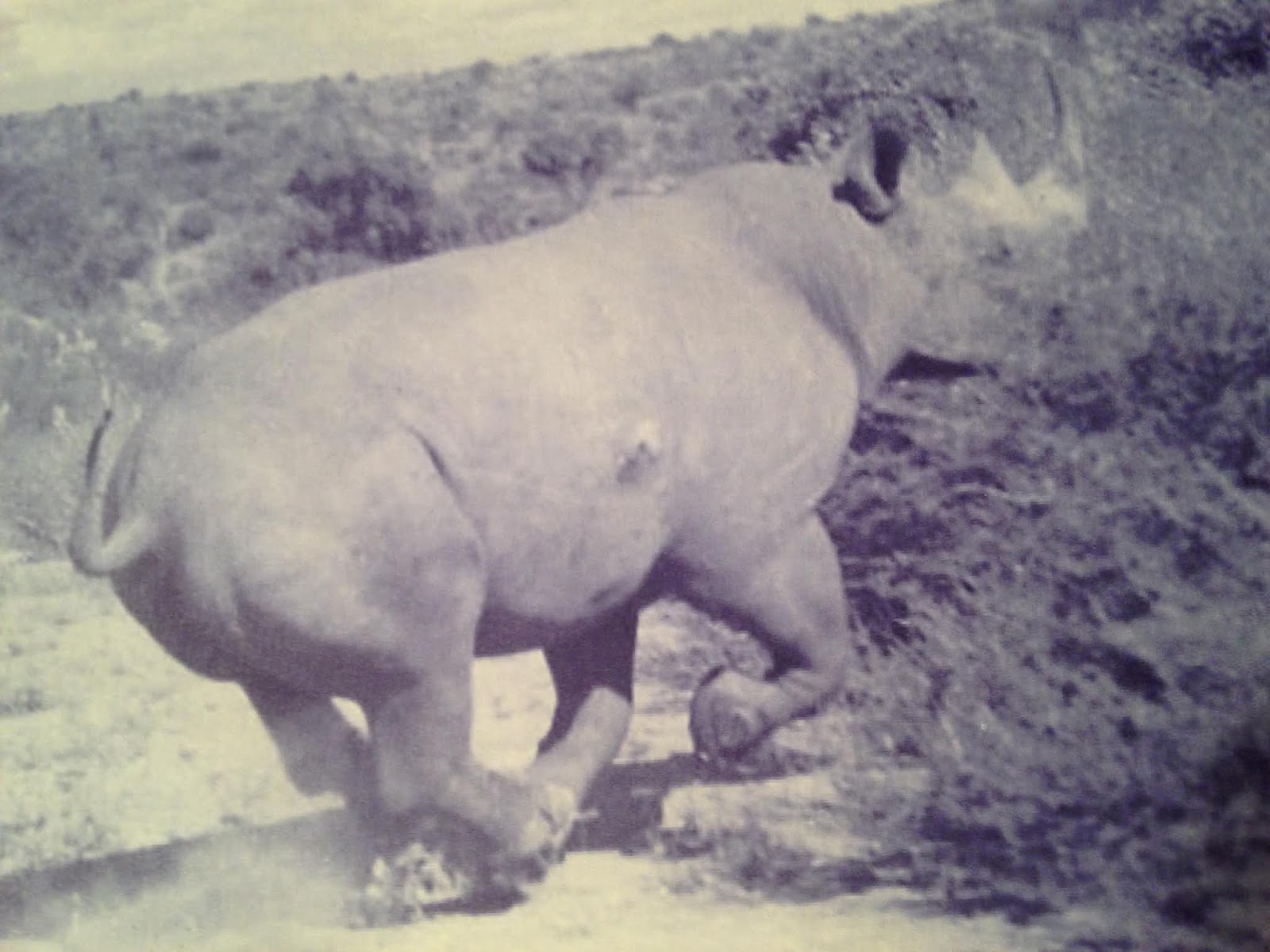
Photo by Sally Puleston McIntosh

Yes, that's the actual rhino which charged us.

Along with laughter, our reactions were simultaneous yelps of "holy shit", "oh my God!", "whoa, man!" and whatever other expletives were common in 1968. Someone may have even blurted out "groovy!"  It was like we'd been watching a movie and suddenly here's the scary part.

For some reason not feeling that the rhino was going to turn around and come after us again, we just continued along on our way -- to the lodge! -- and rather merrily. But after another two or three miles on this two-tire-track-excuse-for-a-road, a new dilemma suddenly presented itself: the road led into a stream and continued out on the other side.

What to do?

We got close enough to the stream to see that a) it was about twenty yards wide, b) it had a sandy bottom, and c) the water was about a foot deep.

Could the bus make it across the stream?  Maybe.  Maybe not.

What to do?

The decision-making process among six teenagers began.

The kid who'd been driving the bus thought we could make it across.  His idea was to back up, pick up speed, and go for it, man!  Three of the others agreed.  It looked doable to them.  Only myself and one other student, Mary Noland, had second thoughts.

Like, wait a minute:

-- our VW bus isn't an all-terrain vehicle, like a Land Rover.  It's got small wheels and a tiny engine.  It's not made for this kind of thing.

-- we don't know how soft the sandy bottom is.  We may not be able to pick up enough traction to get across.

-- the sand may be camouflaging rocks or holes which could not only get the bus stuck but could damage it.

The others disagreed.  The basic reasoning was still, "Oh, come on, we can make it!"

Voices began to rise.   It went something like this:

-- Hang on, what if we DON'T make it???  We're on a road that's more like a trail than a real road.  We haven't seen a single other vehicle since we've been on it.  What if we get stuck in the stream and can't get the bus out?  Who's gonna help us?  What if we sit here for a day or two and nobody comes along?  We only have enough food to last for today.  Someone's gonna have to WALK back to the main road to get help. Who wants to volunteer to walk back to the main road?  And remember, between here and the main road there's a RHINOCEROS which just ATTACKED us!  A RHINOCEROS!    

And if these weren't reasons enough,  there was this:

-- look, we don't even know if we're on the right road to get to this lodge.

-- who cares about the damned lodge, anyway?

-- even if we make it across the stream now, we're going to have to do it again because we'll be coming back the same way.  So it's twice we'll have to make it across the stream.

-- let's just get the hell out of here and hope we don't meet Mister Rhinoceros again.

Finally we all agreed.

We turned around and drove back to the main road.  Luckily we did not see Mister Rhinoceros again and we arrived in Mombasa, if I recall, just before sunset.

Plus we got to live.

********


This "rhinoceros story" became one of the milestones in my memory for future reference. Years later it helped me conclude that, among many ways of categorizing types of people, you could say that:

1. There are people who can learn from observing the experiences of others. (foresight)

2. There are people who can't learn from observing the experiences of others but can learn from their own experiences. (hindsight)

3. And there are people who can't learn even from their own experiences. (no sight)

It also demonstrated to me that survival has a lot to do with the ability to simply confront what appears before you, to not be pretending it isn't there.  This isn't a movie you're in, it's your life.  

And it's helped me understand that there are people in this world who need danger to feel they are alive.   If it isn't dangerous, it isn't fun.  You meet people like that every once in a while.


********


Okay, let's fast forward ten years.  It's 1978.

Now I am driving a taxi in New York City, an occupation that has recognizing danger as one of the requirements for doing the job for more than a week.  (See my post "The Three Strikes and You're Out System" in this blog.)

One day I picked up a young man -- twenty-something, friendly, bright, talkative -- who was en route to JFK.  That's about a forty-five minute ride, so it provided time for us to have a real conversation.   I learned that he was from somewhere in the Midwest, had never been to New York before, and was impressed with the hustle and bustle of the city.  He'd graduated from a college in Ohio, had a couple of jobs since then which he'd found pretty boring, was not married or in a relationship, and was now going out into the world "to make my fortune".  

Interesting!  It's not every day that somebody tells you he's off to make his fortune.  

"Where are you going?"

"To Lebanon."

"Lebanon?  Why Lebanon?"

"They're having a civil war.  I'm gonna sell arms and ammunition."

"Really!  Who are you going to sell them to?"

"I don't know.  I'll find out when I get there."

"Uh, have you been to Lebanon before?"

"No."

"So you have contacts over there?"

"Not yet."

Oh my God, this was a guy who saw himself as some kind of character out of a movie: a Robin Hood, James Bond, or Lawrence of Arabia.   But I saw him as someone who was about to go to great lengths to get himself killed.  Apparently he had no idea what he could be getting himself into.  He also had no considerations about the ethics of profiting from the sale of weapons to people who were trying to kill each other.  It was all going to be a glorious adventure.  And he'll be rich.  

I thought I'd take a shot at changing his mind, as unlikely as that was being that here he was, already on his way to the airport.  Nevertheless, I pulled the rhinoceros story out of my hat.  When the subject of danger comes up in conversation, especially when it involves people who seem to have a blind spot in that area, if there's time and they're up for it, I will tell them the rhinoceros story.  

So I said something along the lines of doing what he's planning on doing sounds intriguingly dangerous and I've got a great story about danger for you.  It's kind of long, but do you want to hear it?

Of course he did, being that danger was his thing.

So I told him how this group of teenagers riding around in a VW bus in a game park in Kenya (I didn't mention its name) back in '68 had a close encounter with a rhinoceros and how obtuse we were to the danger we were in at the time.  Just a rite of passage from adolescence, I said.  I was trying to bring the story around to how maybe he should rethink what the danger of being an amateur arms dealer in an unknown country might be, but before I could get to that he interrupted me.  

"Wow", he said, "that is so interesting that you should tell me this!"

"Why?"

"Just last year the mother of a friend of mine was on a safari in a game park in Kenya.  She stepped out of the vehicle they were riding around in to take pictures and she was trampled to death by a rhinoceros!"

"Oh my God!  Really?"

"Yes!"

"Do you know the name of the park she was in?"

"Yeah," he said, "it's called Tsavo."


It may have been the same rhino.


Wednesday, September 21, 2016

What The Man From The Atomic Energy Commission Told Me

You never know who will show up in the back seat of a taxicab.  It’s like a talk show on wheels, really.  A guest enters, we chat for a while, then he or she exits and the next one gets in.  It’s quite a remarkable human situation, if you think about it, especially in a city like New York where the movers and shakers of the world tend to congregate. 

Back in 1992 I had a passenger in my taxi who made a puzzling statement to me and this statement, considering who he was, has kept me thinking about its meaning ever since.  This story is actually one of the most frequently told stories to passengers in my cab, although I’ve never written about it until now.  And I do so now because with presidential politics being what they are in the United States at this time, I feel a responsibility to share this information. 

My passenger was an American man who I estimated to be in his ‘70s at the time.  I remember thinking that he looked to be in great physical condition for his age and that he mentioned to me that he walked ten miles a day, which impressed me.  I don’t recall how it came up in conversation, but somehow the following datum emerged: he told me he had once been a member of the Atomic Energy Commission. 

Whoa.  You may not be old enough to know what that meant, but if you were around in the ‘50s and ‘60s you most likely do.  The Atomic Energy Commission was the highest level federal agency in the United States which regulated the use and development of atomic energy, including the creation of new types of atomic weapons.  In terms of its importance to the country, it might be compared today to the National Security Agency (the NSA) or the CIA.  Top secret, hush-hush agencies with great, sometimes controversial, responsibilities to the security of the country.  

Realizing that I had a rare opportunity here, I tried to make the most of it in the limited time we would be together.  I know I asked him several questions which he was glad to answer, but there is only one thing I specifically remember asking his opinion about, something I’d already had some attention on for a few years.

And that was this: it had occurred to me some years prior that there seemed to have been a shift in the public consciousness concerning the threat and consequences of atomic war.  It seemed to me that people weren’t nearly as concerned about it as they had been before.  You didn’t see articles in the papers or magazines about it anymore, or hear people talking about it anymore.  Nobody seemed to be worried about it anymore, even though the Cold War was still going on.  I don’t know when this change occurred, but I supposed it was a gradual thing that may have started in the early ‘70s, perhaps when the Viet Nam war ended — I don’t know.

When I was growing up in the late ‘50s and throughout the ‘60s, the seriousness of even the possibility of nuclear war was very much in the public consciousness.  I would say that it and the arrival of television were the two things that shaped the psychology of my generation.  These two developments created a significant “generation gap” between us Baby Boomers and our parents, actually.  They had lived in a world where nuclear bombs and televisions did not exist.  This resulted, I think, in a different view of the world for us and certainly a different view about warfare.  For all the millennia preceding the advent of the atomic bomb, warfare meant men fighting directly against other men with some sort of hand-held weapon or by shooting short-range explosives at each other.  Even in the most horrific wars, it was still understood, if not consciously then subconsciously, that when the war was over, or even if it was never over, the human race would still exist and although it might change for the better or worse, there would still exist what is called “civilization”.

The invention and then the proliferation of nuclear weapons, however, changed that very basic reality.  For the first time in human history, weaponry had been created which could mean the extinction of civilization, if not the extinction of the human race itself and perhaps even all forms of life on the planet.  Man had developed the means of destroying himself as a species.  And this would happen not through masses of armies going up against each other but by certain people pushing certain buttons which would launch the nuclear missiles.  Thus the new reality was that even if everything seemed harmonious and peaceful, this world would always be a very dangerous place.  It could all end tomorrow, complete destruction, just like that, if certain people pushed certain buttons.  That’s a pretty depressing thought, isn’t it?

I grew up knowing, and worrying, about this.  With the Cold War brewing it was always in the back of my mind that this day could be the last day.  This fear was heightened considerably by the Cuban Missile Crisis in October of 1962 when the Soviet Union and the United States came to the brink of nuclear war.  It was horrifying.  

I remember one specific incident which occurred in my 8th grade music class during the crisis.  Our teacher brought out a record of the music from a new Broadway show called Fiorello! about the former mayor of New York City, Fiorello LaGuardia.  We were to listen to the record and there would be a discussion about it when it was over.  She placed the record on the turntable and we waited for the music to begin.  However, this show didn’t begin with music.  It began with the blaring siren of a fire engine.  (Mayor LaGuardia was famous for showing up at fires.)  The entire class, hearing the sound, let out a collective scream.  Not a funny, teenage scream — a real scream of terror.  That’s how on edge we were, and we were only kids.

So I brought this up with my passenger.  I asked him if I was correct in my observation.  Did something change?  Are people in general not concerned about the possibility of a nuclear holocaust like they used to be?  He thought about it for a moment and then told me that I was correct, it was true.  And then he added this comment, and these were his exact words:

“A country that’s worried about a nuclear war is a country that won’t buy a new car.”

I don’t remember if I asked him what he meant by that.  I don’t think I did, actually, maybe because we were at the end of the ride.  But his comment has stayed with me all these years.  If it had come from just anyone, I suppose I would have forgotten about it the next day, but this was coming from the guy from the Atomic Energy Commission, so it carried significant gravitas.    

After giving it much thought, and after hearing the opinions of many passengers in my cab, I came to the conclusion that what he meant was that a country of worried people was bad for the economy, with the implication being that a robust economy was an important ingredient in keeping the peace, not only in America but around the world.  Plus this: what’s the point in having the media and governmental agencies agitating the population about nuclear holocaust when there’s nothing the average person can do about it, anyway?

I decided he was right.  This made sense.  A population which believes the world may end tomorrow might well turn out to be a population of nihilistic, live-for-today stoners.  What it takes for a society to prosper — the steady flow of commerce — could be reduced to a trickle.  No Brillo pads to clean your sink.  No gravy on your mashed potatoes.  No invention of the iPhone.  No Pokemon Go.  If things get bad enough in a country, people will become desperate.  Governments can be overthrown by violence and atomic weapons can get into the hands of some very destructive people.  So the man from the Atomic Energy Commission was right. 

Or was he?

As this presidential election cycle rolls forward in the United States I have given his comment even more thought, and it seems to me something was overlooked.  A country that is not keenly aware of what atomic weapons can do is a country that might elect a rabble-rousing loose cannon to the presidency -- a person who could conceivably blunder our way into a nuclear holocaust.  

So there is something the average person can do about it.  He or she can understand that the risk of atomic warfare is the number one issue in any presidential election, and vote accordingly.  No other issue even comes close.  Not bad trade agreements, not student debt, not illegal immigration, not psychotic lunatics opening fire in shopping malls, not even climate change.  

Please consider this: the president of the United States, when it comes to nuclear war, virtually has the power of God.  By his or her command all we know of civilization could quite suddenly come to an end.  By his or her command billions -- billions -- of people could perish, perhaps even every human being on this planet could perish.  Perhaps even every living thing on the planet could perish.  Is that not the power of God?

So temperament, sanity, intelligence, and empathy mean everything in a presidential election.  It’s the great decision we as Americans must make every fourth year, and it tests our wisdom as a nation.  Candidates who are rude, impulsive, thin-skinned, angry, and impossible to give advice to can be elected to the offices of mayor, governor, and senator all day long, and sometimes are.  

But never to the presidency.

The motto of one of the great American presidents, Theodore Roosevelt, was “Speak softly and carry a big stick”.  There are plenty of big sticks in the United States arsenal.  It’s the “speak softly” part that is so important in a nuclear age. 

If you’re an American, I do hope you will give this your most sober consideration before you vote.


*********


There are links to several Wikipedia pages in this post.  I’m giving three of them again here in case you missed them:


I suggest that you to go to these sites and read the articles. I know it’s disturbing to read this stuff, it really is, but I feel we cannot afford to be unaware of what is really at stake in this and in every presidential election.  Go to the Cuban Missile Crisis page first and listen to the riveting audio of President Kennedy addressing the nation.  Then imagine the wrong person being the president at that time.

I feel strongly that all Americans need to be conversant with this subject. "The Nuclear Age" should be required study for everyone at the high school level, in my opinion. 


This is the world we live in.  


Let’s not kid ourselves.

Tuesday, May 05, 2015

Well Worth The Eighteen Bucks

There are certain rides which you suspect will be trouble, but then it turns out there is none. For example, the passenger looks drunk, acts drunk, is drunk, and you’ve got a feeling that any second now this son of a bitch is going to puke in the back seat. But he does not. And that is good. 

But then there are others for which your suspicion is justified - you could see it coming, and indeed it arrives. But at least you can say, “I saw it coming” and give yourself credit for possessing a certain amount of wisdom, even if your wisdom wasn’t of sufficient quantity to have been able to avoid the damned thing in the first place.

Such was the case with a ride I had a couple of months ago, on a frigid Wednesday evening in February. I had taken a fare from Manhattan to Williamsburg, in Brooklyn, at 6:20 - not something a cabbie wants to do at that hour because it likely means going back to “the city” (Manhattan) without a passenger and that is money lost. And although the mantra of the veteran New York City cab driver is supposedly “I don’t go to Brooklyn”, I took the guy without even a hint of complaint - a sign that I may be softening up in my old age.

It was the next ride that was the trouble. Before I could turn around and head back to the Williamsburg Bridge I was hailed at McCarren Park by three teenage boys, dressed in outfits typical of the so-called “inner city”, each about 15, maybe 16 years old. Now here’s a little truism a cabbie learns, usually the hard way, about teenagers and taxicabs in New York City - there are only two situations in which kids between the ages of 13 and 17 ever take taxis without an adult accompanying them. 1) They are “rich kids” from the Park Avenue or 5th Avenue parts of town. 2) It is a Friday or Saturday night and the teenagers are a boy and a girl who are out on a date. The reason: money. Cabs are too expensive for teenagers unless you’re a rich kid or it’s a very special occasion.

Now, I know this, but as mentioned maybe I’m getting soft in my old age, or maybe it’s just that it’s been so long since I’ve had any teenagers in my cab who didn’t fit into one of those two categories that I’ve let my guard down. Whatever the reason, I stopped and let them in, all three in the back seat. Immediately there was this sinking feeling a cabbie gets when he knows he’d made a mistake. I had gone against my instinct, thinking I was doing the right thing by stopping for whomever wanted my services, as per the rules, but now I had a problem on my hands. As soon as they were in my immediate space, danger signals went off on my taxi driver radar. These were not your normal taxi passenger particles, so to speak. They weren’t passing through the filter.

What I do in a situation like this, as I’ve described elsewhere in this blog, I call my “Three Strikes And You're Out System”. Strike One: from your outward characteristics you look to me like potential trouble of one kind or another. I don’t feel comfortable with you in my cab. Strike Two: I also don’t feel comfortable with where in the city you want me to go and the time of day (like late at night) you want me to go there. Well, these three fellows by appearance, age, and demeanor brought me to Strike Two immediately, and when I asked them where they were going the one directly behind the partition next to the right-side door barked out:

“Ridgewood, yo.”

Ouch.

This was further bad news because not only did they want to take me for a long ride in the opposite direction from Manhattan, but Ridgewood is a low-income, not-gentrified part of the city which I don’t really know very well due to the fact that I get so few fares out there. This ride was going to be something like fifteen to twenty dollars on the meter. Three inner-city teenagers paying that much money for a cab ride when they could have taken the subway? Noooo… this particle was definitely not making it through the filter. Still, the procedure of my system is that when you have a Strike Two, what you do is communicate, or try to. Often what looks like something ominous turns out to be not that way at all upon further observation. So I went at it.

“So what street do you want in Ridgewood?” I asked.

“Huh?” the kid on the right-rear grunted.

“Where are you going? What street?”

There was a brief conversation among them. And then, “We don’t know yet,” replied the same kid, who seemed to be a spokesman for the group. “Get on Metropolitan.”

This was a further bad indicator. They’re taking an expensive ride and they’re not sure where they’re going? Two possibilities enter the mind of the taxi driver: maybe they aren’t concerned about spending money on a ride to a vague destination because they have no intention to pay for it. Or, worse, maybe they want to get to a general area and then find a street where it would be a good place to hold you up. I knew I had to determine which possibility it was before we got to Ridgewood - my life could be at stake here. If I decided what they had in mind was just to beat the fare, I would take them. If I was right, all I would lose, really, would be some time. But if I wasn’t sure, I would have to abruptly end the ride in a busy area with lots of people around (hopefully right behind a police car, if I could find one) and through overt or covert means, get them out of the cab. (That’s Strike Three.) So I had a plan. But first I had to continue with my attempt at communication.

The kid in the middle, who I could easily see in the rear-view mirror, was wearing a Yankee cap. I thought this was a good way to start a conversation, so I looked at him in the mirror and asked him if he was a Yankee fan. He seemed surprised that he was being asked a question. After thinking about it for a few seconds he replied, rather flatly, “Yeah.”

“How do you think they’re looking for the new season? Think they’ll make the playoffs?”

The kid pondered this concept - Yankees… playoffs… and finally responded. “Maybe,” was all he said. He wasn’t saying much, but he said something. I took this as a hopeful sign and continued.

“Hey, you know who I had in my cab last summer? Derek Jeter!”

Now for any Yankee fan, or even any baseball fan, this statement should result in a “Wow!” of one sort or another. Derek Jeter, the recently retired superstar of the Yankees, has been the most admired sports figure in New York for the last twenty years. But all it got out of the kid was an even-voiced, “That’s cool.” And nothing more. This was not good.

I was beginning to think I was going to have to get rid of these guys for my own safety when there was an oddly positive development in the ride. They started goofing off with each other. One of them accused another of farting. Then the one who’d been accused yelled up to me, “Hey cab driver, did you fart?” which brought some laughter in the back seat. It was juvenile and disrespectful, but it gave me something with which to calculate their intentions.

In my understanding of human behavior I could not see three teenagers joking around with each other if what was in the back of their minds was to pull out a weapon and rob me. If that had been their intention, they would have been serious, silent, and mean-spirited. I could see that these kids were basically just wiseass teenagers. Still, something was up and I was pretty sure at this point that what was up was that they were going to try to beat the fare. That suspicion wasn’t enough to kick them out of the cab, however, so we continued on.

When we’d gone a couple of miles down Metropolitan Avenue some disagreement arose among them as to where they wanted to go. One kid said turn left, the other said no, turn right, and then there was a whispered conference among them - a development I didn’t like one bit. What was it they didn’t want me to hear? It was a little after seven in the evening and although it was dark there were still plenty of cars and people on the streets, so I still didn’t think they intended to hold me up. But now I wasn’t so sure. I decided that if they directed me to turn into an alley or a dead-end street I would quickly close the partition window on them, lock it, and order them out of the cab. The Plexiglas partition is bullet-proof (it had better be!) and as long as I had an open road in front of me I could take off the moment they stepped out of the cab and be safe, hopefully. To hell with the money.

If, however, they were simply going to try to leave without paying, as I expected, well, I had another plan…

We took a few lefts and rights and wound up on a one-way, residential street. Halfway down the block the kid in the rear-right says, “Okay, stop here.” As I brought the cab slowly to a halt, I noted that the street in front of me was devoid of other vehicles, a good thing. Stopping the cab, I left it in “Drive” with my foot on the brake.

“You’re getting out here?” I asked the group, noticing that there was $18.30 on the meter.

But there was no answer, as such. Instead there was a sudden, loud, rebel yell from both sides of the compartment as the rear doors flew open simultaneously. With grins of joyous complicity on their faces, the two kids who had been sitting next to their own doors jumped out of the cab and began to run away the moment their feet touched ground. Seeing this, I put my own plan into action. Instead of just sitting there and watching them run, I stepped on the gas, hard, while at the same time reaching back, slamming the partition window shut, and locking it. The sudden forward thrust of the cab caused the two rear doors to close on their own. But I wasn’t driving down the street alone. The kid in the Yankee hat who had been sitting between his friends hadn’t been able to get out in time. In an instantaneous reversal of fortune, he was suddenly a prisoner in a moving vehicle.

“Like I didn’t see that coming,” I called back to him while bringing the speed up to about 25 miles per hour. The look of shock on the kid’s face was priceless. I wish I could have taken a picture of it.

“So,” I said in sarcastic cheerfulness as we continued down the street, “let’s find a cop.”

There was panic and confusion in the kid’s eyes. Perhaps he saw his future melting away due to being arrested. Perhaps he could see how he would lose the respect of certain people in his life whom he admired. Or perhaps he could just see himself being picked up at the precinct by his momma, who would give him more than a piece of her mind when she got him home. Whatever it was, he kept it to himself. He didn’t say a word to me.

For my part, I knew I had to keep the taxi moving while looking for a cop. If I brought it to a stop, the kid would certainly bolt. I continued driving down the street for another block with still no other cars in front of me, but then slowed down a bit to make a left turn at an approaching intersection. As I went into the turn, the speed of the cab going down to about fifteen miles per hour, the kid suddenly pushed open the right-rear door and jumped out, rolling over a couple of times onto the pavement just like in a scene from an action movie. Looking back at him through the mirror, I could see him rising to his feet, apparently uninjured. There was an accumulation of snow on the street which may have cushioned his fall.

I kept driving, satisfied that I had won the game. Actually, just the look on the kid’s face was worth the eighteen bucks. In these fare-beating scenarios, it’s not really about the money, anyway. It’s about pride, not letting someone make a jackass out of you. Also it’s about teaching the person a lesson, if possible. Hopefully this kid had a realization along the lines of there being consequences to stupid behavior. Of course in this particular instance, he may have had a realization of a different kind...

...like that he may have a future as a stuntman!

Wednesday, August 07, 2013

The Card Game

“There was something in the air that night.”

Looking back at it later, that’s the way it seemed.

Someone less familiar with the nuances of a scene - its details, the usual flow of its particles - might not have noticed that something was not right.

But I did. Something, some nebulous something, was out there.

I sensed it at the beginning. I even took action to avoid it, but it happened anyway. Later I concluded that it had all been a karmic phenomenon, like a greeting card from Fate, a scene in a movie in which you sidestep your way around the danger, you even compliment yourself on having been sharp enough to have avoided it, and then, as you open the door to your house, it’s sitting there in your kitchen eating a tangerine. “Hello.”

It happened on a midsummer night last year, July 31st to be exact - around midnight - and that’s about as midsummer as you can get. I took a twenty-something female from lower Manhattan to McDonough Street in the Bedford Stuyvesant section of Brooklyn, a so-called “inner city” part of New York. She was fine, paid with a credit card and gave me a twenty percent tip. But there was a little thing that happened a few blocks before we got to her destination that caught my eye. While we were stopped at a red light a group of about twenty kids, teenagers in that danger-zone between fifteen to twenty years old, walked by on the opposite side of the street. It was the way they were moving, along with a group attitude and a certain buzzing among them, that created the blip on my radar screen. I’ve been watching people walk across the street for thirty-five years. This was a particle that was not flowing smoothly. It was sticking.

Have you ever heard of something called a “wilding”? It’s defined as “the activity of a gang of youths going on a protracted and violent rampage in a public place, attacking or mugging people at random”. I saw one in action a couple of years ago, not far from Times Square. It’s an internet phenomenon made possible by the anti-social media, and it’s very scary. Could it have been that what had caught my attention was a prelude to a wilding? Probably not, wildings are rare, fortunately.

But then, as my passenger departed on McDonough Street, I heard sirens from a few blocks away. They have a language of their own, these sirens. Police, fire, EMS, they’re all slightly different. These were police, I knew, and in the parlance of police sirens they were in the “we mean business” band. (You can tell this by the duration of the wailing and by the speed the police car is traveling which, even if you can’t see it, can be determined by the time it takes for the siren to increase in volume if it’s moving toward you or to decrease in volume if it’s moving away from you. It also lets you know how serious they think the emergency is.) That there was more than one siren was significant, as well. There were two, about a block from each other, and moving in the same direction. Then there was a third, this one from a bit further away.

Something was going on.

Then I heard distant shouts, coming from that same vicinity. And not from one source, but from two or three.

My sacred Taxi Driver Instinct told me, quite clearly, “get the hell out of here”. I flicked on my “Off Duty” light, locked the doors, and began heading back toward Manhattan, the opposite direction from where the commotion, whatever it was, was originating.

But then, just as I was beginning to breathe easier, Temptation appeared in the form of a person approaching from the street. No, not a woman in a red dress. Temptation appeared, oddly enough, in the form of a middle-aged, thuggish-looking man who might have been the guy the song “Bad, Bad, Leroy Brown” was written about. He would have been the last person you would have thought I would allow into my cab at this particular moment, but he came up to my window and said the magic words.

“Take me to Manhattan?”

It was free money. I unlocked the doors and he slid onto the back seat.

“Where in Manhattan do you want to go?”

“Chinatown.”

Perfect. Right across the Manhattan Bridge.

I turned the meter on and thought about what I had just done. It was all right. This guy, although a rough kind of character, represented no threat to me in a physical sense. Just by his age I was certain of that. Morons who think it’s worth the risk of possible consequences to pull out a gun just to get a hundred dollars from a taxi driver are either in jail or dead before they get to the age of thirty. This guy appeared to be around forty-five. Plus he was taking me away from the area where I perceived the danger to be. No need to even use my
“Three Strikes And You’re Out” system to protect myself. Just get on Atlantic Avenue and make a right.

But I hadn’t driven half a block when my passenger spoke. “Pull over, he’s getting’ in,” he said. I looked around. A guy who looked like Bad Bad’s older brother was approaching the cab. I didn’t like it but I was in a situation where I had no choice.

I stopped.

The second passenger got in.

It set off an alarm. My happiness at having an unlikely return trip to Manhattan evaporated in the night air and was replaced by an anxiety, which was only heightened by the next development in the plot.

“He’s goin’ to Buffalo Avenue,” the first guy said.

“Buffalo Avenue,” I repeated, rather robotically. This was not what I wanted to hear. Not only was Buffalo Avenue in the opposite direction from Manhattan, it meant that in order to get to it I was going to have to drive toward whatever was causing the commotion that I’d already been trying to avoid.

“Goin’ to a card game,” the second guy said.

“Then you’re going to Manhattan?” I asked the first guy.

“Yeah.”

“Okay.”

Then, abruptly: “Make a left, make a left!”

I didn’t like the tone. It had suddenly gone from “I’m doing you a favor by picking you up when my Off-Duty light is on” to being ordered around by my passengers, who were seizing control of the ride. And to make it worse, the street they were ordering me to turn onto was Fulton, a two-way road with a single lane in each direction.

I didn’t want to take that route, I wanted to take a parallel avenue, Atlantic, which also has two directions of traffic but with two lanes in each direction. On Atlantic you could move around if something got in your way, but on Fulton you’d be stuck if there were to be an obstruction.

I momentarily considered just telling them forget it, I’m only going to Manhattan, not the other way, but then I would be in a confrontational situation with the Brown brothers which could lead to who-knows-what. Besides, I wanted that ride to Manhattan after the Buffalo Avenue drop-off.

I made the left onto Fulton.

We went two blocks and then came to a dead stop behind a line of cars that looked to be a block long. Not good. After thirty seconds of not moving at all, I realized that the cause of the delay was the thing I’d been trying to avoid. In the distance there were people running. There were people shouting. Like a tornado, it seemed to be coming toward us.

“I’m getting out of here,” I called back to my passengers, who were immersed in a quiet conversation between themselves and oblivious to the outside world. And with that I made a U-turn on Fulton and headed back in the opposite direction, away from the tornado. After a couple of zigs and zags we were on Atlantic, the avenue I’d wanted to take in the first place, heading swiftly toward Buffalo Avenue. I thought there might have been a protest from the back seat since I had countermanded their instructions and had taken them a few blocks out of their way, but there was nothing.

Good.

But better than that, I’d avoided the fracas, whatever it was. It is rare in life that we are grateful for things that didn’t happen, right? This was a case of an experienced cab driver relying on his knowingness to keep himself and his passengers out of harm’s way. There’s no virtue in becoming a victim, mate.

Two minutes later I got them to their building, a tenement, on Buffalo Avenue with $8.70 on the meter. The first guy then surprised me by handing me a fifty and telling me to keep ten.

“You can pay the fare when we get to Manhattan,” I said, as I tried to return the bill.

“We’re both gettin’ out here,” he replied.

“You’re not going to Manhattan?”

“Nah, I’m goin’ to the card game,” he said.

Damn. There went my “free money”. It pissed me off - I immediately wondered if he’d ever intended to go to Manhattan in the first place. Maybe he’d just used that as a ploy to get me to take him deeper into Brooklyn. But what could I do? I can’t force people to stay in my cab. Especially this guy.

I handed him two twenties as his change, said “thanks”, and expected to hear the rear door open and the two of them depart. But instead the second guy handed me my twenties back and said he needed smaller bills.

“Smaller bills?” It was an odd request. I’m not a bank.

“For the card game.”

“Oh… all right.” Okay, that made sense. I counted out eight fives and handed them over.

“Thanks.”

“What do you play? Poker?” I asked as they opened both rear doors simultaneously.

“Yeah.”

“Hey, good luck!”

My blessing was either ignored or not heard as it brought no response - they walked away and disappeared. I drove off toward Atlantic Avenue, disappointed, but not overly so - after all, even though they’d delayed my return to Manhattan, I did make ten dollars for the inconvenience, and that’s not to be discounted. I kept the “Off-Duty” light on, locked my doors anew, and got back on Atlantic wondering if I should take the Manhattan or Brooklyn Bridge back to the city.

When I had driven about a mile past the general area where the commotion had been, and knowing I was beyond the reach of that problem, I began to feel hungry. I’m a creature of habit when it comes to meals - you could set your clock by my stomach - and midnight is feeding time in my taxi. So I found a quiet spot and pulled over. Out of my backpack came my pre-prepared chicken fingers and my whole wheat bread and I began munching away.

I was reviewing mentally what had just transpired with my last ride and suddenly I was jolted by a thought. Wait a minute… they’d paid me with a fifty… and I hadn’t bothered to check it. I pulled my wad out from my pocket and found the bill.

Cautiously, I held it up to the dome light of the cab.

And then, oh, oh no, nooooo… Shit! SHIT!

Forget about teenagers and wildings, if anyone on the sidewalk had heard my wails of anguish they would have thought that I was a source of danger and they’d have crossed the street to avoid me.

The bill was a fake.

How can you tell? There are three ways:

1) First, and easiest, you hold the bill up to a strong light and look for the “ghost” in the blank area on the right side. Pictured on a fifty is Ulysses S. Grant, the commander of the Union forces during the American Civil War and the eighteenth president of the United States from 1869 to 1877. A ghostly image of Grant can be seen in that blank area if the bill is genuine. The high-tech copying machines that are used to produce counterfeit money are not high-tech enough to reproduce the image of that ghost. This bill had none. A fake!

2) Second, similar to the first, is to hold the bill up to a light and look for the bar. On a fifty the thin bar runs the width of the bill, just to the right of Grant’s head and reads, repetitively, in tiny print, “USA 50”. This bill did not have that, either.

3) The third, and not known to most people, are the grooves in the General’s coat. If you run the edge of your fingernail against the coat, you can feel the grooves. Although I didn’t notice it until later, this bill, amazingly, did have grooves. But they hadn’t been somehow duplicated there by a copy machine. Whoever made this bill had cut out a small piece of grooved cellophane tape and carefully adhered it to the left side of Grant’s coat. So to that degree this counterfeit bill had actually been created by hand. Amazing.

When my anger eventually subsided I realized I had an ethical dilemma on my hands. What to do with the damned thing?

Hold onto it until the next time a passenger pays the fare with a hundred dollar bill and then give it as change? No, that wouldn’t be right. It would make me no better than the lowlife who’d handed it off to me. Besides, it could be months before a passenger tried to pay with a hundred.

Try to deposit it at a bank? Forget it, they’re money professionals and I’d probably wind up on some kind of surveillance list.

Turn it in to the government? As if.

Or just the obvious choice, use it to pay for something at a retail store. Yeah, that seemed like the way to go. But where?

It was this that was on my mind as I crossed the Manhattan Bridge, touching down on Canal Street in Chinatown. Immediately, as if Manhattan itself had supernatural powers, my luck turned. My next passenger, a middle-aged fellow who’d perhaps had too much to drink and didn’t want to wait around at train stations, took me out to Jersey City, New Jersey. These OT (out-of-town) jobs are flat-rate and lucrative. We charge much more than the normal, metered fare because a) we can, and b) by law, we’re not allowed pick up passengers outside of the New York City limits - we are required to come back to the city empty.

I was paid $45 plus an $8.50 tip for the twenty minute ride. Travel time back to Manhattan via the Holland Tunnel would be only another ten minutes, and that’s good money, but even better than that, I suddenly realized I had a perfect opportunity to pass off my fake fifty. A godsend, really.

There are about a dozen gas stations lined up in a row near the entrance to the Holland Tunnel. Gas is always cheaper in New Jersey than in New York due to lower taxes, so it saves a few dollars to fill up before entering the tube. What better place than an oil company to pass off a counterfeit bill? After all, haven’t I been getting raped by these people my whole life?

And there was one particular joint, a Gulf station, which I decided was especially worthy of my wrath. A few months earlier I’d had a run-in with an attendant there. New Jersey is one of only two states in the U.S. where, by law, there is no self-service at gas stations - an employee always comes out to do the task. The guy who pumped my gas at the Gulf station had made a hostile comment to me because he thought my fifty-cent tip should have been more. Now, I always tip well above average in situations where tipping is appropriate. I’m in a tipping business myself, after all. But I happen to know that tipping pump boys is not customary in New Jersey. I also happen to know that they make better money than New York City taxi drivers. So the guy had been out of line, in my opinion.

And now, ha-ha, it was get-even time.

I pulled into the station. Funny, even though it was where it was supposed to be, the place looked different. I realized it had been renovated - it was bigger, shinier, and better lit. The attendant came over immediately, but he wasn’t the same guy.

“Fill it?” he asked with a smile.

“Uh, yeah, regular, cash,” I replied.

Well, what to do? I no longer had a justification for using the bad bill. Or did I? Okay, I had no gripe with this particular attendant, but wasn’t he a party to an industry which is keeping me poor? I mean, when I started driving a cab in ‘77 I was paying $10 for a shift’s gasoline. Now I’m often paying more than $50. And I’m not making five times as much as I did in 1977. So what more justification did I need? The plan remained in place.

The total on the pump came to $29. Giving no indication by voice or body language that I was trying to pull a fast one, I handed him the $50 bill. A moment of truth was at hand, and that’s what it was - a moment. It took the guy maybe two seconds to recognize that the bill was a phony. He abruptly handed it back to me.

“This is counterfeit,” he said. Interestingly, there was no great outrage in his voice. Perhaps he was used to this sort of thing.

“What do you mean?” I replied, showing surprise and very genuine concern at hearing this startling revelation.

“It’s a fake.”

“How do you know?”

“Hold it up to the light.”

Throwing what may have been left of my personal integrity completely out the window, I jumped headfirst into an impromptu act of being utterly shocked that I had received and was now unwittingly attempting to pass on a counterfeit note of the United States Treasury, followed by outrage at whoever had done this to me and the deepest, most sincere apology to the attendant.

“I’m really, really sorry about this, man.”

I handed him some actual money to pay for the gas.

Oh, and I tipped him a dollar.

Cruising back toward Manhattan in the Holland Tunnel, the flaw in my thinking edged its way into my consciousness. I had been assuming that if I’d been able to get the guy at the Gulf station to take the fifty that the entity which would be out the money would be Gulf Incorporated, and that would be okay. But what if they had a policy of making their attendants pay for any phony money they’d accepted out of their own pockets? Maybe they do that, for all I know. Then I’d be victimizing the attendant, wouldn’t I? And that would not be okay.

Emerging from the tunnel in deepest thought, I realized I had been given an integrity wake-up call. There was simply no way out, integrity-wise, but to swallow the loss. Right away I started feeling better about myself. Hey, it wasn’t the end of the world. All I’d actually lost was forty dollars (the change I’d given for the fifty) and the time it had taken me to drive those guys to Buffalo Avenue. Not that big a deal in the larger scheme of things.

Still, it stung.

But onward into the night. My next fare was a drunk, middle-aged man coming out of a gay bar. He seemed friendly, so I thought I’d use him as a sounding board for the woes of my evening and started telling him about the counterfeit fifty. He slammed back that, forget it, he knew all about these cab driver tricks, I was just trying to get him to feel sorry for me so I could get a bigger tip out of him. Then he accused me of being a Jew.

What was going on? I’m a karma guy. I felt like I was in a rowboat and was being tossed around in Somebody’s Ocean. Why was all this happening to me? I believe, as I wrote at the end of the “Karma Versus Coincidence” chapter of my book, that “what can be fully viewed will vanish” (if I may quote myself). What was I not fully viewing? I did not know. Shouldn’t my slate have been wiped clean, so to speak, by the realization that the ethical thing to do was to not pass along the fifty? So why was I continuing to pull this crap in?

I did not know.

I decided to finish the shift in silence. Passengers had become too dangerous to communicate with, and that was that. I spoke not a word to the next fare, a couple of tourists traveling from the Village to the Upper West Side, nor to a finance guy on a long ride from Midtown way up to Washington Heights. I felt if I could just tip-toe my way around Whatever It Was, maybe it would blow out to sea by tomorrow.

Well, the strategy seemed to work. I had no further trouble with passengers for the final three hours of my shift and had almost forgotten about my extraordinarily lousy night when I pulled into the Hess Station on 44th and 10th at 5 a.m. to fill up.

Now, in New York City you pump your own gas. You go up to the cashier who sits in a secure, box-like structure, push the money through a slot, and then go back to your vehicle and pump away. Since I’d already spent $29 on gas in New Jersey I figured I only needed another $30, at most, to fill up the cab, so I placed a twenty and a ten into the slot, turned, and walked a few steps toward my taxi.

And that’s when the screaming began.

“THIS BILL IS NO GOOD!” screeched the voice of the cashier, a female who is normally surly without any special reason to be. I turned and looked back at her, quizzically.

“THIS IS NO GOOD!” she screamed again, waving the twenty dollar bill in the air.

What??? I walked over to the booth. This information was not being processed mentally.

“What are you talking about?” I almost screamed myself. “You want to see a fake bill, look at this!” And with that I pulled out the fifty and held it up. “This is a fake bill!”

On some moronic level I must have been thinking that I’d already met my quota of counterfeit money that night so there couldn’t possibly be more. Of course this made no sense whatsoever to the enraged cashier who continued to wave the twenty in the air as if it were a flag.

“THIS BILL IS NO GOOD!” she screamed again and shoved it back at me through the slot.

I picked up the bill and looked at it. Oh my God, it was indeed a fake. Not nearly as well made as the fifty - the green ink was too bright and anyone who handles money could see at a glance that this one was suspicious. Except me, apparently.

Stunned, I apologized profusely to the cashier. Oddly, this time my apology was quite genuine as I’d really had no idea that I’d handed her a fake. But unlike the attendant at the Gulf station in New Jersey, she was not inclined to be so forgiving, screaming again that the bill was no good and giving me the evil eye of death. Talk about karma being a bitch, indeed.

I handed her another twenty dollar bill from my wad, making sure this one was not also a fake, and then, as I walked toward my cab in a daze, it hit me. Oh, God, no, could it be?

I opened up my roll of bills and looked warily at each of the twenties. There was the counterfeit she’d just returned to me. The next twenty was perfectly fine, nothing wrong with it. Then another, also fine. And then… oh, shit, there it was - another fake twenty!

Yes, I had not one, but two counterfeit twenties - both with the same serial numbers - in my roll. And now I finally understood what had happened: when the characters in Brooklyn handed me the fifty, I’d given them two twenties as change for the ten dollar fare. Then the guy going to the card game said he needed smaller bills. He handed me two twenties back and I gave him eight fives. But the twenties he’d given me weren’t the twenties I’d given him! He’d switched them for his counterfeits. It was dark in the cab and I hadn’t noticed.

So the whole thing had been a set-up, beginning with the first guy telling me he was going to Manhattan, which he’d never intended to do. There had been no “card game”. They didn’t need “change”. I’d been royally conned by a couple of very smooth operators. Damn, I’d even told them “good luck” as they left the cab.

Ouch!

It's been just over a year now and I still have attention on the events of that shift. Had there actually been “something in the air that night”?

Yes, there had been danger without, the turbulence in the vicinity of McDonough Street.

But there had been danger within as well. Something else, the nebulous something I had been vaguely aware of, had come from within, a mental phenomenon. What exactly it was I do not know - it has not been fully viewed.

So what is one to do?

Be more alert.

Be more honest.

Try to raise your level of confront.

And may the storm pass you by.