Showing posts with label animals. Show all posts

Sunday, June 07, 2020

The Rhinoceros Story


Here's a story from the vault.  It's always been an oral narrative I've told to passengers in my cab when it seemed appropriate, but until now never written up. It concerns a certain rhinoceros with anger management issues.  How could that have anything to do with driving a taxi in New York City?  Read on.

First, some history...

I grew up in Levittown, New York, about a forty-five minute drive from Manhattan, where I was a student in a typical American high school.  I graduated in 1967.  It's common to look back at that time in your life as the "good old days", but not for me.  I couldn't wait to get out of the place!  It felt like prison to me.  This was the '60s and the tumult of the era was weighing heavily upon me.  The prospect of spending another four years in an academic environment, which is where most of the kids I knew were headed, had no appeal whatsoever.  I wanted to get far away and "see the world".  However, the idea of being drafted into the U.S. Army and being shipped far away into the world of the Viet Nam War also had no appeal.  So the thing to do, at least if you were a white, middle-class American boy, was to get yourself into college.  That was your ticket to stay out of the military, at least for a few years.  It was called a "student deferment".  So I needed to find a college that could serve both of these needs.

And find one I did in an offbeat school which had just recently been established not far from my hometown by the Society of Friends (the Quakers).  It was called Friends World College.  (Actually it was an "institute" when I enrolled in September of '67.  It was so new at the time that it was still in the process of becoming accredited by the State of New York.  When that occurred, about a year later, it could then officially be called a college.)

The basic idea of Friends World College was to create a learning experience in which students could grow into young adults with a "world view".  For four years they would spend successive semesters living in different parts of the planet.  This would not be sitting in classrooms, reading books, and taking exams.  It would be an integration into the cultures in which they were living.

It was very loosely structured.  There were no examinations or formal courses. The only real requirement was the keeping of a journal of one's thoughts and experiences.  Seminars and field trips were offered mostly having to do with topics which were progressive in that era, such as ecology, civil rights, consumer cooperatives, regional development, universal suffrage, intentional communities, and socialism.  Individual projects were encouraged and advisors were assigned to each student to offer guidance.

My first semester was spent at the North American campus (if you could call it that) on Long Island in a converted barracks leftover from a decommissioned Air Force Base named Mitchel Field.  There were 37 kids in my class.  We not only participated in student activities, but we shared work responsibilities like cooking and cleaning.  So this was not just a school, really, but a community.  Here I had finally found a group I could fit in with.  Spirited, intelligent, socially conscious to the point of being willing to do something about it, adventurous, iconoclastic: these would all be apt descriptions of the kids there, and of the faculty, too.  Plus we all traveled around in the preferred mode of hippie transportation in those days, the Volkswagen bus. 


68 vw bus for sale


My second semester was spent in Kenya, in East Africa.  Now this was "far away" indeed.  Not only in distance, but in time.  Kenya had only recently obtained independence from Great Britain and in 1968 was barely a nation state.  Being there was like traveling back in a time machine to an era when people lived in tribes, subsisted from the land, had very little, if any, contact with the outside world, and needed to be aware at all times of the dangers posed to them by their own predators, the animals.  

Our center was in the capital of the country, Nairobi.  It had many of the basic things we took for granted back home such as buildings, electricity, running water, paved roads, telephones, a post office, and a hospital.  But once you were just a little bit away from Nairobi, wow, were you ever in a different world.  Some of the things that remain engraved in my memory are:

-- living among people who never in their lives owned a pair of shoes.  Over the years the bottoms of their feet eventually became so calloused that they actually became their "shoes".

-- realizing that in the months I lived in Kenya not only had I never seen a tractor, I had never seen a horse-drawn or ox-drawn plow.  What I did see were women bent at right angles tilling the soil by hand.


April | 2011 | Brown. Girl. Farming.

-- going on a field trip with a few other students which was led by Jesse, a young man employed at the center, who escorted us to the village where he'd grown up.  We had to leave our VW bus behind and walk the last mile because there were no roads which led to the village, only trails.  At one point along the way Jesse suddenly screamed "Get down!" and we all hit the dirt just as a mass of bees the size of a truck flew right over our heads.  Damn!  Continuing on, we were greeted effusively by villagers, some of whom bestowed presents upon us.  We were only the second group of white people they had ever seen.  (Jesse had brought students from the previous class to his village a few months earlier.  They were the first.)   We were graciously welcomed by Jesse's parents who served us a wonderful meal. The homes in their village were made by building a frame from sticks and filling in the gaps with cow manure.  When it dries it hardens like clay and keeps the rain out.  Should a big storm come and wash the homes away, the villagers simply build new ones.

-- the school rented a house in the village of Machakos.  I stayed there for several weeks.


One day a long line of ants somehow entered the house, marched across the wooden floor, and exited on the other side of the place.  The "soldier" ants formed two columns and remained stationary.  In the lane they created, the "worker" ants, moving swiftly, carried small bits of food.  This went on for about an hour and then quite suddenly they were all gone.  Just passing through.

-- one of the few other places in Kenya which at that time could be called a city was Mombasa, on the Indian Ocean, 273 miles from Nairobi. These two cities were connected by what was then the only paved road in the country (other than those within the cities themselves).  Once while traveling in a car on this road with one of the faculty members we encountered some elephants standing right in the middle of it, blocking our way.  We moved forward quite slowly but got a little too close to them.  Suddenly one turned, raised his trunk, and started running toward us in a most unfriendly manner.  Not wishing to dispute the point, the car was hastily thrown into reverse and we backed up until the elephant was satisfied we were far enough away from him.  Then he went back to his buddies.  We sat there for what felt like half an hour before they finally went on their way.  We'll move when we damn well feel like it.


********


It was on this same road one day that six of us students -- none over the age of nineteen -- were making a journey from Nairobi to Mombasa in one of the VW buses. I don't remember why we were going to Mombasa but I do recall that we were in no rush to get there.  It was to be an all-day trip but not an urgent one.  We had some time to kill and to explore whatever might come our way.  And what came our way was...

Tsavo.

Tsavo (pronounced SAH-vo) is Kenya's largest National Park.  It's an area set aside for animals to live in their natural habitat.  No towns, no factories, no taxi garages. Just wide open land.   If you're a human, you come with the understanding that you're in Animal Town.

Sometimes when I speak about places like Tsavo to people I feel a need to emphasize the size of these so-called "parks".  This is not a theme park, like a Great Adventure or Disney's Animal Kingdom.  These national parks are extraordinarily huge.  Tsavo's land mass is 8,494 square miles (22,000 in kilometers).  That's almost exactly the same size as the entire state of New Jersey in the U.S. and slightly larger than Wales in the U.K.

We'd been rolling along in the bus for a few hours since departing from Nairobi, just looking at the usual sights along the road.  The landscape in this part of Africa is primarily flat, open plains, not heavily vegetated as you'd find in a rain forest or a jungle.  Your field of view is usually relatively unobstructed, allowing sightings of things like baobab trees and herds of zebras and antelopes.

We came upon a sign telling us we were approaching an entrance to Tsavo National Park.


Airstrips and entrance gates in Tsavo west national park

We stopped and pulled over to the side of the road.  A quick tally was taken -- "Hey, wanna check out Tsavo?" -- and the consensus was a unanimous, "Sure, let's do it!"

So we approached the entrance where a gatekeeper was sitting in a little hut.  After a brief conversation we paid him the entry fee of a few shillings, and he handed us a crude hand-drawn map which looked something like this:


Then he opened the gate and into Tsavo we drove.

The map was pretty much useless as it had no way of calculating the distances between things, no clues as to which animals might be found at any particular location, and no words of caution other than the standard "do not step out of your vehicle".  The only thing that looked like it might be of interest (simply because of its name as there was no information about what could be found there) was the "lodge".  And so, even though we had no idea how far away it was, we agreed:

"Let's go to the lodge!"

Our excursion began.  We'd all been to at least one other park like Tsavo, so we already had an idea of what it would be like inside.  The roads are all dirt, of course, and are just about wide enough for two vehicles to pass by in either direction.   Sightings of gazelles, zebras, and elephants are common. (The elephants in Tsavo actually appear to be a reddish-brown color due to the volcanic soil they like to roll  around in at a watering holes.)

The Red Elephants of Kenya | The Ark In Space

 It was also not unusual to see baboons, ostriches, water buffalos, giraffes and, with a little luck, lions.

After we drove about five miles we saw a little cluster of vehicles ahead, just a bit off the road.  This is a sign that there is an unusual sighting to be had, so we went over to take a look.  Sure enough there was a family of cheetahs hanging out in the grass.  None of us had ever seen a cheetah before so this was special.

Close Encounter With a Desert Roaming Cheetah – National ...


It's interesting that some of these animals get quite used to vehicles like ours just showing up and parking close to them.   One assumes that over time they've simply gotten used to our presence, or at least the presence of these things with four wheels, and don't see them as a threat or a source of food.  The cheetahs barely gave us a second look, and we were right next to them.

Well, that was interesting.  We drove on -- probably, I would guess, for about another five miles for so, just following the line on the map.  Suddenly, wait, stop the bus.  A decision had to be made.

According to our little map we would eventually come to a place where two roads converged.  If we wanted to get to the lodge we should follow the road to the left. But there was a problem.  First, there were no signs on these roads.  They didn't have names or numbers, they were just there.  Secondly, the road which went to the left was not a wide one like the one we were on.  It was merely a narrow, two-tire-track road.  Was this the road to take?  We couldn't be sure.  But, what the hell?  It went to the left, so...

...we took it.


Tsavo Discovery Tour - Kenya Safari

It was a little bumpy, but passable.  We continued along for a few miles, not seeing much of anything but birds and trees.  No elephants, no zebras, nor any of the usual gang. And then, truly out of nowhere and without anyone even noticing that it was coming right at us -- we were charged by a rhinoceros!

It was running very fast, I'd say at about 30 miles per hour, and it "crossed our bow", so to speak, missing the front of the bus by only a few yards.  Then it kept running in a straight line, kind of like a prehistoric cannonball, and disappeared from sight. One of the students, Sally Puleston, an avid photographer, was sitting in the front seat with a camera already perched on her knee and instinctively snapped it, getting this incredible shot:
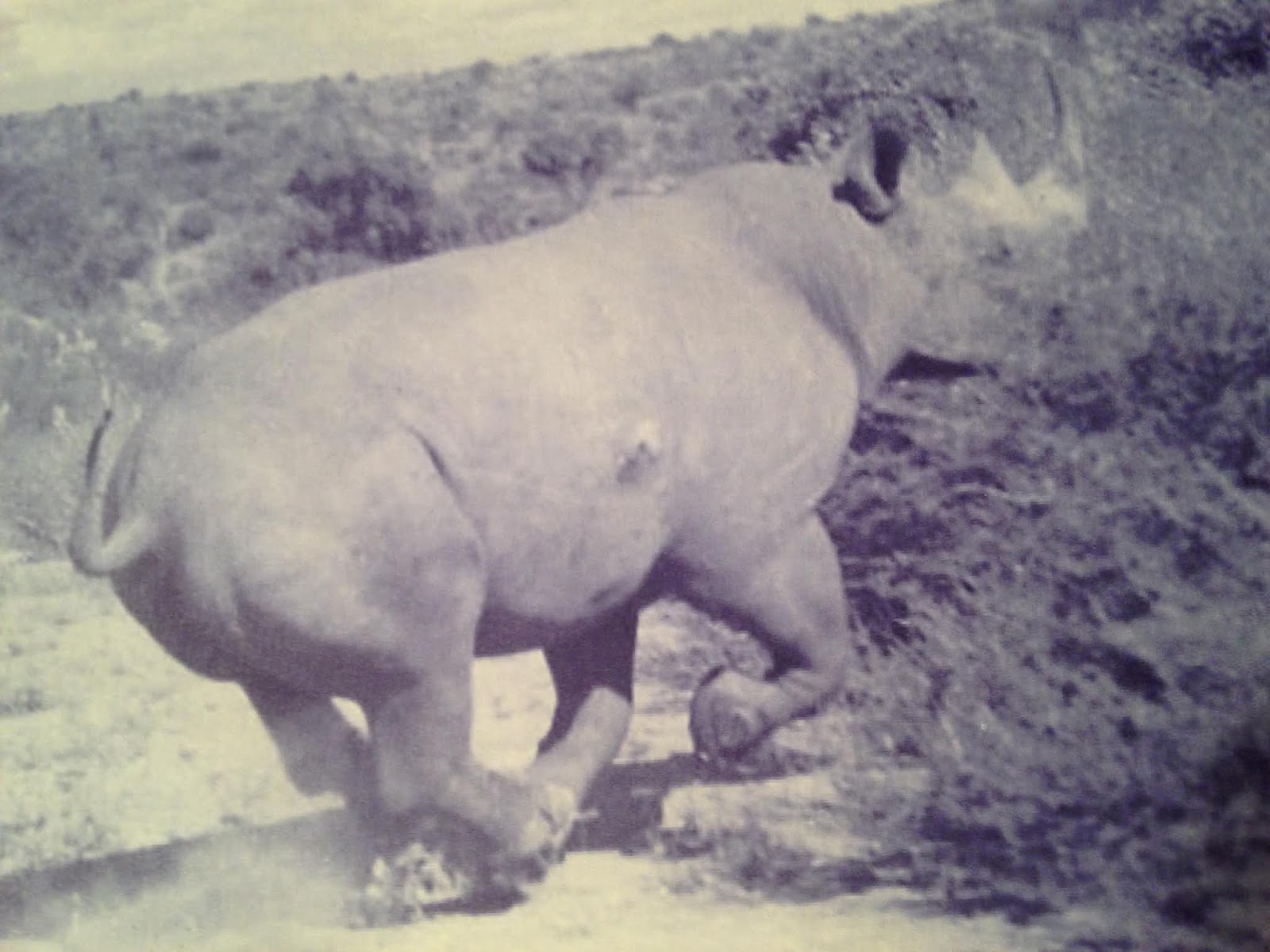
Photo by Sally Puleston McIntosh

Yes, that's the actual rhino which charged us.

Along with laughter, our reactions were simultaneous yelps of "holy shit", "oh my God!", "whoa, man!" and whatever other expletives were common in 1968. Someone may have even blurted out "groovy!"  It was like we'd been watching a movie and suddenly here's the scary part.

For some reason not feeling that the rhino was going to turn around and come after us again, we just continued along on our way -- to the lodge! -- and rather merrily. But after another two or three miles on this two-tire-track-excuse-for-a-road, a new dilemma suddenly presented itself: the road led into a stream and continued out on the other side.

What to do?

We got close enough to the stream to see that a) it was about twenty yards wide, b) it had a sandy bottom, and c) the water was about a foot deep.

Could the bus make it across the stream?  Maybe.  Maybe not.

What to do?

The decision-making process among six teenagers began.

The kid who'd been driving the bus thought we could make it across.  His idea was to back up, pick up speed, and go for it, man!  Three of the others agreed.  It looked doable to them.  Only myself and one other student, Mary Noland, had second thoughts.

Like, wait a minute:

-- our VW bus isn't an all-terrain vehicle, like a Land Rover.  It's got small wheels and a tiny engine.  It's not made for this kind of thing.

-- we don't know how soft the sandy bottom is.  We may not be able to pick up enough traction to get across.

-- the sand may be camouflaging rocks or holes which could not only get the bus stuck but could damage it.

The others disagreed.  The basic reasoning was still, "Oh, come on, we can make it!"

Voices began to rise.   It went something like this:

-- Hang on, what if we DON'T make it???  We're on a road that's more like a trail than a real road.  We haven't seen a single other vehicle since we've been on it.  What if we get stuck in the stream and can't get the bus out?  Who's gonna help us?  What if we sit here for a day or two and nobody comes along?  We only have enough food to last for today.  Someone's gonna have to WALK back to the main road to get help. Who wants to volunteer to walk back to the main road?  And remember, between here and the main road there's a RHINOCEROS which just ATTACKED us!  A RHINOCEROS!    

And if these weren't reasons enough,  there was this:

-- look, we don't even know if we're on the right road to get to this lodge.

-- who cares about the damned lodge, anyway?

-- even if we make it across the stream now, we're going to have to do it again because we'll be coming back the same way.  So it's twice we'll have to make it across the stream.

-- let's just get the hell out of here and hope we don't meet Mister Rhinoceros again.

Finally we all agreed.

We turned around and drove back to the main road.  Luckily we did not see Mister Rhinoceros again and we arrived in Mombasa, if I recall, just before sunset.

Plus we got to live.

********


This "rhinoceros story" became one of the milestones in my memory for future reference. Years later it helped me conclude that, among many ways of categorizing types of people, you could say that:

1. There are people who can learn from observing the experiences of others. (foresight)

2. There are people who can't learn from observing the experiences of others but can learn from their own experiences. (hindsight)

3. And there are people who can't learn even from their own experiences. (no sight)

It also demonstrated to me that survival has a lot to do with the ability to simply confront what appears before you, to not be pretending it isn't there.  This isn't a movie you're in, it's your life.  

And it's helped me understand that there are people in this world who need danger to feel they are alive.   If it isn't dangerous, it isn't fun.  You meet people like that every once in a while.


********


Okay, let's fast forward ten years.  It's 1978.

Now I am driving a taxi in New York City, an occupation that has recognizing danger as one of the requirements for doing the job for more than a week.  (See my post "The Three Strikes and You're Out System" in this blog.)

One day I picked up a young man -- twenty-something, friendly, bright, talkative -- who was en route to JFK.  That's about a forty-five minute ride, so it provided time for us to have a real conversation.   I learned that he was from somewhere in the Midwest, had never been to New York before, and was impressed with the hustle and bustle of the city.  He'd graduated from a college in Ohio, had a couple of jobs since then which he'd found pretty boring, was not married or in a relationship, and was now going out into the world "to make my fortune".  

Interesting!  It's not every day that somebody tells you he's off to make his fortune.  

"Where are you going?"

"To Lebanon."

"Lebanon?  Why Lebanon?"

"They're having a civil war.  I'm gonna sell arms and ammunition."

"Really!  Who are you going to sell them to?"

"I don't know.  I'll find out when I get there."

"Uh, have you been to Lebanon before?"

"No."

"So you have contacts over there?"

"Not yet."

Oh my God, this was a guy who saw himself as some kind of character out of a movie: a Robin Hood, James Bond, or Lawrence of Arabia.   But I saw him as someone who was about to go to great lengths to get himself killed.  Apparently he had no idea what he could be getting himself into.  He also had no considerations about the ethics of profiting from the sale of weapons to people who were trying to kill each other.  It was all going to be a glorious adventure.  And he'll be rich.  

I thought I'd take a shot at changing his mind, as unlikely as that was being that here he was, already on his way to the airport.  Nevertheless, I pulled the rhinoceros story out of my hat.  When the subject of danger comes up in conversation, especially when it involves people who seem to have a blind spot in that area, if there's time and they're up for it, I will tell them the rhinoceros story.  

So I said something along the lines of doing what he's planning on doing sounds intriguingly dangerous and I've got a great story about danger for you.  It's kind of long, but do you want to hear it?

Of course he did, being that danger was his thing.

So I told him how this group of teenagers riding around in a VW bus in a game park in Kenya (I didn't mention its name) back in '68 had a close encounter with a rhinoceros and how obtuse we were to the danger we were in at the time.  Just a rite of passage from adolescence, I said.  I was trying to bring the story around to how maybe he should rethink what the danger of being an amateur arms dealer in an unknown country might be, but before I could get to that he interrupted me.  

"Wow", he said, "that is so interesting that you should tell me this!"

"Why?"

"Just last year the mother of a friend of mine was on a safari in a game park in Kenya.  She stepped out of the vehicle they were riding around in to take pictures and she was trampled to death by a rhinoceros!"

"Oh my God!  Really?"

"Yes!"

"Do you know the name of the park she was in?"

"Yeah," he said, "it's called Tsavo."


It may have been the same rhino.


Monday, March 15, 2010

Stranger In A Strange Land

I was driving down Columbus Avenue on the west side of Manhattan a couple of Sundays ago at 2 a.m., doing what I am often doing at that time of the night - looking for my next fare. Columbus is a one-way avenue with synchronized lights that move like a wave, and the best way of getting that hoped-for passenger is by riding the front of the wave, much like a surf boarder. This gives you the best chance of being the first cabbie to get to someone who may be looking for your services somewhere down the road.

It's a routine thing for me, something I've been doing for so long I could probably do it blindfolded, just based on the timing of the lights that becomes internalized as years go by. But as I approached 79th Street, something not at all routine occurred quite suddenly. A pedestrian was crossing against the light, from the west side of Columbus to the east, causing me to slow down a bit to avoid hitting him. There's nothing unusual about that, of course. Pedestrians are known to be reckless in New York City. What was unusual was who this pedestrian was.

It was a coyote.

I think that's worth repeating: I braked for a coyote crossing Columbus Avenue!

Now, if you have ever been to New York City or if you live here, you know without need of further explanation how impossible that is. But in case you've never visited the Big Apple, let me tell you that Manhattan is an island upon which Man has evicted all but a few select members of the animal kingdom (pigeons, sparrows, chipmunks, rats, mice, a few raccoons, and a hawk or two) and created a world of skyscrapers, subways, and coffee shops that is meant for HUMANS ONLY. So the sudden appearance of a coyote on Columbus Avenue is almost as unheard of as would be the sudden appearance of an elephant or a camel on East 34th Street (which I have also seen, by the way, but they were a part of the annual parade of circus animals en route to Madison Square Garden, so it doesn't count).

The coyote moved just quickly enough to avoid the oncoming vehicles, as many humans do, and stopped on the sidewalk at 79th Street. Realizing I was witnessing an extraordinary event, I brought the cab to a halt, as all the other vehicles proceeded down the avenue without me. For about ten seconds, separated by not more than thirty feet, we checked each other out. I had thought that perhaps it was a dog, but as he turned to face me I could see that, although they were quite similar, this was not a member of that group known as "man's best friend". It had a wolfish face and an independence in its bearing that was not like that of a domesticated animal. It was definitely a coyote.

My immediate thought was to get his picture. I carry a camera with me at all times that sits beside me on the front seat and I grabbed it. But, as often happens in street photography, by the time I had the power on and had brought the viewfinder up to my eye, my subject had moved away, trotting into a four-block-long park that surrounds the back of the American Museum of Natural History. He was gone.

Nevertheless, I knew I still had a great photo opportunity on my hands, so I pulled the cab over to the curb, took camera in hand, and walked into the park at 79th Street in pursuit. The coyote had gone north, toward the park's 81st Street boundary, and I caught sight of him again from a distance of about one block. There then began a fascinating game of cat and mouse (so to speak) between the two of us.

Envision this scene, if you will: just myself and this animal in a snow-covered park at two in the morning, with no pedestrians on the streets and the only sounds to be heard coming from the occasional rumblings of automobiles moving down Columbus Avenue. The stillness, silence, cold air, and light from a full moon evoked an appropriate feeling of actually being in the wilderness. I could tell that the coyote had caught sight of me and was aware that I was following him. Whenever I moved, he moved. When I stopped, he stopped. And, as if to frustrate me, whenever I was about to snap a picture, he would move again.

Even so, I was able to take a few pictures. I shot a distance of about a hundred yards with a hefty zoom lens, but with the darkness and the unwillingness of my subject to stand still, I must admit these pictures are not very clear. Here's what I came away with...


I spent about ten minutes in the park with the coyote until he finally exited near 81st Street, went back out on Columbus Avenue, and lost me. I circled the area a couple of times in the cab, but couldn't spot him again. I pulled over to the curb to check how my pictures had come out and had a few reflections about the experience. First, how completely odd and curious it was that, of all the locations he could wander into, he chose the grounds of the Museum of Natural History. It was as if he was seeking sanctuary in the one place that humans have set aside for the study and understanding of nature and its creatures.

Next, how astonishing it was for a shift of taxi driving to be interrupted by a wildlife adventure in the middle of Manhattan. That is surreal.

And finally, I found myself empathizing with the plight of the coyote. He had somehow wandered away from his natural habitat and found himself a stranger in a very strange land. It's a feeling I've often had in my own life.

I wondered if I should call the police and report the sighting. but I decided against it because of a previous occurrence. A few years ago there had been another coyote in Manhattan and, amazingly, I saw that one, too, walking alongside the wall that adjoins Central Park on 5th Avenue one night at 3 a.m. The next day it was on the news that the cops had been chasing the poor animal around Central Park all day and finally were able to capture it and turn it over to the wildlife service. Unfortunately, two weeks later it died in captivity. I really didn't want that to happen to this one, so I didn't call the police and wasn't even going to write this post about it unless the media reported its presence, which they did a couple of days later. It was reported that a coyote had been sighted in Chelsea and was being pursued by the police around the West Side Highway, but had slipped away. No one knew how it got into Manhattan, but speculation was that it might have wandered south through Westchester County and come across the river on railroad tracks.

To this point the coyote hasn't been seen again.

I hope he made it back home.


********
And when he got there, it would be great if he clicked here for Pictures From A Taxi.

Monday, July 30, 2007

Animals In Manhattan

I had a passenger the other day who asked me if I'd ever had an animal in my cab other than a dog or a cat.

What a great question!

I thought that surely at one time or another there must have been something. Someone with a snake or a hamster or a rabbit or something. And finally after racking my brain over it for a minute or two I did think of a ride where I'd had a woman who was taking home with her the "office parrot". She worked in a law firm and every day brought her parrot in to the office in a nifty little plastic transporting box. The parrot was the beloved mascot of the lawyers.

But other than that, not counting a wide variety of drunks, in 29 years there have never been any animals in my cab other than dogs and cats. Although, come to think of it, I did have a cab for a single shift one night that had cockroaches in it. Does that count?

Anyway, my passenger's question led into a related topic of conversation - the subject of what animals either of us had ever seen on the streets of the city. Now after some contemplation on this, I realized that any such list would have to be divided into two categories:

a) animals that were being controlled by humans, and

b) animals in the wild.

It turns out the list of animals being controlled by humans is long and tremendously varied. On the streets of New York I have seen snakes, lizards, monkeys, horses (around Central Park, of course, a common sight), lots of parrots on people's shoulders, and a parade of circus animals on 34th Street en route to Madison Square Garden (camels, zebras, and elephants). And many years ago there used to be some kind of Peruvian fellow on 6th Avenue who walked a llama around on a leash.

But it's the list of animals running around on their own in the middle of Manhattan that is the most intriguing. Okay, what have we got? Pigeons, sparrows, squirrels, rats, and mice. I have seen raccoons several times very late at night on 5th Avenue and Central Park West, so I guess you'd have to add them to the list, too. And I've been told there are a few hawks nesting on ledges of very tall buildings, although I've never seen one. But that's it, right? I can't think of any other animals that are indigenous to New York City. Except one.

There was that coyote...

Do you remember that story about the coyote that was running around in Central Park in March '06? Nobody knows how he got there, but suddenly one day there was this coyote. It took two days for the police to catch him. Amazingly, I actually saw this animal myself.

I was driving down 5th Avenue, which borders Central Park on the east, at around 3 am one night and suddenly I caught a glimpse of a strange-looking animal walking rapidly on the sidewalk next to the park. The animal was dog-like, but you could tell that it wasn't a dog. I could see that it was in some distress as it had a fearful demeanor and its tail was between its legs. Another cabbie on my right saw it, too, and we both slowed down to about 5 mph as we tried to understand whatever it was that we'd both witnessed.

"Maybe it escaped from the zoo," he called out to me.

That seemed like a good enough answer for whatever the hell it was and I put the matter out of my mind. Then the next day the big news in the city was about this coyote that was running around in Central Park.

Anyway, since having this discussion about animals in the city, I have been taking every opportunity I can find lately to ask my passengers this sure-fire conversation starter:

"What is the most unexpected encounter you've ever had with an animal?"

Isn't that a great question?


And another great question is, "Would you like to click here for Pictures From A Taxi?"

Saturday, July 14, 2007

Chefs, Woodpeckers, and George Costanza

Last Tuesday night was going along like any other night shift...

-- a ride to Grand Central

-- people going out for the evening

-- some guy who took the subway to the wrong stop and now needed a cab because he was running late

-- an "inner city" kid going from the East Village to Bed-Stuy in Brooklyn with whom I discussed in detail the All-Star Game and the plight of the National League.

But as the night wore on the shift acquired a little theme. Within a few hours I had several memorable rides that each had something to do with the world of television...


10:35 pm - I was again discussing baseball's All-Star Game, this time with a male thirty-something going from 33rd and Broadway to Clinton and Grand in the Lower East Side, when the guy tells me that for 7 years he held the exact same job that the George Costanza character played in "Seinfeld" - assistant to the traveling secretary of the NY Yankees. This meant that for 7 years he was the butt of jokes from his friends and even suspected he was being referred to as "Costanza" behind his back. He said he and the staff would meet with Yankee owner George Steinbrenner every day at 10 am for a strategy meeting and I was surprised to hear him say that Steinbrenner is actually quite a nice guy, at least in his opinion. So why did he leave the job? The pay was too low, only 30 grand per year. Okay, but I'm thinking, how cool would it be to have your office in Yankee Stadium?

11:40 pm - I took a young lady from 72nd and Amsterdam to 49th and 2nd who turned out to be someone I think of as being an "uplifting personality". Someone who is so cheerful, so conversational, and so interesting and interested at the same time that you actually feel uplifted after being around her for awhile. We had one of those discussions that travel effortlessly from one subject to another and probably could have gone on for an hour, only to be abruptly ended by arriving at her destination. As she started to pay me she noticed something on the other side of the intersection and said, "Oh, there's one of my billboards!"

She was referring to an illuminated advertisement on the outside of a telephone booth for a reality show called "Top Chef" that airs on the Bravo channel on Wednesdays. It turns out my passenger is a chef who is currently competing with other culinary rivals for a prize of $100,000 and there she was, with the other contestants, in her white chef hat staring out at me from the ad - while also staring out at me from the back seat of my cab. Another unique taxi-driving experience for me! Actually, I've long imagined how wild it would be to have a passenger in the cab who was also the model whose picture happened to be used in the advertisement on top of the cab. I guess this was the next best thing.

Anyway, her name is Sara Nguyen and you see her here posing for me in front of her own picture. I want everyone who reads this to watch the show and root for Sara. Then when she wins she's going to invite us all over to her place and cook us a big meal. (joke)

Go, Sara!

2:32 am - the streets of Manhattan become relatively empty on a Tuesday after midnight and this is when crafty taxi drivers distinguish themselves from the ones who don't really know what they're doing. You know, driving a cab is a lot like being a fisherman. You have to know where they're biting and where the big ones are. It takes experience.

Anyway, not to brag, but here's how I reeled in a passenger at 2:32 am. Anyone who's ever driven a cab in NYC will appreciate this. I was driving down one of my standard late-night cruising streets in Midtown (no, I will not tell you which one!) and I know that on this particular street there's a building where film post production goes on 24/7 and they do not use "black cars" (car services used by corporations to give their employees a free ride home). So I always have an eye on this place. A woman came out of the building and gave me just enough of a glance to tell me she wanted a cab. I slowed down, hoping she would hail me, but she did not. Instead, she kept walking in the opposite direction from which I was driving. Yet I knew she wanted a cab and I knew the only reason she didn't raise her arm was because I was not driving in the direction she wanted to go.

So, instead of giving up on her, I circled the block and within 30 seconds I was back to the spot where I thought she would be if she hadn't already found another taxi. And she was. And she got into my cab.

And that is how expert fishermen catch fish in NYC.

She was headed out to Forest Hills in Queens, a 20 minute ride. I asked her if she was editing a film. She was. And that led to a conversation that pretty much took up the whole trip. The film is going to be a 90-minute documentary about the ivory-billed woodpecker, a bird that was thought to be extinct, but now is thought to be maybe not extinct after all. She told me there have been sightings of the woodpecker in deeply forested and remote areas by reliable "birders" (as they're called), but no one has ever gotten a photograph of it. And that the film is intended for release in movie theaters.

I thought that was interesting, in fact, very interesting, but - come on - how could a movie like this be commercial enough to compete with regular feature films? She told me some amazing statistic about how many birders there are out there. Something like 42 million people. And that to them finding this woodpecker is like the quest for the Holy Grail. It's the ultimate of the ultimates.

Still, she admitted, the thing may wind up on Animal Planet.

Chalk another one up to "the things you learn from driving a cab". Extinct woodpeckers - who knew?

3:15 am - coming back to Manhattan from this ride, I crossed the 59th Street Bridge and was heading west on 63rd Street when, just as I began to go through a green light at 3rd Avenue, I witnessed something you never see except on television - a high speed car chase. Screaming through a red light at 70 miles per hour was a small, white car that, if I'd been two seconds further into the intersection, would have t-boned my cab. About three blocks behind it were about 20 police cars which, to their credit, were making sure the intersections were clear before going through them.

Actually, it looked to me like the runaway car was going to get away. It also looked kind of surreal because this is a scene you never see in the city. But you do see it in cop shows all the time.

As I traveled west toward my usual cruising routes it occurred to me that it was like I'd spent Tuesday night at home and watched TV. I'd seen a sitcom, a food show, an animal show, and an action flick. All that was missing was a talk show. But, then again, my cab is a talk show, so I guess I had that, too.


And all you have to do to see the Pictures From A Taxi show is click here.

Thursday, March 22, 2007

Characters

Some recent ones...

Sunday night, 3:48 am, 49th and Broadway. A twenty-something, good-looking female comes out of the Playwrights Tavern, gets in the cab, and we are headed for 79th between West End and Riverside. She has a nice, friendly space about her and it would be easy to have a conversation with her, but, as is the case so often these days, she is preoccupied with a cell phone conversation that was already in progress before she got in the taxi. Some kind of a late-night emergency is underway and she asks me in a polite way to get her there as quickly as possible.

There is virtually no traffic at this time of the night and I know where the green lights are, so within four minutes we have shot up the Henry Hudson Parkway to the 79th Street exit and have arrived at her desintation. But she directs me not to turn off the meter - another passenger is going to join us and then we will be proceeding to 88th Street between Columbus and Central Park West. Within a minute her friend, another twenty-something female, comes running out of an apartment building, crosses 79th Street, and jumps in the taxi.

Of course my curiosity has been aroused and I am wondering what the emergency is all about. I'm thinking it's most likely a romantic problem. The second girl is probably having boyfriend troubles and needs a shoulder to cry on. Or maybe it's a family crisis. Maybe she just got a phone call from her mother in San Diego and learned that her brother was in a car accident. Or maybe her dog is sick and she needs to get him to a vet. No, that couldn't be it - she doesn't have a dog with her. Maybe she realized she doesn't have any decent clothes to wear to work the next day and she wants to borrow something from her friend. No, who the hell would do that at 3:48 in the morning?

I find myself in full fly-on-the-wall mode with the radio off and my ears straining to hear what they're talking about (also known as "eavesdropping"). I have a feeling this is going to be a good one. And it is. The second girl, it turns out, was awakened from a deep sleep by something moving under her pillow and now is afraid to stay in her own apartment. So she's going over to her friend's place to spend the rest of the night. What was under her pillow?

A mouse!

She goes on to say that she's not sure if there's one mouse or more than one mouse but her attempts to kill it, or them, with mouse traps coated with peanut butter and chocolate syrup have failed. And now she's too freaked out to stay there.

When we arrive at 88th Street I tell them I couldn't help overhearing their conversation (which was fine with them) and I make the obvious suggestion: get a cat! The second girl says that, in fact, she is planning on "borrowing" the cat of another friend of hers. Which gets me thinking this could be a brilliant business idea - "Rent-A-Cat". Hmmm....


Monday night, 11:15 pm, Empire State Building. two young guys come out of the Empire State Building on 33rd and 5th, jump in the cab, and we are off to Greenwich Village. They turn out to be from Sweden and are in search of a bar I had never heard of, The Spotted Pig, at Greenwich Avenue and 11th Street. They tell me it was recommended to them by a customs agent at the airport which sounded like a weird source of information to me so I joke that it's probably a set-up for a drug bust. They wonder if I'm familiar with a band that's supposed to be playing there but I tell them my usual answer to the subject of popular music which is that I haven't been aware of anything new since the Beatles broke up. And, in fact, I'm still waiting for the Beatles to get back together again.

Well, I said the magic words. They are Beatles fans, big time. One of them is actually wearing a Beatles t-shirt and the other has a very cool Beatles belt on. AND they are members of a rock band called Like A John Needs A Yoko! I am blown away. How refreshing it is to meet a couple of guys who are about 30 years younger than I am and who know more about Beatles music than I do!


Their names are Jon (on the left) and Andy. You can hear some of their music if you click onto their link, above. I tell them my John Lennon stories (click on the "John Lennon" label below to read it) and a May Pang story I happen to have and they are truly a receptive audience.

It's too bad these guys are over twenty-one. I want to adopt them.


Tuesday night, 9:35 pm, 52nd and Broadway. Two thirty-something fellows and a sixty-ish woman, all from the U.K., squeeze into the back seat and are en route to the Marriott hotel in Brooklyn Heights. One of the gentlemen is the stage manager of a Shakespeare company that is performing The Taming of the Shrew at B.A.M. (the Brooklyn Academy of Music). We engage in a lively conversation about the show, his job, and the Bard, but it is something that the lady says that amazes me.

She mentions that she is from Wales but has never been to London.

I have been to London. Twice. And she has been to New York. But never to London. I didn't delve into how that could be - it seems incredible to me - but I found it to be fascinating. And it reminded me of another fare I had many years ago.

In 1986 I picked up a woman who was in her thirties who was accompanied by her mother, who was probably close to seventy. The daughter lived and worked in the city and was playing tour guide hostess for her mom, who was seeing New York for the very first time. What amazed me was that Mom was from New Hampshire, only a five or six hour drive away.

How could someone live their entire life so close to the greatest American city, the center of the universe, so to speak, and never think it worthwhile enough to come see it? I asked her why she had decided to come now.

"To see Liberace!" she said.

Indeed, the great showman was playing at Radio City Music Hall at the time. And it turned out to be his last appearance in New York, as he died a year later.

Timing is everything.

Click here for Pictures From A Taxi.