Thursday, May 26, 2011

Celebrity Look-Alikes

Has anyone ever told you that you look like a certain celebrity?

Over many years of taxi-driving, I have found this question popping up from time to time between myself and various passengers. It, like the question posed in my last post - "Have you ever met or known of anyone with the same first and last name as your own?" - is a sure-fire conversation spark plug. Really, it never fails to get a response. By actual survey, I've found that the majority of people say "yes" to that question when asked. And then they'll tell me which celebrity it is and I'll usually see a vague resemblance. ("Ah, yes, you both have two eyes and a nose!")

But sometimes the passenger really is a celebrity look-alike. Many years ago (before he died) I had a man in my cab who was a dead ringer for Henry Fonda. This fellow looked so much like Henry Fonda that I thought he was Henry Fonda.

"Uh, are you Henry Fonda?" I asked, figuring the straightforward was the best approach.

"Nope," he said with a smile, "just look like him."

I still wasn't sure. Maybe this was the real Henry Fonda's way of avoiding annoying people. Only after a few more back and forths was I able to discern that, indeed, my passenger was not Henry Fonda. Then he told me a story about a time he'd played in a charity golf tournament in which Henry Fonda himself was a participant. With great pleasure in the recollection, he remembered the reactions of all the people who saw him there and had no questions in their minds that he was the actual item. What an opportunity for the accidental wannabe.

Another time I had a young man in my cab who told me he made his living as Michael J. Fox's body double. Seeing him close-up, you would not have mistaken him for Michael J. Fox. The face was similar, but not convincingly so. However, his height, weight, bone structure, hairline, and hair color were identical. His job was to stand in for the star when only long-distance shots were on the schedule. This enabled the real Michael J. Fox to not have to show up on the set that day so he could do other things. What a gig!

It can also happen that the person you thought bore a resemblance to a certain celebrity turns out to actually be that celebrity! One night I picked up a man coming out of a bar on the Upper West Side who was wearing a skullcap that covered most of his head. He told me he wanted to go to a building on Central Park West, just a few blocks away, and asked if I could wait for him for a few minutes while he went inside, explaining that it was his daughter's birthday and he wanted to drop off a present.

Not a problem. He made his delivery and, upon returning to the back seat, took off his hat. Suddenly his appearance caught my attention.

"Say, do people ever tell you that you look like James Taylor?" I asked.

"Yeah, it happens all the time," he replied, "...I am James Taylor."

I looked at him more closely in the mirror. Goddamn, it was James Taylor!

"Oh. Hi, J.T.," I said.

And then I drove him back to the bar.

It is not always me who brings up this subject of celebrity look-alikes. I have often been told by passengers on their own origination that they think I look like such and such a famous person. Going back to the late '70s, when I started driving, and throughout the '80s, I was frequently told that I bore a resemblance to three celebrities in particular: Dick Cavett (an American talk-show host who peaked in popularity in the '70s); Chevy Chase (the comic actor); and Richard Dreyfuss (the movie star). Of the three, the only one I myself could see a resemblance to was Chevy Chase, particularly from certain angles. In fact, a couple of times people on the street approached me thinking I was Chevy Chase, which gave me a little vicarious thrill. However, as years went by and the aging process affected Chevy and me differently, the similarities kind of mutated and disappeared. Now I have to settle for the occasional half-blind passenger telling me I look like Dustin Hoffman or Woody Allen, neither of whom I look anything like, at all.

Now, to jump back to Karma Versus Coincidence again, what are the odds of this happening? Of the three celebrities I just mentioned whom I'd often been told that I resemble, two them - Dick Cavett and Richard Dreyfuss - eventually became passengers in my cab. What are the odds against that? A million to one? A hundred million zillion to one? But it did happen. And in both cases it gave me an opportunity which I think anyone who's ever been told that they look like a celebrity would love to have: the chance to ask the celebrity what he thinks.

Dick Cavett was first, in the autumn of 1980. He and his wife, Carrie Nye, hailed me as they emerged from a rear entrance to Lincoln Center on Amsterdam Avenue, and jumped in. I recognized him immediately and greeted him with a smile.

"Dick Cavett," I said cheerfully, "hi!"

I've had over a hundred celebrities in my cab over the years, most of them more famous than Dick Cavett, but his response to my greeting put him in a special celebrity category that is his alone: "Snob".

"79th and Park," he replied.

No return of my greeting, no show of being glad to be recognized, no smile, no "hello". Just "79th and Park". No "please", either.

Ouch.

Well, the nuance of his response was clear to even the oft-obtuse me. He was not allowing for the temporary equality of stature between taxi driver and passenger which - it may surprise you - is usually the case with very famous and influential people. (Read my Robin Williams story, for an example.) Instead, he had erected a little wall which said, "I'm on this side, you're on that side. Stay where you are."

Having been put in my place, I drove toward his destination without any attempt at conversation. I was heading for the Central Park transverse at 81st Street when a request came forth from the back seat to make a stop at a building on 83rd and Central Park West and wait there for a minute or two.

Sure.

I navigated the route and pulled up to the apartment house there in two minutes' time. Dick Cavett got out and scurried off into the building, leaving his wife behind with me. Rather than sit there in an uncomfortable silence, I attempted some small talk with her and found her to be a pleasant and conversational person. Perhaps that loosened me up a bit, as when her husband returned to the cab a couple of minutes later, I felt comfortable enough to pose the question to him that had been on my mind all the while.

"Mister Cavett," I said (he is the only celebrity I've ever felt that I needed to address as "mister"), "I have been told by people from time to time that they think I look like you. Do people ever tell you that they think you look like me?"

To his credit, Dick Cavett (who made his living as a quick-thinking wit) was right on it. He looked over at my name on my hack license and said, "Yes, as a matter of fact, I was having lunch with Greta Garbo just the other day and she mentioned to me that I look like that taxi driver, Eugene Salomon."

This was very funny because, in case you didn't know about Greta Garbo, she was a big movie star in the '30s who quit the movie business, retired to New York City, and never gave an interview again in her life. So it was a talk-show host's ultimate wet dream to ever be able to have a meeting with her, as she was so completely unobtainable.

I never did get Dick Cavett's opinion as to whether or not he thought I looked like him, but by this time it didn't matter to me. I was happy enough just to get any reaction at all, so I left it at that.

Richard Dreyfuss, on the other hand, was a piece of cake. As is usually the case with big-name celebrities, he was friendly, courteous, and very easy to talk to. I picked him up in the Theater District, where he was doing a Broadway show, and drove him to the Upper West Side where, he said, he was going to go shopping for a new watch. We chatted it up all the way to his destination on Columbus Avenue and then, just as he was about to get out, I hit him with my big question.
Turning around in my seat so he could easily see my face, I said this:

"I've often been told by passengers that they think I look like you. Do you think I look like you?"
He studied me carefully for a few moments before rendering judgement. I turned a bit from side to side and changed the expression on my face to give him more to work with, the tension mounting. Finally, he spoke.

"Hmmm..." he said, "no... but you've got a Richard Dreyfuss attitude."

And I've been a fan ever since!


********


Hey, buddy, can you spare a click? Put it here for Pictures From A Taxi.

Saturday, April 09, 2011

Karma Vs. Coincidence Strikes Again

Was it karma?

Or coincidence?

That is the question, and if you've been reading this blog for a while you know this is a little, pet recurring theme of mine. Something happens that would seem to utterly violate the laws of probability and you have to wonder whether it was just a wild coincidence or if there's a mysterious, natural phenomenon at work.

Karma?

Or coincidence?

Well, it happened again recently and I'm telling you now there wasn't a snowflake's chance in Hades that this could have been a coincidence! No way! But that's just my opinion. What do you think?

I was cruising on the Bowery in the Lower East Side a few weeks ago in search of the next one when I was hailed by two maybe-over-twenty young ladies - a redhead and a brunette - at about 8 p.m. They were smiling and pleasant and had what I would call very "clean spaces" around them, which made having a conversation with them not only an easy thing to do, but a natural thing to do. It was one of those rides that just had an immediate known-you-for-a-long-time feel to it, so to speak.

As our trip got going, for some reason one of them brought up my name, which she'd noticed on my hack license, as a topic for discussion.

"So, what kind of a name is Eugene Salomon?" she asked.

"That's a name with five syllables," I replied.

"You know," she continued with a laugh, "like what's the ethnic origin of that name?"

"Well, my last name, Salomon, is a biblical name that goes back to the Old Testament, as in King Solomon. Eugene appears in many languages in slightly different forms. Eugenio, for example, is the Spanish version, Eugene is the Irish. My mother's side of the family was from Ireland, so that's why I was given that name."

That seemed to satisfy her curiosity. But it reminded me of something that had happened a couple of times in my cab, so I asked them a question of my own about names. It's a great question, by the way, a real conversation starter.

"Tell me something," I inquired, "have you ever met anyone who has the same name as you? Or had someone tell you that they know someone who has the same name as you?"

They thought about it.

"First and last names?" one of them asked.

"Yeah, it's got to be both."

"No, I haven't," one of them said after some consideration, a little disappointed.

"I met someone once who had the same first name as me," the other one said, "but never both names."

"Only once? What's your name?"

"It's unusual - Corrina," she said.

Indeed it was unusual - not unheard of, but not common, either.

"It's happened to me twice," I said.

"Both names?" the redhead asked.

"Yeah."

"Wow, that's freaky," she said.

It was freaky. I told them the stories.

The first one, which happened about twenty years ago, was the time a passenger's jaw dropped when she saw my name on my hack license because, she said, it was also her own father's name. I wound up writing a note to him which said, "To Eugene Salomon, Best wishes and good luck, from Eugene Salomon." I wished I could have seen Eugene Salomon's face when he read that!

The second time, also about twenty years ago, two businessmen from Spain squealed, "Increible!" and told me their boss' name back in Madrid was also Eugene Salomon. Same name, same spelling.

Increible!

Well, our ride was soon over and the two cheerful young ladies paid the fare, gave me a generous tip, and were on their way. My evening continued with the next few fares taking me from the Lower East Side to Greenwich Village, from Midtown to somewhere else in Midtown, to the Upper East Side and from there back to Midtown again.

At around 9:30 a middle-aged man jumped in at 49th and 1st who was heading for the Upper West Side. We drove about ten blocks up 1st Avenue with a little chit-chat and then, from out of nowhere, he says:

"Hey, I know someone who has the same name as you."

"You mean the same first and last name?"

"Yeah!"

That sign post up ahead, which actually said, "No Parking, 8 a.m. to 6 p.m.," suddenly appeared to me to be saying, "You are entering The Twilight Zone." Perhaps this guy was a Lizard Person from Planet Surreal and I was in the first stage of an alien abduction. This could not be happening.

He went on to tell me that he's an attorney and that the Eugene Salomon he knows is an entertainment lawyer in Los Angeles who occasionally sends him referrals. He said he's spoken with him numerous times on the phone but has never met him in person. In fact, he doesn't even know what he looks like. Which led, of course, to my joking that Eugene and I are actually the same person. There's no money in entertainment law, you see, so I supplement my income by driving a cab in New York one week out of every month. Then it's back to L.A.

Well, it turned out to be another ride in good spirits and not an alien abduction after all. (Or if it was, I don't remember any of it because those sneaky aliens always erase your memory of their abductions, right?) I told him about the other two times I'd had passengers in my cab tell me they knew someone with my exact same name. He was amazed. And then I told him that less than two hours ago I had told these same-name stories to the two girls who had asked me about my name. He was amazed again.

Now I ask you, what are the odds of this happening? It had been twenty years since anyone had told me that they knew someone with the same name as me and something like ten years since I had told anyone these stories. And then, within two hours of each other, I tell the stories to the two girls and bingo!, a person appears in my cab telling me he knows someone with my name.

Is there some kind of natural phenomenon, the rules of which we know not what, that causes this kind of thing to happen? Are the dynamics of thought, intention, and attention senior to the dynamics of the physical universe?

In other words, was it karma?

Or coincidence?

What do you think?


********


Okay, if you think it was karma, click here. If you think it was coincidence, click here.

Wednesday, March 23, 2011

Down Goes Frazier

Many people in New York assume that the taxicabs are busy all the time. It just ain't so. During any twenty-four hour period, there are hours that are extremely busy, it's true, but there are also hours that are only somewhat busy, and then there are hours that are extremely not-busy. During the night shift (5 p.m. to 5 a.m.) it goes like this from Sunday to Thursday: From 5 p.m. to 8 p.m. it's extremely busy. One passenger gets out and the next one gets in within three minutes. From 8 p.m. to midnight it's somewhat busy. Perhaps ten minutes between passengers.

From midnight to 3 a.m. it's extremely not busy. You could go half an hour or more between passengers.

And then from 3 a.m. to 5 a.m. it's so not busy that it turns out the phrase "the city that never sleeps" was just so much hype. There's a big-time catnap going on and you wish you could get on a foghorn and ride around screaming at people to get out of bed and do something! There's not much business at all, although you could be lucky and get an airport ride after 4:00.

On Fridays and Saturdays it's a different story. It's either extremely busy or somewhat busy throughout the whole shift, although it can get pretty slow on Fridays after 3 a.m.

However, there can be periods of time, like unexpected fluctuations in the weather, when these patterns can inexplicably change. It could be 7 p.m., for example, and half an hour goes by without a fare. Or at 2 a.m. from out of nowhere it's suddenly super-busy for a while. That phenomenon occurred recently on a Wednesday at 10:45 p.m. I had just dropped a passenger off at Madison and 24th and circled around onto 5th Avenue, heading downtown, to look for the next one. Pulling up to a red light at 23rd Street, I noticed something that cabbies love to see: there were perhaps six or seven people on both sides of the intersection, all looking for taxis. There's a certain rush that goes straight through to the core of a taxi driver's psyche when he sees this sight. It's an aesthetic thing, like a Mozart crescendo. How fortunate I am, the cabbie thinks, to be alive and to experience such beauty.

Since I was surrounded in the front, rear, and on both sides by other vehicles, the plan that instantly formed in my mind was to cross 23rd Street when the light turned green, veer over a couple lanes to the right, and pull up at the curb where there were several people who looked like they were in need of my services. I would place the cab kind of in the middle of them, without choosing anyone in particular, and let them work it out among themselves as to who would get possession of the coveted taxi. It's a tried and true method I use so as not to give the impression that I prefer one person over another.

But my plan suddenly became irrelevant as, coming toward me on foot, was a guy who did what many savvy New Yorkers do when demand exceeds supply: he walked directly into the middle of the street in order to gain possession of the cab before the light could turn green. It's a bold move that the more timid still standing on the sidewalk might construe as cheating, but it's certainly a part of the gamesmanship that is common in Manhattan when it comes to grabbing a cab. As he opened the rear door and sat down, I greeted him with a smile and, although I didn't say anything except hello, I was mentally admiring him for being a take-charge guy. He returned my greeting with a smile and an hello of his own and then surprised me by telling me that his destination was just across the street, at the far right corner of 23rd and 5th, the same spot I'd intended to drive to before he'd hopped in. He explained that a friend was waiting there and, I assumed, the friend would jump in the cab and the three of us would then be on our way to somewhere else.

Okay.

The light turned green and I put on my right-turn signal, skillfully maneuvered my way across two lanes of traffic, and came to a stop right where he wanted me to be. He opened his door on the curb side of 5th Avenue, as he should have, and then... the action began. A large man - about six-foot-one, 190 pounds, maybe thirty-five years old - moved forward on the sidewalk toward the cab. My passenger - who was something like five-foot-eight, 150 pounds, thirty years old - stepped out of the cab and, seeing that the other man wanted the cab, politely told him that it was not available because someone else was about to get in. Normally the other person would say, "Oh, okay," and step back. But not this guy. He stepped forward and, although I didn't catch exactly what he said, his body language and tone of voice were clearly saying, "Tough shit, jerk-off, this cab is mine!"

I knew immediately it was big trouble. Competition for possession of taxicabs - an indigenous sport in New York City - can be nasty, but it's extremely rare for it to be so in-your-face, especially between men.

The first guy fired back a sarcastic put-down of the other guy - "Oh, so you're owner of this cab, huh?" - and, realizing if he moved forward on the sidewalk that the other guy would get in, called out to the person who was waiting for him, a thirty-something woman, to come over to the taxi, which she did. This woman then stood in the space of the cab's opened door, thus securing possession of the taxi, at least for the moment, but she did not get in. She was apparently concerned for the safety of her friend who, although smiling, was in a heated jaw to jaw with the other guy.

After this went on for a very long thirty seconds, I decided I had to do something. There was no way I was going to let the other guy take the cab away from the first guy, so I thought if I told him this - politely, of course - I could be the face-saving interventionist who could end the conflict. So I got out of the cab and approached him.

"Listen," I said to the other guy, "he had the cab first. I started the meter already."

No response.

"I'm sure you'll get another cab in a minute. But I can't let you take this one, okay?" 

But I was talking to wall, a wailing wall at that, because he was so focused in on insulting and being insulted by the first guy that I don't think he could even see me. Really, it was like I wasn't there. Defeated as a referee, I walked over to the woman and suggested she get in the cab, but she wouldn't - "I want to make sure he's okay," she said.

"Why doesn't he just get in the taxi?" I asked her, figuring that she should know. If the two of them would just get in, I could drive away and that would be the end of it.

"He's not getting in," she replied. "He's got his bicycle chained to the pole over there," pointing to a sign post. 

Oh.

So there was more to this story than met the eye. The first guy must have been waiting with the woman there at that corner where the other guy was and, perhaps trying to impress her, had hustled across 23rd Street when he saw me - an empty cab! - pull up to the red light on the other side of the street. The other guy, who perhaps had been waiting at the corner longer and perhaps had put down a beer too many, was no doubt pissed off about what he perceived to have been a dirty rotten move and now, seeing that the first guy wasn't even getting into the cab himself, decided he was within his rights to be outraged at the injustice that had been perpetuated against him.

Of course, he wasn't within his rights. Hell, there are no rights when it comes to grabbing a cab, but you couldn't tell him that. He raged on at the first guy who at this point seemed to have had enough of the whole thing and simply turned his back and walked over a few steps to attend to his bicycle. He squatted down on bent knees to get to the lock, ignoring the other guy who, shadow-like, bent over, too, and continued to hurl invectives at the back of his head.

Suddenly the first guy stopped what he was doing and stood up, calmly.

He turned to the other guy.

And then... wham! He decked him with a right cross!

The other - much bigger - guy went down like a sack of potatoes. All right, like a sack of bagels - this is New York.

I was stunned, of course. But oddly enough, although this was real violence happening right in front of my eyes, it all seemed so comical to me. Seeing the other guy suddenly sprawled across the sidewalk, what came to mind immediately were the immortal words of legendary sportscaster Howard Cosell while broadcasting the heavyweight championship fight between George Foreman and Joe Frazier in Kingston, Jamaica, in 1973. Foreman connected with an uppercut to Frazier's jaw in the first round and Cosell's voice boomed:

"Down goes Frazier!"

"Down goes Frazier!"

"Down goes Frazier!"

(Here's the link to the call: https://youtu.be/JZEIMQ42-oU)

Well, the corner of 23rd and 5th wasn't a boxing ring in Kingston, but it was certainly a theater of the absurd - and it wasn't over. The other guy rose to his feet, turned to the first guy, and hurled not a fist, but another derogatory comment at him. The first guy looked at him, smiled, and then... wham!...

Down went Frazier once again!

Suddenly a woman I hadn't noticed before came rushing over to him. She helped him to his feet and began fussing over him. He leaned down so she could see if any damage had been done to his face and made a gesture to her that looked like he was inviting sympathy, as if to say, "Did you see what that awful, awful man did to me?" She touched his cheek like a mother bestowing a healing hand on her poor child's wound.

Meanwhile, the first guy, in a display that should earn him immediate acceptance into the Nonchalance Hall of Fame, turned his back on a much bigger man whom he'd just slugged twice and went back to the task of unlocking his bicycle. This accomplished, he then mounted the bike, waved goodbye to his female friend still standing in the space of the cab's opened door (and now stunned by what she had just seen), and pedaled away in no particular rush.

The other guy, with his own woman still consoling him, slumped off in the opposite direction.

The first guy's lady-friend finally got into the back seat and closed the door. Her destination was 19th between 8th and 9th, a distance so short it could have been walked in six minutes, making the whole incident even more absurd than it already was. I stepped on the gas and began my interrogation.

"Who is that guy?" I asked.

"He's a colleague - we work in the same office," she replied.

"What kind of work is it?" 

"It's online marketing, like doing surveys of customer satisfaction. That kind of stuff."

"Have you ever seen him do anything like that before?"

"No! He's usually like really 'even-Steven', you know? Except maybe when he's in a stressful situation, he might explode. But not physically, you know, just yelling at somebody." 

"Wow, that was really wild," I said.

"Yeah, that was wild," she agreed. I wasn't sure if her tone of voice implied an admiration for the guy, like maybe she was discovering that the caveman type really turned her on, or if she was thinking, wow, the guy is really a psycho. 

She used a credit card to pay for the ride, giving me a 25 per cent tip on a $6.70 fare. Not bad.

As I drove off in search of my next passenger, I had some time to contemplate this incident in relation to the broader scheme of things. You know, taxi drivers are low on the social totem pole - we don't generally get much respect. You've heard me complain about this from time to time. But, hey, when was the last time you ever heard of two patients slugging it out in the waiting room of an orthodontist over who gets to go in next? And when did anyone ever deck somebody because there was only one attorney left in the office and the big guy wanted him all to himself?

Damned right. It never happens.

********

Clicking here for Pictures From A Taxi does happen, however. But, please, no fighting! Just clicking!

Thursday, February 10, 2011

Village Voice Interview

I was interviewed last week in the online edition of The Village Voice, New York's "alternative weekly" newspaper. Here's the link:

http://blogs.villagevoice.com/runninscared/2011/02/nyc_taxi_driver.php

I liked the way it was done - questions sent to me in advance - as it gave me a chance to give thoughtful and hopefully entertaining answers. My only gripe is that some of my answers were edited out, for brevity's sake, I am told. So since, hey, I have my own voice right here, this is what I wanted people to know about one of the touchy subjects in the interview that was not published...

If you haven't ridden in a New York taxi since 2008, all cabs are now equipped with television monitors in the back seats which give out information, advertising, news, feature stories, and more advertising to passengers. The pictures and sound - the volume of which is under the control of the passenger - come on automatically when the meter is started. The speaker is about nine inches behind the head of the driver who must listen to the same repetitive programming over and over again during the course of a twelve-hour shift.

Obviously, the drivers hate these things. And most passengers, who may or may not be aware that they can turn it off, aren't too crazy about it, either.

Here's the thing that I wanted known that wasn't in the Village Voice piece, and I think it's an important point that has been overlooked by the public, the media, and the Taxi and Limousine Commission. It's that these things are dangerous. How so? They are distracting and irritating to the driver. As if driving a cab in the streets of New York City wasn't distracting and irritating enough without them!

The analogy I make to passengers in my cab when this subject comes up, and it comes up often, is how would you like it if, when you were flying in an airplane, there was a television nine inches behind the head of your pilot, the volume of which was under the control of the passengers? For that matter, how would you like it if this thing was nine inches behind the head of your bus driver? Well, guess what? Statistically, riding in a taxi is more dangerous than riding in either a plane or a bus.

Several years ago I was hailed from the street by a woman in a wheelchair. After helping her into the cab and putting the wheelchair in the trunk, she told me her story. She had been paralyzed in an accident in a taxicab in Chicago.

Have I made my case?

The main justification for the existence of the city agency known as the Taxi and Limousine Commission is to ensure the safety of the passengers. That is priority number one. So to add an unnecessary and unwanted element into the environment of the taxicab which is distracting and irritating to the driver is utterly contrary to its mandate.

And it needs to be changed.

So there is my rant. Other than its omission, I was quite happy with the interview. Hope you'll give it a click.


********
And while you're clicking, let's not forget to click here for Pictures From A Taxi!

Tuesday, January 04, 2011

The Car On East 86th Street

You may have heard that we had a blizzard in New York City on December 26th. They say it was in the vicinity of 20 inches and was the 6th largest snowstorm ever recorded here, but I don't know if it was really that big. It was certainly a huge storm, but men in general and weathermen in particular tend to exaggerate when it comes to inches.

In any case, the story here wasn't so much the storm itself as it was the failure of those in charge to clean it up. In New York the snow removal is done by the Sanitation Department. The army of sanitation workers, who are normally removing trash, become the people plowing and salting the streets. It's a highly organized, military-style operation when it's done correctly. The city streets are designated primary, secondary, and tertiary in importance and are attacked in that order. In Manhattan, this means the highways, avenues, and major cross-town streets are cleared first.

Taxi drivers need to be extremely aware of predictions of snowstorms, as the potential for disaster is everywhere even in relatively minor events. Unfortunately, most of us learn this the hard way. I was initiated by ice myself one night in 1981. We were in the beginning of a medium-sized storm and I was driving a Checker cab which had a two-way radio in it for business purposes (no longer allowed in yellow cabs). A call for a lucrative out-of-town ride kept coming through and no one would take it. Eventually the dispatcher was sounding desperate and I hesitatingly agreed to do the job, taking an executive from "Black Rock", the CBS headquarters on 6th Avenue, to his home in Darien, Connecticut. Although the snow was steadily falling, I had no problem getting the fellow to his residence. But a couple of minutes after dropping him off I skidded into a snow drift as I came down a hill and got completely stuck there. The Checkers (like the Ford Crown Victorias we drive today) had rear-wheel drive and thus had terrible traction in the snow. These were the days before cell phones, of course, and I was on a back road at midnight with no civilization in sight, so I was truly stuck and quite upset with Checkers, the weather, God, and especially myself for having taken the job against my better judgement in the first place. Luckily, a couple of very nice people in a four-wheel drive Jeep eventually came along and towed me out of there, even tagging along behind me to make sure I made it back to the highway safely. Lesson learned, and here it is. (New York taxi drivers, take note.)

1. If possible, don't drive at all during a real snow storm (more than three inches). Your chances of having an accident are enormously greater than normal and you won't make decent money, anyway, because the weather will slow you down to less than half speed and there isn't much business on the streets. People tend to stay indoors while the snow is coming down.

2. Wait a few hours until after the snow has stopped falling before venturing out. If the Sanitation Department is on the ball, the primary roads will be plowed and salted by that time.

3. For 24 hours after a major storm, ride with your "off-duty" light on and your doors locked. Ascertain that a passenger isn't leaving Manhattan before you allow him into your cab. The reason for this is that however bad the secondary and tertiary streets may be in Manhattan, they're much, much worse in the outer boroughs. Plus it will take you forever to get back to Manhattan (without a passenger) if you make it back at all.


4. Use the avenues and major cross-town streets as much as possible while driving in Manhattan. If a passenger's destination is on a street that hasn't been properly plowed, ask if it would be all right if you could drop them off on the corner (unless the passenger is disabled in any way).

Following my own rules, I called my garage when the storm was just beginning and told the dispatcher I would not be coming in, even though it was a Sunday, normally one of my driving days. He said that was okay, a fortunate response because the owner of the garage (my boss) might have instructed him to tell any driver who didn't come in that he'd have to pay for the shift even if he didn't work it. That's the way it's been since the recession started in '08 and garages have been overflowing with drivers, some of whom are turned away because there are no cabs for them. This surplus of drivers is a new thing in New York, by the way. In all my years in this business, there had never been a time when there were enough drivers for all the cabs. Until now.
Anyway, I agreed to drive the Monday night shift. It was seemingly a good strategy because the snow, as predicted, stopped falling on Monday morning and that gave the Sanitation Department over six hours to salt and plow the primary streets before my shift would begin at 5:00. That should be enough time, right?

Wrong!

I was alarmed when emerging from the subway to see major Manhattan avenues unsalted and snow-covered - not good! Walking a few blocks to my garage, I stared in astonished dismay at a bus that had been abandoned and was left completely blocking an intersection. It was an eerie sight I had never seen before and looked more like post-disaster than post-snowstorm.

I entered my garage where employees were coping with the chaos that blizzards create in the taxi world. I was given the keys to a cab and told it was "ready to go", meaning it wasn't stuck in a snow drift. An hour later, after clearing the cab and freeing it from the drift it wasn't in, I pulled out into the slippery night, wondering if what I'd seen between the subway stop and my garage had been an aberration.

It had not been. Manhattan was a mess. The avenues and major cross-town streets such as Houston and Canal had been plowed perhaps once before the snow had stopped falling and then were newly covered with a few more inches, enough to keep the top speed of vehicles at around ten miles per hour. Even Times Square was a slippery adventure at 8 p.m. And that's how things remained throughout the night. It wasn't until 2 a.m. that I finally saw some salters and plows on a few of the avenues. And the abandoned bus that I'd seen on my way to the garage was not alone - I encountered at least half a dozen more during the course of my shift.


As the night wore on, veterans of New York snowstorms such as myself and many of my passengers realized something was amiss and we began speculating through our anger as to what the hell was going on. This storm had not been a surprise. It had been forecast accurately more than a day before it arrived. Where was the Sanitation Department? Suspicion began to grow that this may not have been merely incompetence but may have been a union tactic against management - the conspiracy theory! The mayor, who is still trying to master the art of speaking from both sides of his mouth, at first was making excuses, saying that we'd "never seen a storm like this". (Oh, really? I have.) Then, noticing the rising tide of outrage, he started putting heads on pikes. Investigations have since been initiated by the City Council and even prosecutors, so we may someday get to the bottom of it.

But be that as it may, I realized in retrospect that, like many inconveniences and minor disasters, something of value had been inadvertently created by the mess. It was something I'd seen during the night but which took me until the next day to comprehend that it potentially had the stuff of legend about it. Something symbolic. Something that could stand as a metaphor for the angst of urban living.

It was the car on East 86th Street.
At 10 p.m. I picked up a woman at 86th and Amsterdam on the Upper West Side who wanted to go straight across the Central Park transverse to 91st Street and 1st Avenue on the Upper East Side. Our route would take us all the way across town on 86th, a major, four-lane cross-street that runs in both directions (in other words, it's not one-way, like most streets in Manhattan). It was this woman who told me about "the car". Apparently this vehicle had achieved instant infamy in the neighborhood.

She said that not too long after the snow had started coming down heavily during the previous night, at around 7 p.m., a car had been abandoned right in the middle of 86th Street between 2nd and 3rd Avenues. Not double-parked. Not pushed off to the side. Just sitting there in the middle of 86th Street. She, like I, had seen many big snowstorms in New York City, but she could not recall ever seeing a car just sitting there in the middle of a major crosstown street. Neither could I.

She went on to tell me that earlier in the evening she had taken a bus across town to the West Side, where I'd picked her up. The route of this bus went along 86th Street, but had encountered a problem in transit. It couldn't make its way around this abandoned car - which was still there eight hours after the snow had stopped falling - nor could any of the other buses on the 86th Street route.

Solution? Take a detour. All day long and into the night the buses that normally go straight across 86th had instead been making a left turn onto 2nd Avenue, going down to 79th Street (the next major cross-street), and then coming back uptown to 86th on 3rd Avenue in order to avoid "the car".

Slip-sliding along 86th Street, we wondered when we got over to the East Side if "the car" would still be there between 2nd and 3rd Avenues. Actually I was hoping it would be, as I wanted to witness the spectacle for myself.

It was!

We had a mutual lamentation about the absurdity of it. How many individuals and city agencies had dropped the ball here? First, of course, the person who had walked away from his own car and had not come back to get it out of there, even many hours after the snow had stopped falling. Second, the people in the area who assumingly could have at least helped him push the car off to the side. Third, whatever towing service the owner of the car could not get help from. Fourth, the Traffic Department which normally will tow your car away if it is twenty seconds beyond the time posted on the "no parking" sign. Fifth, the Police Department, which has tow trucks of its own. And sixth, the Transit Authority which we can assume was too busy trying to get their own buses out of the snow to do anything about a car that was blocking one of its routes.

There was, however, one city agency which had not dropped the ball.

The Sanitation Department.

For surrounding "the car" on both sides were piles of snow which had been deposited there by the plows attached to city garbage trucks, thus creating an impassable island in the middle of 86th Street.

You've gotta love irony.


********
And you've gotta love Pictures From A Taxi, too! Click here.

Sunday, December 12, 2010

The Oath

There are certain characteristics that make someone a "New Yorker". One of them, for example, is that a New Yorker must be a connoisseur of bagels. If a person doesn't know bagels and have a strong allegiance to a particular bagelry, well, he or she is not a "real" New Yorker. Sorry, but that's the law. You gotta know your bagels.

Another one is the way someone goes about hailing a cab. A cab driver can separate the amateurs from the professionals at a glance. The novice may wave his hand at a taxi which has its roof light off (meaning the meter is on and there's already a passenger in the cab). You would never see a real New Yorker do that. Or he may hail while standing on the sidewalk, a faux pas for a New Yorker, who will always step out a few feet into the street (so he can be seen).

A few Fridays ago around midnight I was cruising along on LaGuardia Place in Greenwich Village in search of my next customer when I came to a red light at West 4th Street. Three cars were in front of me there, putting me a short distance from the intersection. After a few seconds of red-light waiting, I noticed a welcome sight down at the corner: two people were standing on the sidewalk, looking at me and waving their arms in the air - my next passengers. I knew they were tourists because, as noted, they were standing on the sidewalk, but who cares? A customer is a customer and, besides, I love tourists.

Now, aside from the sidewalk blunder, they were also making another mistake that is characteristic of the uninitiated - instead of walking to me, they were waiting at the corner for the light to change and for me to approach them. It was quite busy on the streets at this time, with not too many available cabs around, so standing there and waiting was a risky thing to do.

And they paid the price.

Suddenly, coming from behind, was a twenty-something guy without inhibition. Raising his arm into a hail, he walked right past the couple on the corner, approached my cab, and got in. He then called out to his friends, another guy and a girl, who followed. It didn't seem to me that they were aware of the others' intention to obtain my services but, even if they had been, it's not my role to intervene. I've found through experience that it's best to stay neutral in these affairs. And, really, a cab isn't truly "taken" until someone is literally sitting on the back seat.

So in they got and off we went, passing the poor inept couple on the corner of West 4th, who looked at us with bewildered expressions on their faces as we zipped by. I found the episode somewhat amusing and commented on it to my new passengers.

"Well," I said, "that's the difference right there between a New Yorker and a tourist," and I went on to give the young man a compliment on his expertise when it comes to getting taxis.

"How long have you lived here? Ten years?" I asked.

"Actually, I don't live here," he said, "I'm from Canada."

I was shocked.

"Are you kidding me?"

"No, I'm from Toronto."

"But you come to New York often, right?"

"No, this is my first time. Well, I was at the airport a couple of years ago, but that doesn't count." And then he added that "ayy?" that Canadians are known for saying at the end of their sentences.

"Wow," I said, "I don't think you know how good you are. You did that like a veteran New Yorker - you're a natural!"

Well, he and his friends loved that. Visitors to New York often feel a bit intimidated by the speed of particle flow here until they get used to it, so a compliment from an entrenched New Yorker like a taxi driver is a valued communication, indeed. The affinity level in the cab shot way up and they told me they were all college buddies and were here for the weekend to attend the wedding of another college buddy and tonight was a party night at the apartment of another college buddy who now lives in New York and that is where they were going, ayy?

Well, I thought this group was swell, and they seemed to think I was swell, too. It suddenly occurred to me that there was a way I could acknowledge their swellness, particularly the swellness of the fellow who'd hailed me, whose name I now knew was Hermie.

"Hermie," I said as we came to a stop at 4th Street and 2nd Avenue, "I'm going to make you an honorary New Yorker. Raise your right hand and repeat after me." Realizing he was in the presence of Authority, Hermie lifted his arm up in the air, as I did mine.

"I, Hermie..."

"I, Hermie..."

"Do hereby declare my love for, and loyalty to, the city of New York..."

"Do hereby declare my love for, and loyalty to, the city of New York..."

"I promise never to wait for a WALK/DON'T WALK sign to change..."

"I promise never to wait for a WALK/DON'T WALK sign to change..."

"I will always obey the first rule of getting a cab, which is I SAW IT FIRST IT'S MINE..."

"I will always obey the first rule of getting a cab, which is I SAW IT FIRST IT'S MINE..."

"I swear before my God that I will always turn off the damned television in the back of the taxi as soon as I sit down..."

"I swear before my God that I will always turn off the damned television in the back of the taxi as soon as I sit down..."

"I will eat a bagel every day..."

"I will eat a bagel every day..."

"with a schmear..."

"What's a schmear?" Hermie asked, not wanting to commit himself to something he didn't fully understand.

"It's cream cheese," I replied.

"With a schmear," said Hermie, continuing his vows.

"Unless it turns out you're lactose intolerant..." I added.

"Unless it turns out I'm lactose intolerant..."

"Or you really don't like cream cheese that much..."

"Or I really don't like cream cheese that much..."

"In which case, fa-gedda-bowt-it..."

"In which case, forget about it..."

"Fa-gedda-bowt-it..."

"Fa-gedda-bowt-it..."

"Very good. Now, Hermie, there's just one more thing - I'm going to spell out a word and I want you to pronounce it."

"Okay."

"C-O-F-F-E-E."

"Coffee."

"CAW-fee..."

"CAW-fee..."

"Again. CAW-fee..."

"CAW-fee!"

"Hermie, by the power invested in me by, uh, the Taxi and Limousine Commission, I hereby pronounce you to be an honorary New Yorker. Congratulations!"

A cheer went up in the cab that I believe was noticed by the passerby on the street. We continued on our way and by the time we arrived at their destination of 13th Street and 1st Avenue, the camaraderie had become so high among us that they actually invited me to go up to their party with them, a great honor. I had to decline, having a living to make, and they were fine with that, but then, as they were piling out, I realized I had one more thing to say.

"Hey, Hermie..."

He paused as he was halfway between the cab and the street and gave me his full attention.

"Yes?"

"The ayys have gotta go, okay?

"Yes, sir!"

And with that, Hermie and his friends were on their way.

I heaved a sigh.

It's always a pleasure to welcome a new one to the ranks.

********

And a pleasure, as well, to welcome you to click here for Pictures From A Taxi.

Wednesday, December 08, 2010

John Lennon Remembered

(This is a post I originally published on Dec. 8th, 2006, the 26th anniversary of John Lennon's death. I am putting it out again today, the 30th year, in case you hadn't seen it before.)
Mozart had it.

Beethoven had it.

Cole Porter, Irving Berlin, and Richard Rodgers had it.

Brian Wilson and Bob Dylan had it once.

I guess Paul McCartney also had it, but I'm not sure if he still does. And Stevie Wonder, he may still have it.

But, man, John Lennon really had it: the rare ability to master each element of a musical composition - lyrics, voice, melody, rhythm, harmony, instrumentation - in order to produce perfect music - a lot of perfect music, actually - that stands the test of time. Music that sounds fresh, interesting, and vibrant no matter how many times you listen to it. Music that continues to intrigue the listener, to produce emotional impact upon the listener, year after year, and that just doesn't get old.

Plus, at least in the case of John Lennon, a social conscience to go along with it and courage in the extreme to take a stand.

I really miss this guy and continue to feel cheated that he was taken from us. I think of him each time I drive past the Dakota in my taxi and wonder what further music he would have created that now we will never hear. In fact, if I ever find myself feeling a bit too cheerful, all I need to do to restore my cynicism is remind myself of his tragedy - that the reward you get from a certain segment of the human race for creating great art is to be snuffed out like an insect if you make the mistake of letting them know where you live.

I would like to use this occasion, the 26th anniversary of his absurd death, to share with you a few John Lennon stories - really just glimpses - I happen to have as both a New Yorker and a taxi driver. A little trip down the misty passageways of time, if you will indulge me...


I actually used to live across the street from him. Mini (my ex) and I shared a large, two-bedroom apartment with another couple, Bob and Claire Luhrs, in the Bancroft building at 40 W. 72nd Street in 1975 and 1976. It was quite a kick in those days to be able to say to someone, "Oh, yeah, well, John Lennon is my neighbor, you know..."

Spotting him was kind of a game people in the Upper West Side would play in those days. You might walk into a shop and the girl behind the counter would say, "Hey, guess what, John Lennon was just here!" And lots of people would mention that they'd seen him walking around at one time or another. But I lived there for a year and had never laid eyes on him. After awhile I began to feel like there was something wrong with me! Why were these other people seeing John Lennon all the time and I never was? And then one day, finally, there he was, walking down 72nd Street toward Columbus Avenue.

The truth is, I never would have noticed him if he hadn't been with Yoko Ono. She stood out like a beacon, smiling right at everyone on the street, as if to say hello to the world, and you recognized her instantly. And then you looked around to see if he was there. And yes, there he was! - along with the baby, Sean. But his way of carrying himself was the opposite of Yoko Ono's. He wore a big hat, a scarf covered half his face, and his gaze was downward, not outward. She was the extrovert and he the introvert, it seemed. (Of course, appearances can be deceiving. If you really want to know about John Lennon's personal life, I suggest reading LOVING JOHN, by May Pang, John's companion for the year and a half he was separated from Yoko Ono.) I felt an impulse to say hello, but immediately sensed that that would be an harrassment to him, so I just smiled and kept walking.

And I saw him one other time, in 1977, when I was doing a brief stint as a street peddler. One morning Phil Reinstein and I were waiting on the 3rd Avenue side of Bloomingdale's for the truck with the umbrellas to arrive, when suddenly John and Yoko walked by. And it was just as it had been the first time - Yoko was smiling at the world and John was looking down at the sidewalk (perhaps composing a song in his mind, who knows?). And again I wouldn't have recognized him if he hadn't been with her.

They crossed 3rd Avenue and walked down 60th Street toward 2nd. Phil and I looked at each other and said, "Let's follow them!" And for a block we shamelessly did trail them, from a distance, of course, so they wouldn't know we were there. I remember two things from this little adventure: John and Yoko stopped and did some window shopping in the stores that were not yet opened, and a girl, walking by them, turned around and did the most classic double-take (widened eyes and dropped jaw) I have ever seen a human being do.


By 1979 I was a full-time taxi driver. One summer night I had two gorgeous "party girls" in my cab and they were going to the Dakota - John and Yoko were having a party.

They were both very friendly and quite conversational and one of them was kind of silly, as well. She was interested in what it's like to be a cab driver and was asking me all sorts of questions. One thing she wanted to know was how much money we made.

"Is it ludicrous?" she asked (meaning "lucrative").

"Not as ludicrous as this conversation," I replied with a smile, doing my imitation of Groucho Marx.

"Touche," her friend said, laughing. The silly one laughed, too, but didn't realize anything funny had been said. We pulled up to the Dakota and they jumped out of the cab, merrily waving goodbye before disappearing into the caverns of the building. Out of my world and into the world of John and Yoko, where so many people of my generation wanted to be.

Now, a hundred years later, I look back and think that if I'd played my cards right, I could have gotten those girls to bring me upstairs to that party. I could have said this or that and one of them would have said, "Hey, why don't you come on up with us? Come on, you'll be our guest, no one will mind." And I would have gone upstairs with them and had that experience.

When the Time Machine is invented I'm going to go back to that night and I'm going to that party. I'll stand in a corner like a ghost and take it all in and I'm sure I will realize then, more than I ever could have in 1979, what a very special and fragile time it was.


I was driving a cab on that night of December 8, 1980. Around midnight a bizarre bulletin came across the radio - John Lennon had been shot and was taken to Roosevelt Hospital. The hospital wasn't far from where I was at that moment and I decided on impulse to go there to find out for myself what condition he was in. It actually hadn't occurred to me that he might have been killed. I thought it must have been some stupid accident and he'd been shot in the foot or something.

I parked my cab on 9th Avenue near 57th Street and walked two blocks to the hospital's emergency room. There, in the ambulance parking area in front of the E.R., was a scene quite surreal. People scurried in all directions. Television broadcasting trucks and cameras were everywhere. A young man was making a spectacle of himself by kneeling in prayer with the TV cameras on him. A girl came running out of the hospital crying and screaming. Jimmy Breslin, the reporter, showed up and was ushered inside. Then someone announced that everyone should go to the hospital's lobby on 59th Street where a statement would be made to the media.

I went along.

The lobby was a small area with a few tables and chairs. The room was tight and tense and filled with about sixty or seventy people, mostly reporters from news agencies. A middle-aged woman representing the hospital came out first and briefed the reporters on how to correctly spell the name of the place and the name of the doctor who was about to talk to them. She had an odd smile as she spoke that I found annoying.

A girl standing next to me started to move her body to sit down on a wobbly table that would not have supported her weight. I stopped her from sitting there by touching her on the back, probably saving her from injury. She didn't seem to appreciate my helpfulness, however, not bothering to thank me. (It's funny how I remember this, considering the magnitude of what was happening, but I do.)

Then the doctor whose name it was important not to misspell came out and read a prepared statement. John Lennon, he said, had been admitted to the hospital at such and such a time - and was "dead on arrival".

A collective gasp - a terrible sound I have never forgotten - immediately filled the room.


A few months later I had three women in my cab who turned out to be nurses at Roosevelt Hospital. They spoke among themselves but I, the fly on the wall, overheard their conversation. John Lennon was still alive when he was brought into the hospital, they said. The doctors didn't know who he was, they said. He was NOT "dead on arrival", they said.

Could the doctors have saved him? Based on the very carefully worded statement the doctor made and the conversation I overheard, I speculate that they thought they might have been able to had they been totally on the ball. But I doubt that there's any real blame to be shared. I would suppose they did the best they could. Still, I find it disturbing to have the feeling that they were more concerned with protecting their reputations than in telling the whole truth.


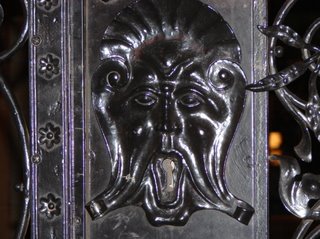
So those are my Lennon memoirs. Just a few glimpses from a distance. The pictures are from the ironwork that surrounds the Dakota building, by the way.

I do think John Lennon's music will be listened to as long as people have ears. It continues to speak to us, people of all ages. I am often impressed by how well many teenagers I have in my cab are very knowledgeable of the music of the Beatles, indeed.

One other thing. You know, I wish I'd said this to him when I had the chance: thank you, John.

Saturday, October 30, 2010

If A Tree Falls In A Forest...

It takes about twenty minutes of driving around the city without a passenger for a taxi driver to start getting edgy. It's at about the twenty-minute mark that you realize I am not making any money and things begin to look oh-so-serious. So I was delighted on a Thursday night at 2 a.m. a few weeks ago when I picked up a fare right at the twenty-minute mark - two men in tuxedos, bow ties removed, with an older woman in an evening gown - who wanted to go to Fort Lee, New Jersey.

Bingo!

The out of town ride is like hitting the jackpot. You usually wind up making double the money you normally would have made for the time spent it takes to get there and back. The fare is not done on the meter - it's a "let's make a deal" situation, the price being agreed upon by driver and passenger before the journey begins.

My three passengers climbed into the back seat. It took me five seconds to conclude that they were merrily sloshed. There are mean drunks and there are happy drunks and these were the latter, which of course is better than the former. The older lady, in her mid-60s I would guess, and one of the men took the middle and right-rear positions on the back seat, behind the cab's partition, and the other man sat down on the left side, which meant he was in a better position from which to have a conversation with me through the opened partition window. The other two wound up kind of slumping over each other, laughing and chattering away only between themselves. The charge for the ride was negotiated with the fellow more directly behind me and what we agreed on was $40, to be paid in cash at the end of the ride. It was actually a bit on the low end for the twenty-minute trip to Fort Lee, but it was still good money for thirty minutes of my time (twenty to Fort Lee and ten back to the Upper West Side of Manhattan), so I was happy. I drove straight across 57th Street to the Henry Hudson Parkway, and we were on our way.

Well, the first thing I wanted to know about was, why the tuxes? Obviously, there had to have been an event. The gentleman behind me, who turned out to be an able conversationalist, explained. They had been to a fund-raising event at Cipriani's for a charity that provides medical treatment to children in South America who were born with a cleft palate. Doctors are flown in and perform corrective surgery on indigent people free of charge. It's something he and his family had been involved in for many years. The woman to his right was his aunt and the man beside her was her son, his cousin.

When he told me that, it immediately struck me that his aunt and cousin were more physically engaged with each other than I was used to seeing between a mother and an adult son. Her head was nestled just beneath his shoulder and he was caressing her hair in a manner more commonly seen with lovers. The way they laughed and spoke softly to each other created a kind of bubble around them which would prevent an intrusion from unwelcome visitors, another thing that lovers tend to do. But I dismissed any suspicions of an incestuous relationship and attributed their behavior to having spent a bit too much time with Johnnie Walker and Margarita. Still, it was odd. Fortunately I had this other fellow to talk to.

I commended him on the good work his family was doing and for the remainder of the ride learned something about cleft palates, cleft lips, and how the condition, a birth defect, could be surgically repaired. It was really a wonderful thing the charity was doing, the kind of information that rehabilitates a belief in the goodness and generosity of people in general.

We crossed the George Washington Bridge and were instantly in Fort Lee, where I was directed around several darkened side streets until we arrived at their destination, a parking lot beside a church. Normally passengers pay me by handing money through the partition window, as they should, but instead of doing that, all three of them got out of the cab at the same time. I wasn't concerned. It was crowded back there and it could be difficult to reach into a pocket in a cramped space. I expected the passenger with whom I had been chatting to appear at my driver's side window with my forty bucks, but he did not. Instead, the other man, with whom I had not spoken during the ride, appeared beside me and just stood there without making any attempt to pay me. Ten... fifteen... twenty seconds went by without a word or a dollar coming forth, so finally I said:

"Uh, that's forty dollars, sir."

I thought I would see him reach into a pocket for the cash, but instead I heard this:

"I paid you."

I was stunned.

"You haven't paid me yet, sir," I said.

"I just paid you," he replied firmly, although through a drunken haze.

"Uh, sir, you have not paid me," I returned without raising my voice.

"Hey, I just paid you, you shit!"

It turned out the guy was not a "happy drunk" after all - he was the other kind. I was suddenly confronted with a situation which I had occasionally wondered about, but which had never occurred in all my years. What would happen if a passenger simply insisted that he'd paid you? How could you prove to a cop that he was lying? It would be your word against his, and as long as he didn't fear he'd be physically assaulted by the cab driver, it seemed to me he could get away without paying by just pretending that he'd paid.

But this fellow wasn't pretending. He'd probably stepped up to the side of the cab with the intention of paying, but once he got beside me an image in his boozed-up mind of having already paid the fare had become his reality. As far as he was concerned, there was no question about it: he'd already paid me and the transaction had been concluded. In fact, he may have been just standing there because he was expecting me to give him change!

And then the absurdity took a turn for the worse.

Keeping my cool even though he'd just referred to me as "you shit", I repeated in an even voice that I had not been paid. His response:

"You wanna get your ass kicked, shithead... huh? Come on, get out of the cab, you fuck!"

That "I am on the wrong planet" feeling came over me. A grown man in a tuxedo who was returning home from a completely worthwhile charity event is now preparing to duke it out with his taxi driver over a currency dispute caused by his inability to differentiate his own fantasy island from the physical universe. Beam me up, Scottie!

It was time to call for the cousin.

Fortunately I was able to get him to come over without having to step out of the cab and possibly getting slugged. After just a few seconds of explanation he realized what was happening, apologized, and handed me $60, keep-the-change style, and that was that. I pulled out of there and headed back toward the George Washington Bridge.

The incident got me thinking about the nature of reality. What is "reality", anyway? If you have the courage to look this word up in a dictionary, you will find ambiguity and contradiction. One definition has it as the state or quality of occurring as fact - that is, not imaginary or fictitious. Another definition includes a kind of existence or universe either connected with or independent of others, as in "alternative realities". Another calls it the totality of "real" things in the world, independent of people's knowledge or perception of them. But right there, the question could be asked how something could be assumed to be actual if we cannot perceive it. And, if we were to assume that there were things that were in existence that were beyond our perception, wouldn't that make them imaginary and therefore, by one definition of reality, not real?

You see how this can drive you crazy.

As far as my belligerent passenger was concerned, he had paid the fare in full (and perhaps had even given me a generous tip) and now I was trying to cheat him. And it made perfect sense to him that he shouldn't let a dishonest creep like me get away with it. This was quite real to him.

It brings to mind that most basic of philosophical questions: if a tree falls in a forest and no one hears it as it hits the ground, did it make a sound?

I now have the answer to that question.

The answer is no.


********


And now that that's been resolved, why not click here for Pictures From A Taxi? It's sooo real.


Saturday, September 25, 2010

Good Morning, Have A Nice Night

A comment I often hear from passengers just after they learn how long I've been driving a cab is, "Wow, you must have seen it all!" My standard reply is, "Yeah, I have seen it all. Until I see the next thing."

As an example, let's take the crime of robbery. Many years ago two men jumped in my cab in a rush in front of the Hilton Hotel on 6th Avenue. They stayed in the taxi for only about three minutes before ordering me to pull over, then they paid the fare and disappeared into the street. A few moments later I discovered an opened briefcase and an opened piece of luggage lying on the floorboard back there with various items scattered around, which I suspected were the leftovers from a crime. I returned to the hotel, reported the incident, and had my suspicion confirmed - a guest waiting on the check-in line had placed his briefcase and luggage on the floor, had been distracted, and then discovered they were gone. My passengers had used my cab as a getaway car.

"Wow," I thought, "now I've seen it all!"

And that's what I continued to think until a few years later when I had a passenger actually mugged while sitting in the back seat by three slick thieves who approached the cab from the street while we were stopped at a red light in Chinatown.

"Wow," I thought, "now I have seen it all!"

And that's what I continued to think until a few years later when I had a passenger in my cab get robbed by the person sitting next to him in the cab! They were two men who'd emerged from a gay bar in Midtown and were en route to a residential address on the Upper West Side. Suddenly there was commotion in the back seat, the two of them wrestling around. I thought it was groping but what was actually going on was grabbing. The larger man was assaulting the other one and grabbed money from his pocket. He then opened his door, causing me to stop abruptly, and scurried off into the darkness. What had been thought by the victim to be a "pick up" had actually been a "set up".

"Wow," I thought, "now I really have seen it all!"

I'm mentioning this because now I can finally and definitively say that I have indeed seen it all. It wasn't a robbery, it was something else. But this is it, it's official, the book is closed. I have now seen it all...

It happened on the 6th of July of this year, a Tuesday, at exactly 7:55 p.m. I had just dropped off a passenger at the Marriott hotel on 92nd Street between 1st and York, a residential area on the Upper East Side, when I had a bit of good fortune in the form of a new passenger entering the cab as soon as the old one got out. Quick turnovers of passengers are the ingredients of a good money night.


My new passenger was a middle-aged woman, around fifty years old, neatly dressed, who told me she wanted to go uptown to 106th Street and 5th Avenue. I said okay, turned on the meter, and we were on our way. I made a couple of turns, waited at a couple of red lights, and was soon cruising up 1st Avenue. It was simple navigation - a left on 106th, across Spanish Harlem to 5th, and there we would be.

During the ride up to this point my passenger had been talking with someone on her cell phone, which is so common today. When that conversation ended she put aside her phone and spoke directly to me.

"Excuse me, driver," she asked, "do you know what time it is?"

I looked at the digital clock on the dashboard. It was visible from the back seat, so I wondered why she hadn't just looked at it herself. But, no matter, I was glad to accommodate.

"7:55," I said.

Instead of a "thank you", there was a silence. I looked at her in the mirror to see by her facial expression if she had heard me. She had, but she seemed confused. Then she spoke:

"A.M. or P.M.?" she asked.

"P.M., of course!" I replied, laughing.

I looked at her again in the mirror. To my surprise, she wasn't smiling. Her expression was rather grim, as if she'd just received some bad news.

"Are you sure?" she asked, almost pleading.

"Ma'am," I replied, "there are three things I'm certain of. Everything else is debatable , but these three things I am certain of - my name, my address, and whether it is night or day. Yes, I'm sure! It's P.M.!" I laughed again. Clearly, this was hysterical.

"You're really sure?" she asked again, this time with a touch of resignation and sadness in her voice, as if her fate had just been revealed to her.

"I'll tell you what," I said, "if the sun hasn't gone down by nine o'clock, I'll refund you the money for this ride. I'll give you my card, you can call me." This was funny!

"Oh, my god," she muttered, more to herself than to me.

"You thought it was 7:55 in the morning?"

"Yes," she replied, almost in a whisper, seemingly ashamed of herself and going into an introspective spin.

Interestingly, if one were to judge only by the brightness of the sky, it could have been either morning or evening. In July the sun rises at around 6 and sets at around 9. Still, since the invention of the sundial Man has had better ways of knowing what time it is than by just looking up. I realized she was in need of some taxi driver counseling, so I jumped into it.

"Why would you think it was the A.M.?" I asked, with considerable curiosity.

And she told me this story...

Her home and her company are in the midwestern state of Arkansas but she had been living and working in New York on a special project for the last six months as a "systems coordinator" at the Cardinal Spellman Hospital at 106th and 5th Avenue. The Marriott Hotel, where I picked her up, has been her home away from home all these months. At four o'clock, earlier that evening, she finished her day at the hospital, went back to her room in the Marriott, and decided to take a nap before waking at 7:00 to do a bit more on her project. She set her alarm and went to sleep.

When she awoke at 7, she had completely forgotten about the idea of doing more work in her hotel room and thought it was morning. She got out of bed, took a shower, dressed, did her face and her hair and went downstairs to get a cab. When she found one (mine) she was simply on her way to work to start a new day, having no idea it actually was not a new day.

Then her cell phone rang. It was her husband in Arkansas, calling to tell her he was sorry he hadn't called earlier, but he'd just gotten home. This confused her because she thought he should still be in bed asleep (it was 6:55 in Arkansas). He didn't usually get up until 7:30. He told her he'd had to work overtime at his job, that's why he was late getting home. She thought he meant he'd been working all night, and that never had happened before, so she asked him what in the world was so important that they expected him to stay at the job all night. He told her he hadn't been working all night, he'd only been working until 6:30.

"Then why didn't you call me last night?" she'd asked.

"I did call you last night," he'd replied.

"No, you didn't," she'd said, "I went to bed without hearing from you."

He reminded her of what they had talked about and she told him that that wasn't last night, it was two nights ago. Completely confused, it occurred to her that he might be putting her on. So she told her husband she'd call him back in a few minutes and ended the phone call. She knew of a way to find out the truth.

She would just ask her cab driver what time it was.

So there we were, on 106th and 2nd, in a reality free-fall zone.

"Should I take you back to the hotel?" I asked.

"Yes, I guess so," she replied from the haze.

I felt sympathetic toward her and tried to cheer her up. It was an understandable confusion, I said, and from the light of the sky it really could have been either A.M. or P.M. She didn't seem particularly consoled, so I tried to think of something else to tell her, something that would be worse, and I came up with this...

"Listen, if you think this is so terrible, not once, not twice. but three times I've had tourists in my cab who not only did not know the location of the hotel they were staying at, they didn't know the name of the hotel, either. Each time we had to wander around the city trying to locate their hotel by descriptions of landmarks only." (Oddly enough, all three times they were Englishmen. Go figure.)

That may have helped a bit. Looking at her in the mirror, I thought I saw a slight smile back there.

Her ride into the Twilight Zone and back came to $7.90. She paid with a corporate credit card and threw in a $1.50 tip. I thought it was appropriate that her company should pay. Strange city. Too many months away. Taking your work home with you to a place that's not even your home. In the military they have an expression for it:

"Shell shock".

********


People have also been known to have been shocked by clicking here for Pictures From A Taxi. It could happen to you.

Monday, August 23, 2010

Running The Gamut, Number Two

I wrote in a previous post (Running The Gamut) that one of the spectacular things about driving a cab in New York City is that on any given night it is possible to encounter passengers from the very top of the social spectrum all the way down to the very bottom. People - who can be so different from one another that they might as well be from other planets - make their entrances and exits in what could be described as a microcosmic parade of the human condition. It's vaudeville on wheels, and it can be quite a show.

Not long ago I had one of those nights that tap danced on the treetops and then slopped around in a puddle of mud. It dined at le Cirque, only to stretch its arm into a garbage can to scoop out a half-eaten slice of Ray's pizza. It was a warm bed in the Waldorf, then a cardboard box on the steps of the 5th Avenue Presbyterian Church.

You get the idea.

Let's start at the top.

On the evening of May 4th, a Tuesday, I found out that Time Magazine puts out an issue every year in which they announce the "100 Most Influential People In The World".

They divide their 100 into four categories:

1) Leaders

2) Artists

3) Thinkers

4) Heroes.

An essay is written about each person by another prominent person to make it even more interesting. The article about Bill Clinton, for example, was written by Bono. The one about Prince was written by Usher. The one about Oprah Winfrey was written by Phil Donohue.

I'm not particularly a reader of Time Magazine, so the reason I found out about this issue at all was a unique one. It turns out they have a big event to go along with the annual publication which is held, appropriately enough, in the Time Warner Building at Columbus Circle. It's a red carpet affair, of course, and guess where the red carpet ends? In a taxi stand right in the middle of the circle, that's where.

So when I was brought into the area by a passenger at 11:40 p.m., I noticed there was something going on and quickly secured a position on the taxi cue. Paparazzi were milling about, always a good sign, and a contingent of onlookers held their ground on both sides of velvet ropes that extended all the way from the curb to the entrance of the building, a distance of about thirty yards. What or whom these people were waiting to see I did not yet know, but my interest in the event itself was secondary. What interested me most was the extra business I could get at a time of the night when passengers start to become less plentiful. This was going to be money found, kind of like discovering a five-dollar bill smiling up at you from the sidewalk.

The taxi line moved quickly. Within five minutes I welcomed my next fare aboard - two gentlemen wearing tuxedos, one of whom sat up front with me, and two ladies all decked out in evening gowns. Obviously they were coming from this event, whatever it was, and, just as obviously, they were in great spirits. As we began driving toward their first destination, 40th and 9th, my curiosity kicked in and I slipped in some questions during slight pauses in their own conversations. It went something like this...

"So, what's going on at the Time Warner Building?" I asked the man sitting next to me.
He told me about Time's 100 Most Influential thing. I was impressed.

"Wow! There must have been a lot of celebrities, huh? I saw the paparazzi outside the building."

"Oh, lots of them," he replied.

"Any big names?"

"Elton John."

"Wow!"

"Sarah Palin."

"Wow!"

"Bill Clinton."

"Wow, Bill Clinton's in there? How's he looking?"

"He looks good! And he gave a great speech."

"You know, say what you will about Bill Clinton's politics or his personal life, but no one can deny he's one of the great orators of our time."

"He is, it's true."

"So what was your end of the deal?"

"Well, the gentleman in the back, and myself, were two of the people being honored."

"You mean, you are two of the most influential people in the world?"

"Well, I don't know about that, but that's what Time Magazine seems to think."

I was stunned. I would have thought that anyone who could be given such an honor would either be so famous that they'd be instantly recognizable or would be driven around in a luxurious private car with their own chauffeur. The four people in my taxi, I had assumed, were probably involved with the production of the event in some way, or perhaps had been invited guests.
My next question was the obvious one:

"So... who are you?"

The gentleman on my right introduced himself as Dr. Douglas Schwartzentruber and the gentleman in the back seat, he told me, was Chetan Bhagat. The ladies were their wives. The reason Time Magazine chose them was because Dr. Schwartzentruber is a pioneer in developing a vaccine that can treat certain types of cancers and Chetan Bhagat is India's most popular author.

As a taxi driver in New York City I'm sure I often have passengers in my cab who are truly Very Important People within their own spheres of influence, but it is rare that I actually get to know who they are. And it is never that I get them at a time when they've just been bestowed with an acknowledgment on so grand a scale. So I was aware of how special this moment was not only for them, but for me as well.

We drove down 9th Avenue in a taxi full of happy chatter. The afterglow of their evening was filling the cab with an energy that was rubbing off on me. It was that floating feeling you get sometimes during a perfect ride.

The organizers of the event had given the attendees souvenirs of several copies each of that issue of Time Magazine. Dr. Schwartzentruber gave me one to keep. After thanking him for this gift, I asked him and Mr. Bhagat to sign it for me. In all my 32 years of taxi-driving, and after having had well over a hundred celebrities in my cab, it was only the second time I had ever requested an autograph. The other time had been back in the '90s when I had Tori Spelling, then starring in the hit TV show Beverly Hills 90210, in the back seat, and the only reason I'd asked her was to impress Suzy, my teen aged daughter (who failed to be impressed - of course).


What's funny here is that Dr. Schwartzentruber, in order to help me find him in the magazine, wrote "heroes" after his name, but after looking him up I discovered that they had actually put him in the category of "thinkers". Not that it matters, of course - no doubt he's a hero as well. Chetan Bhagat's signature came out kind of illegibly (maybe he should be a doctor!), so he kindly printed his name under it, again so I'd be able to find him in the magazine.

As we arrived at 40th and 9th, the location of the Bhagats' hotel, it was interesting to overhear their conversation as they parted ways. Mr. Bhagat handed his card to the Schwartzentrubers and invited them to stay at his home in Mumbai if they were ever in that part of the world. And then he said this:

"I don't belong on the same stage with you."

I repeat this not in any way to diminish the work of Mr. Bhagat. In fact, as a writer myself, I find having someone of his stature in my cab to be a bit intimidating. I repeat this because I think he was correctly sizing up the magnitudes of importance here. Writers - whether they be writers of novels, screenplays, stage plays, or songs - are very important, indeed. We all know this. But the man sitting on my right - well, let's put it this way...

What if you, or someone you care for very much, had been diagnosed with a cancer and you were confronting the prospect of undergoing chemo and radiation therapies? But now, because of this man, that cancer could be treated, and very possibly defeated, with a vaccine. How would you regard the man who had spared you from this ordeal and perhaps had saved your life? It would be how the human race regarded the man who defeated polio in the '50s, Dr. Jonas Salk.

Kind of like God.

So as we proceeded toward the Schwartzentruber's hotel on 6th and 39th, a three-minute ride, I would have to admit to feeling honored and even humbled just to be in his presence. They say we are all born equal, and that is true in a legal sense, but we surely don't wind up being equal in terms of our worth to other people. Some of us are giants. This man had a value to the world that was beyond measurement. The thought occurred to me, as mundane as it was, that I should drive extra carefully with this precious cargo in my taxi. What if a mistake on my part caused him to be injured or killed? There could be no amount of taxi insurance that could ever cover the loss.

So we drove across 38th Street at about half my normal speed. I crossed the intersections of 8th and 7th Avenues only after being absolutely certain that no vehicle was about to run a red light and crash into us. And when we arrived at their hotel I scrutinized the oncoming traffic in my rear view mirror to make sure Dr. Schwartzentruber was not struck by an approaching car as he opened his door. He was damn well not going to die on my watch!

Along the way I tried to ask him some semi-intelligent questions about his work and he answered in layman's terms. I noted that he had no condescension in his manner and gave me no feeling of being "lesser than". And that's the way it always is with the great ones, isn't it?

After dropping off the Schwartzentrubers, my night went on. I went back to the Time Warner Building and picked up another fare. This time my passengers, a young man and a young woman, indeed were a part of the team that produced the event. After some pleasant chit-chat and a drop-off in the Gramercy Park section of Manhattan, business slowed down considerably, as it normally does on a Tuesday night after the witching hour. I took my post-midnight, fifteen-minute break and resumed cruising the streets of the city in search of business.

One of the great misconceptions about taxi-driving in New York is that many people assume we are always busy. Nothing could be further from the truth. After midnight on a weekday it is brutally competitive amongst cabbies trying to gain better position on the avenues so they will be the first to get to any passenger who may be somewhere down the road looking for a taxi. It's like a horse race, really.

In the next two and a half hours, I got only four rides and was feeling the stress that comes from working hard and having little to show for it. As it turned out, it was time for the bottom to show up.

Bottom appeared in the form of a potential passenger, a thirty-something male, hailing me on Amsterdam Avenue between 74th and 75th. I could tell from the way he was waving that this guy was in an undefined state of inebriation and stopping for him at all was not necessarily a good idea. When I say "undefined" I mean I knew he was drunk but I wasn't sure how drunk. Most stoned people are still viable passengers. This fellow was iffy. Nevertheless, I was desperate, so...
I pulled over and stopped.

As he approached the cab, he did the semi-coherent shuffle - one foot forward, one foot to the left, one foot forward, one foot to the right - but still he was able to get into the back seat without too much trouble. It looked like he might be okay, but that turned out to be wishful thinking.

"Hi, there," said I.

"How-you," he replied after a few vacant seconds.

"So where are you heading?"

"Yeah."

"Where you wanna go?"

A long pause, and then: "No wan go dere no go wan go."

I knew it was hopeless but for two minutes I kept trying to get a destination out of him, anyway. Finally I accepted defeat and left him standing in the same place where he'd been before he hailed me. I drove up Amsterdam, made a right on 81st, another right on Columbus, and headed downtown to a part of town where I'd be more likely to find a passenger at 3 a.m.

The thought later occurred to me that within three hours I'd had two passengers in my cab whose influence spans the globe and affects millions of people and then, sitting in the same seat, I'd had someone whose sphere of influence was so microscopic that he couldn't get his own memory banks to tell him where he lived.

I'd run the gamut.
********

And you can have gamuts galore by clicking here for Pictures From A Taxi. What a deal!

Saturday, July 10, 2010

"Make The Light"

Among the many annoyances in the game of taxi driving is the rare passenger who has the nerve to tell you how to drive. Not where to drive or what route to take, and not even how not to drive ("please don't drive so fast, I'm feeling nauseous"), but how to drive.

Examples:

"Change lanes."

"Get ahead of that bus."

"Go!"

And my favorite: "Make the light!"

Let us consider for a moment the implications involved in making such a statement. It is as if to say:

"Not only do I not regard you as a professional who knows how to do his job, I think I'm better at it than you are, so do what I tell you."

Or, to put it more bluntly:

"You're an idiot. I'm smart. Obey me."

A couple of years ago I was going down 11th Avenue with a passenger in that back seat when we hit a bit of heavy traffic and he abruptly commanded, "Get in the left lane!" Never letting a comment like that go by, I made eye contact with him in the mirror and said, Robert de Niro-style, "Are you talking to me?" And then, not waiting for a reply, "You must be talking to someone else, because no one talks to me like that!" He immediately changed his attitude and we had a relatively pleasant ride across 23rd Street to his destination at 6th Avenue.

It's a good feeling when little mutinies like that are squelched and you can regain the captaincy of your ship. Your dignity is restored and life seems to be worth living again. Which leads me to the latest incident on this chain...

I was cruising on West 63rd Street a little after 6 p.m. a few weeks ago when I was hailed by a doorman on the block between Central Park West and Broadway. He opened the door and in came a 60ish woman in a rush to get to 65th and Amsterdam, a short ride. About fifty yards in front of us was a green traffic light and she barked out those words:

"Make the light!"

I bristled internally and continued driving at my normal speed. Now, there seems to be a Force that decrees that whenever a passenger says, "Make the light!" the light you've been ordered to make will turn yellow just as you're approaching the intersection and you will have a moment of truth to decide whether to speed up and maybe go through a red, or to play it safe and hit the brake.

Right on cue, the Force did its thing and the light turned yellow.

I had my moment of truth, and...

I hit the brake.

My passenger was very displeased. She grunted an "ugh" and barked, "You could have made it," with a scowl on her face that was so pronounced that it was clear that from her point of view stopping for the red light wasn't merely an error, it was a crime.

So the scene was set for conflict. My professionalism had been assaulted, and there would be a response. But rather than turning around and giving her a lecture about safe driving, fines, and suspended licenses, I tried to reason with her. First, I pointed out the layout of the intersection in front of us.

Broadway, as its name implies, is a wide road with an median of greenery separating two directions of traffic, so the width of the intersection has to be considered before crossing it at a yellow light. Following Broadway, a mere fifty more yards away, is the next intersection, 63rd and Columbus Avenue. Having driven through these intersections perhaps a hundred thousand times in the last 32 years, I am quite familiar with the timing of the lights there and I knew that even if we'd made the yellow light at Broadway at the last second, we certainly would not have made the next light at Columbus. However, when the light turns from red to green at Broadway and you drive straight ahead, you will always get a green at Columbus, too. So there was no reason to speed up to "make the light" at Broadway in the first place.

My passenger's response to this perfectly rational and accurate dissertation was to snap back, "We won't make the light at Columbus". It was a direct contradiction to what I'd just said.

"Yes, we will," I replied.

"No, we won't," she returned, as if we were having a verbal tennis match.

The thought occurred to me that here was a situation where I could win a bet. I could say, "Oh, really, if you're so sure of that let's make it double the meter or nothing." I could add a few extra doubloons to my coffers with this ride and, better than that, I could humble this old crab and put her in her place. But I decided not to stoop to that level. It would be like taking candy from a baby. Better than that, I thought, would be to offer her a deal in which she couldn't lose, except if losing meant that she'd have to shut up and eat crow.

I said these words:

"Tell you what, if we don't make the light on Columbus, this is a free ride."

The success of my strategy was immediate. She did shut up, her demeanor changing instantly into an interested facial expression that said, "Well... okay...". The eating crow part would come in just a bit.

In a few more moments, our light at 63rd and Broadway turned green. The light ahead of us at Columbus, the light I had to make, was already green, as I knew it would be. With just fifty yards between these two lights, it was impossible not to make that Columbus light.

My foot pressed down on the accelerator.

You know, there's a military truism that in combat operations, nothing ever goes according to plan. Apparently the same thing is true in taxi driving. For just as I drove through the Broadway intersection, not one, not two, but three cabs suddenly appeared in front of me and stopped to discharge passengers at the Empire Hotel, the only building on the tiny block. These taxis didn't pull over to the side. No, they just stopped in the middle of the street, making it impossible to get around them.

Precious seconds ticked by. A couple of beeps from my puny horn did nothing to move them. The light at Columbus turned yellow. The light at Columbus turned red. And I found myself in the midst of my latest humiliation, a knife in one hand, a fork in the other, and a crow on a platter in front of me.

I tried taking it like a good sport, laughing out loud, and not trying to wiggle out of the noose I'd created for myself by using the cabs blocking the street as an excuse. "Well," I said, "a deal's a deal. This is a free ride."

Of course, what I was hoping she would say was what any fair-minded person would say - that it was all right, that she wouldn't hold me to my offer. But instead, what she said was, "Well, I'll give you a good tip." In other words, "Thanks for the free ride, sucker."

My only solace was that my misery would be brief. 63rd Street runs into Lincoln Center at Columbus, so we had to make a left turn, go down to 62nd Street, make a right, and then drive over to the next avenue, Amsterdam, make another right, and finally go just three blocks to her destination, the Lincoln Center Library, at 65th Street. As it turned out, the reason she was in a rush was because she works in the library and was running late for the evening shift.

In the few remaining minutes of our ride, which seemed like an hour to me, she did an attitude reversal. No longer was she an ill-mannered cow in a china shop, stomping over anything in her way because she was late for work. Her getting something for free had trumped her bitch card, and she became a chatty human being sitting in the back seat. But I even found her attempt to be sociable offensive when she asked me this famous, left-handed question:

"So what else do you do besides drive a cab?"

I am asked this occasionally, and when it happens I usually look at it as a cast-not-your-pearls-before-swine situation. The person who asks it is telling you that the job you are doing is considered by him to be beneath his standard of what a respectable job should be - would he ask a teacher what else does he do besides teach? - and what I normally say is, "This is it, I drive a cab." And then give him a little speech about the good things of taxi driving - freedom, adventure, the whole human race sitting in your back seat, no boss, no four walls, no office politics, no deadlines, no bringing your work home with you. I leave out the parts about twelve hour shifts, no health care, no pension - things like that.

But to this passenger, probably because I was hoping she would realize it would be mean-spirited to hold a working man to his promise of a free ride, I tossed a pearl.

"Well," I said, "I'm a writer."

"What do you write?"

Holding back a temptation to say "words", I told her I had a blog.

"You must have lots of stories."

"Yes, driving a cab and stories are a good fit," I agreed.

"So much material," she added.

"That's the thing - the material just comes right to you," said I, mentally noting the irony of someone who could be "material" herself commenting about the abundance of material.

Amazingly, against all odds it seemed that we were developing some rapport between us and, as I pulled in front of the Lincoln Center Library, it started to feel like this ride might actually have a pleasant ending. I had left the meter running and the total was $6.00, including the $1.00 evening rush hour surcharge and the 50 cent New York State tax. So here was a second moment of truth - would she redeem herself by handing me the full fare, telling me thanks, but no thanks, for the free ride offer? I had already decided I would say that I appreciated that and then, like Harry Chapin in his Taxi song, stuff the bills in my shirt and we'd both be on our way.

But instead she handed me $2.00, opened her door, said, "Have a nice night," and walked away. I watched her enter the library and shot an imaginary arrow through her head. Then, realizing I had an extra arrow in my quiver, I took it out and shot myself, too.

For having offered, and given, a free ride to someone who was not one of the nice people of this world.

********


Target practice? Don't shoot a mean person. Send an arrow over here instead for Pictures From A Taxi.